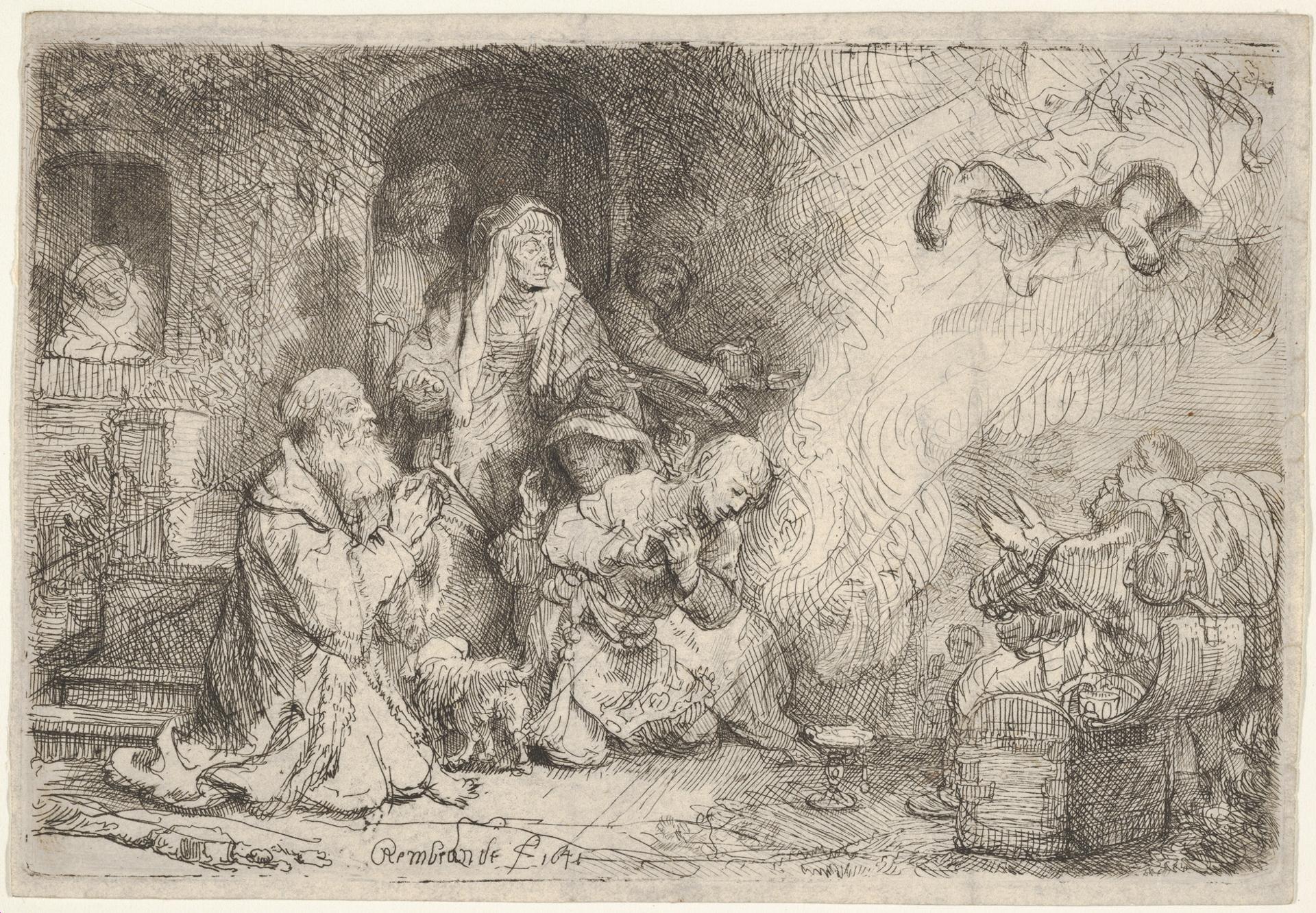
The Angel Leaving the Family of Tobias
Original title: The Angel Leaving the Family of Tobias
kurzbeschreibung
Unlike many Tobias depictions of its time, Rembrandt's 1641 etching focuses entirely on the moment of farewell: the archangel Raphael withdraws from Tobias's family. The biblical story unfolds in a dense, expressive web of lines. This impression is the third of nine states.
Description
Upper right, Raphael hovers in a bright, radiant robe, a document in hand. Below in the foreground stand four figures – Tobias, his mother Sarah, an older man and another person – in rustic clothing. They are in a simple dwelling with sparse furnishings and a basket; a dog sits on the floor. The layout sharply separates the angel's heavenly sphere from the earthly level of the people, who pause in their postures.
Context
The etching was made in 1641, when Rembrandt lived and worked in Amsterdam. The story of Tobias and the angel was popular in the seventeenth-century Netherlands and was seen as an example of divine providence and gratitude. Rembrandt produced several etchings of biblical scenes noted for their intimate, human approach. This sheet belongs to his extensive printmaking oeuvre, which circulated widely during his lifetime.
Impact
A calm, almost devotional mood pervades the print, reinforced by the contrast between the hovering angel and the motionless people. The dense linework and varying line strengths create depth and texture. The expressive lines draw the eye to the farewell scene and convey a palpable emotional tension.
Technique
The image was made as an etching, an intaglio process in which the drawing is scratched into a wax layer on a metal plate and then etched. Rembrandt set dense and fine strokes side by side to work out shadows, contours and textures. The sheet measures 10.9 by 15.8 centimetres and is the third of nine states, suggesting careful reworking and refinement of the plate.
AI-generated description text
Source: Metropolitan Museum of Art · Public Domain (CC0 1.0)