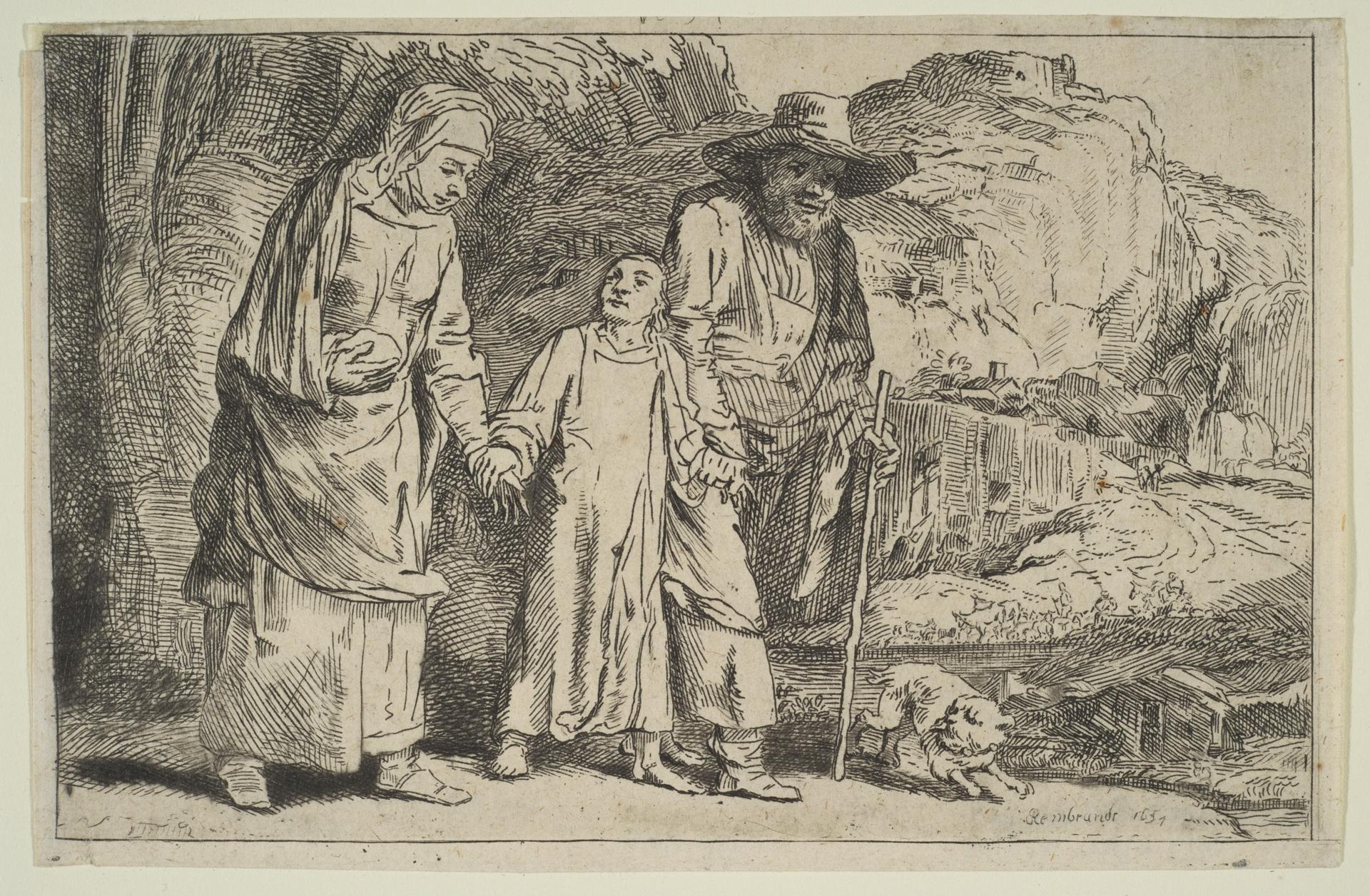
Christ Between His Parents Returning from the Temple
Original title: Christ Between His Parents Returning from the Temple
kurzbeschreibung
Mary holds the hand of the twelve-year-old Jesus as he walks home to Nazareth between her and Joseph. Baron Dominique Vivant Denon captured this biblical subject in an undated etching. The line work renders figures and landscape with comparable precision, making the return from the temple tangible as a quiet family event.
Description
A man in a broad hat with a walking staff stands on the right; on the left, a woman in a long robe and head covering. In the middle, a young person holds the woman's hand. This clear sequence of three figures shapes the layout. Behind them opens a rocky landscape with a river, and near the right figure a dog lies on the ground. The black-and-white print uses densely set lines that bring out fabric folds and rock structures alike. The figures occupy the foreground, while the landscape steps back into depth.
Context
Dominique Vivant Denon (1747–1825) is known as the first director of the Louvre under Napoleon Bonaparte; he was also active as an artist and connoisseur. His etchings often go back to Old Master works that he studied on his travels and while building his collection. The return from the temple is one of the rarer subjects from Jesus's childhood; it was widespread mainly in Dutch and Italian art of the 16th and 17th centuries. Neither the exact year of creation nor the occasion for the etching is recorded.
Impact
A calm, almost familiar mood emanates from the sheet, carried by the even arrangement of the figures and the delicate linework. Clothing and landscape are rendered so precisely that the scene feels physically close and draws the viewer into the biblical narrative. Because color is absent, the structure stands out clearly, and the gaze remains fixed on the constellation of the three figures.
Technique
The sheet was made as an etching, an intaglio process: the drawing is scratched into a metal plate, which is then bitten by acid. Parallel and crossing lines create graduated gray values and surface textures that are crucial to the realistic effect. Trimmed, the paper measures 9.7 × 15.1 cm, suggesting a small, concentrated format.
AI-generated description text
Source: Metropolitan Museum of Art · Public Domain (CC0 1.0)