Return of the Prodigal Son
Original title: Return of the Prodigal Son
kurzbeschreibung
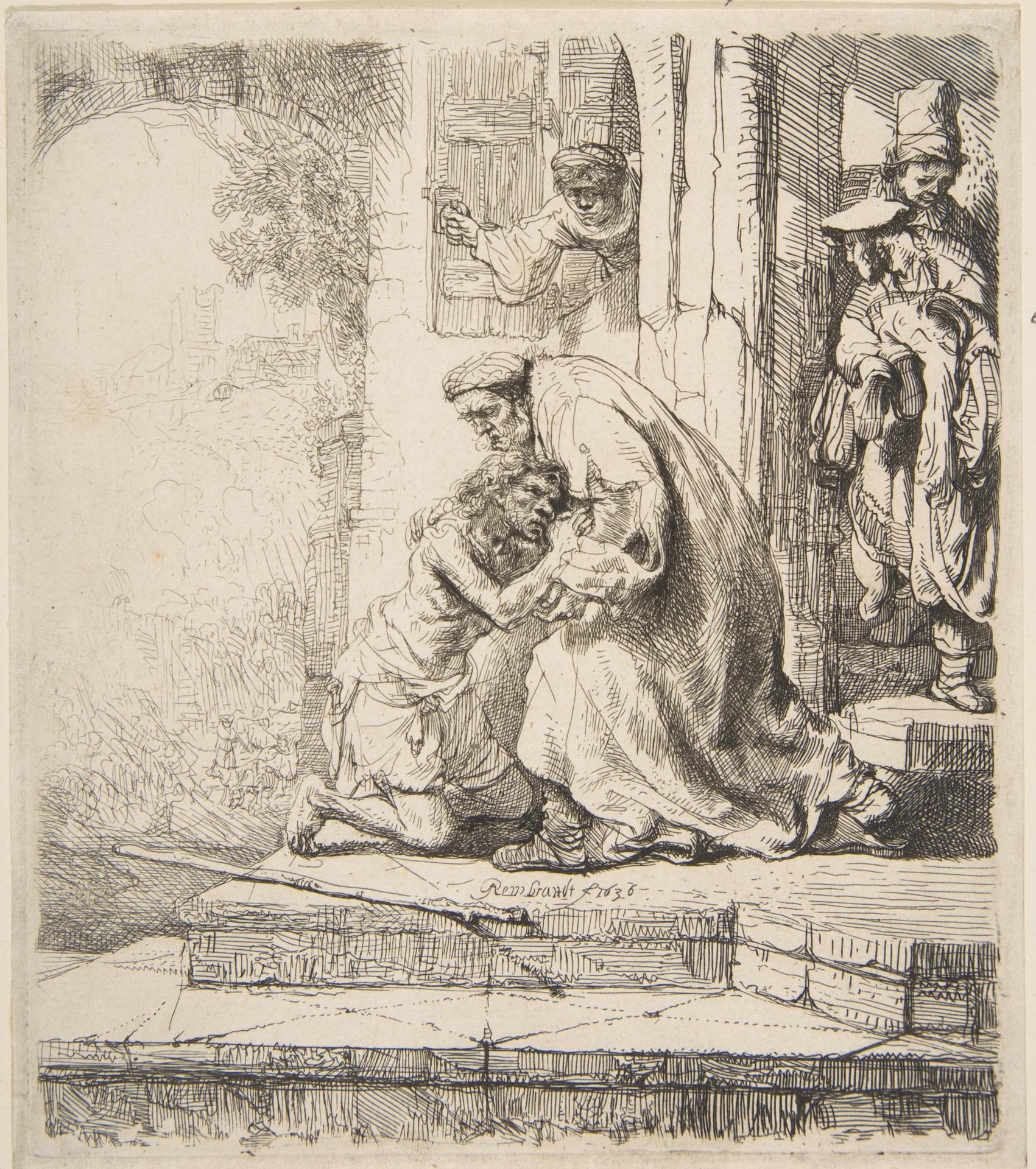
The homecoming son kneels before his father, a biblical moment Rembrandt captured in an etching dated 1620–69. Worked as an etched plate and then finished with pen and ink, the image has the father receiving the one who has returned.
Description
Down in front a man kneels — the lost son — while a second figure, presumably the father, bends toward him and places something in his hand. Through two windows a man and a woman in the distance watch what is happening. Delicate drawn strokes suggest a house, the setting for the encounter. Kept in monochrome, the sheet lives on the strong contrasts of light and dark so characteristic of Rembrandt.
Context
This etching arose between 1620 and 1669, during a period of intense engagement with biblical subjects. The parable of the prodigal son was widely familiar in the seventeenth-century Netherlands and stood for repentance and forgiveness. Rembrandt returned to the theme several times; this sheet belongs among his early interpretations.
Impact
Attention settles on the central gesture of forgiveness between father and son. Fine hatching and the direction of the light produce a quiet, contemplative mood. The onlookers in the distance deepen the narrative reach of the motif.
Technique
The plate was bitten with acid, and pen and ink were also used. This approach allowed delicate lines and graded shading. The plate measures 15.6 × 13.8 cm, the sheet 16.3 × 14.2 cm.
AI-generated description text
Source: Metropolitan Museum of Art · Public Domain (CC0 1.0)