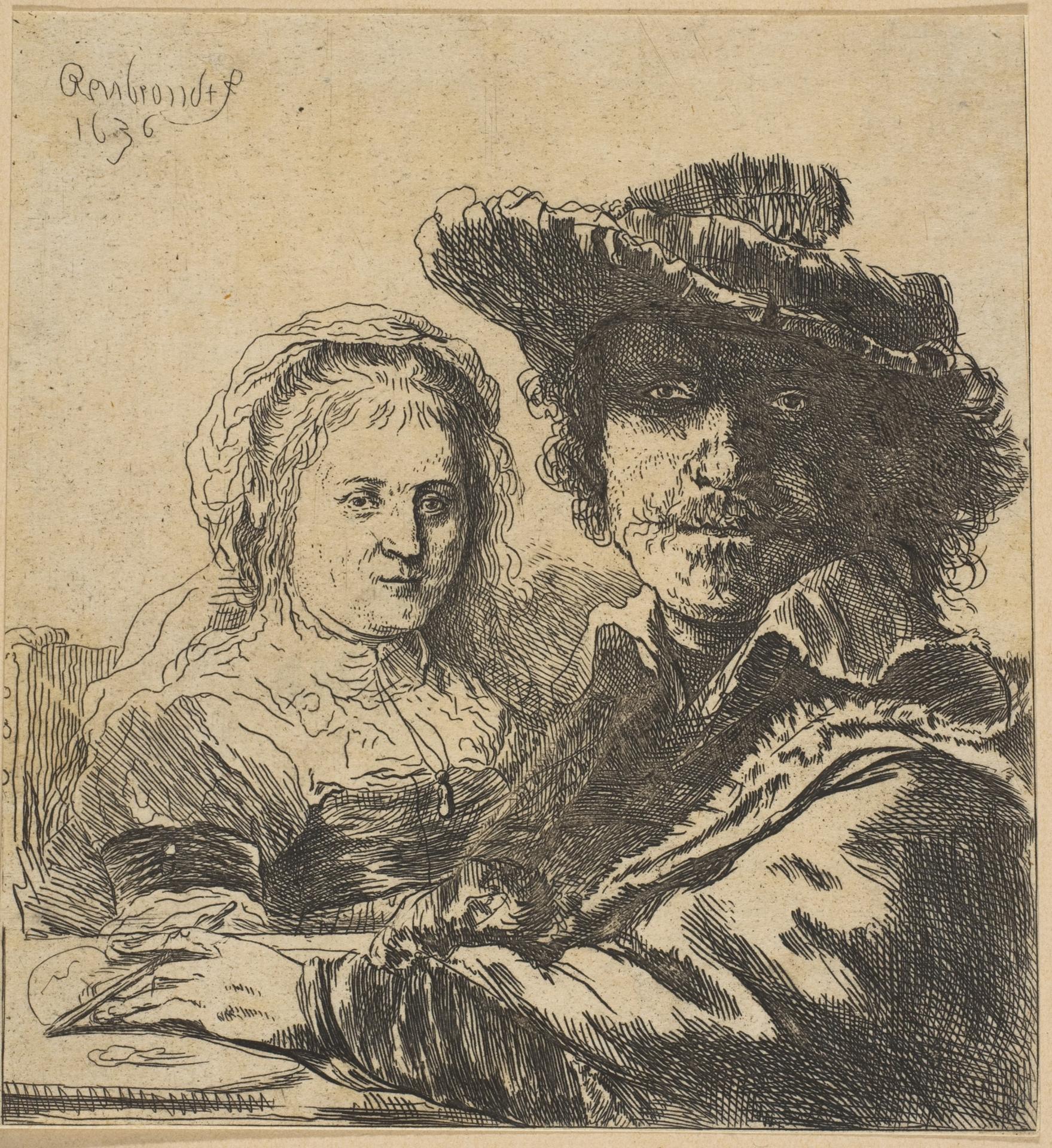
Rembrandt and his Wife (copy)
Original title: Rembrandt and his Wife (copy)
kurzbeschreibung
Where comparable double portraits of its day tend toward invention, this sheet takes a different route: Chevalier Ignace Joseph de Claussin reproduced a well-known Rembrandt subject in etching, the couple long identified as Rembrandt and his wife. It dates to the years 1786 to 1844, the span of Claussin's working life. The subject is a double portrait, carried out as an etched plate.
Description
What strikes the eye first is how both figures look the same way. The woman wears a head covering and a dress; the man, a hat and a coat. In his hand he holds an object that recalls a palette or a brush. A piece of furniture is suggested behind the two of them. The layout is centered, with pronounced light-and-dark contrasts and hatching of the kind associated with Rembrandt's work.
Context
Claussin, a French artist and art dealer, was active in the late eighteenth and early nineteenth centuries. He was driven by the aim of bringing significant models closer to a wider public through copies. The dates 1786–1844 correspond to his period of activity. The source was a famous self-portrait of Rembrandt with his wife Saskia.
Impact
The dense web of lines and the sharp contrast between light and dark passages create an atmosphere of closeness. The pair seems familiar and yet withdrawn into themselves, a trait also found in Rembrandt's own portraits. Because the sheet is kept in black and white only, the faces and the man's hand gesture move to the foreground.
Technique
This work is an etching: the drawing is bitten into a metal plate, an intaglio process. Tonal gradations come from the density and direction of the lines. Claussin presumably made the copy himself, adopting the technique of the original.
AI-generated description text
Source: Metropolitan Museum of Art · Public Domain (CC0 1.0)