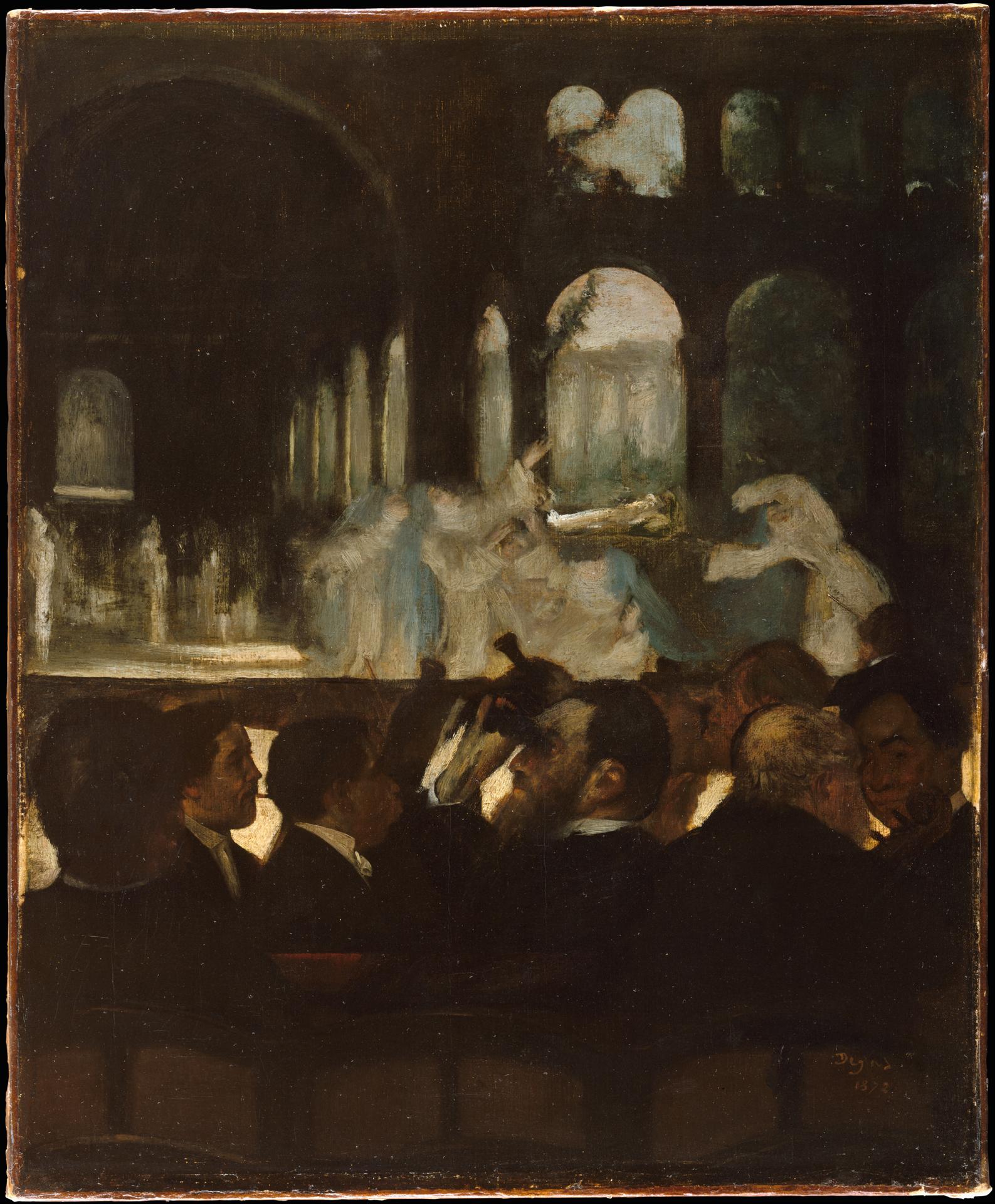
The Ballet from 'Robert le Diable'
Original title: The Ballet from "Robert le Diable"
kurzbeschreibung
Two dancers in light-colored costumes strike expressive poses in the background of this 1871 painting by Edgar Degas. In front of them, seated in a dark room, are spectators. The oil on canvas, titled 'The Ballet from Robert le Diable,' captures a scene from the ballet of the same name.
Description
Darkly dressed spectators, their faces partly in shadow, fill the foreground. Deeper in the space, two dancers in bright costumes appear, caught in dynamic, expressive movements. A dimly lit window in the background illuminates the scene, emphasizing the contrast between the gloomy audience rows and the luminous dancers. Browns and grays dominate the overall dark, muted palette, evoking a theater or opera atmosphere.
Context
The picture was made in 1871, when Degas was deeply engaged with the Paris ballet and opera. 'Robert le Diable,' an opera by Giacomo Meyerbeer, was hugely popular throughout the 19th century after its premiere in 1831. Degas became known for his ballet scenes, which often took unusual viewpoints and highlighted the everyday life behind the scenes.
Impact
Because the viewer experiences the scene from the perspective of the dark audience rows, the mood feels both intimate and detached. The bright dancers in the background seem almost otherworldly, underscoring the fascination and mystery of the stage. The subdued colors and the contrast between light and shadow give the work a melancholy, almost nocturnal atmosphere.
Technique
The work is executed in oil on canvas, with Degas using loose, visible brushstrokes typical of Impressionism. Through areas of color and the deliberate use of light and shadow, he achieves an atmospheric depth that emphasizes the movement and mood of the scene.
AI-generated description text
Source: Metropolitan Museum of Art · Public Domain (CC0 1.0)