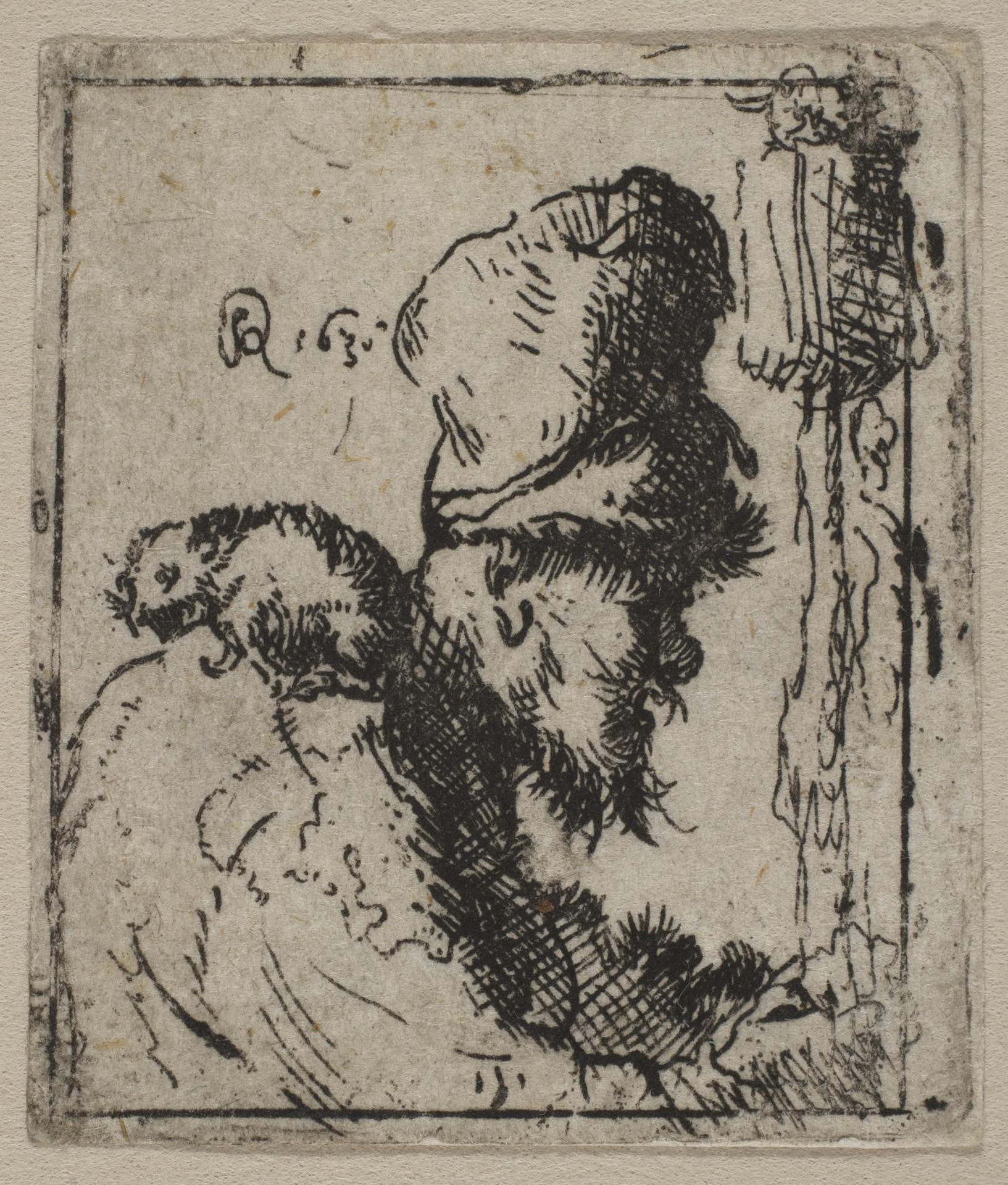
Head of a Rat Catcher
Original title: Head of a Rat Catcher
kurzbeschreibung
Rembrandt van Rijn devoted this 17th-century etching to a bearded man wearing a cap. The figure is shown from behind, turning his head to the left. On his shoulder sits a small animal that resembles a squirrel. The print is among the artist's smallest works, measuring 3.9 x 3.4 cm.
Description
A bearded man in a cap faces away from the viewer, his face turned to the left. A small animal, like a squirrel, crouches on his shoulder. A tree trunk runs through the right side of the image. Black-and-white tones and dense, detailed hatching define the view. Light falls evenly across the sheet, with no pronounced shadows.
Context
Rembrandt worked intensively in printmaking during the 17th century, and this sheet belongs to that phase. The title refers to the study of a rat catcher, a profession that was part of everyday life at the time. Small formats like this often served as studies or were made for collectors. Nothing certain is known about the exact circumstances of its creation.
Impact
An intimate, sketch-like note characterizes this small print and brings the figure close to the viewer. Fine lines and the reduced layout create a quiet, collected mood. Showing the man from behind gives the view something detached and enigmatic.
Technique
Rembrandt used etching here, an intaglio process in which the drawing is worked into a metal plate and then bitten with acid. Delicate lines and the precise rendering of figure and surroundings demonstrate his sure handling of the medium. The tiny size of 3.9 x 3.4 cm makes the precision of the execution especially clear.
AI-generated description text
Source: Metropolitan Museum of Art · Public Domain (CC0 1.0)