A Man Grieving
Original title: A Man Grieving
kurzbeschreibung
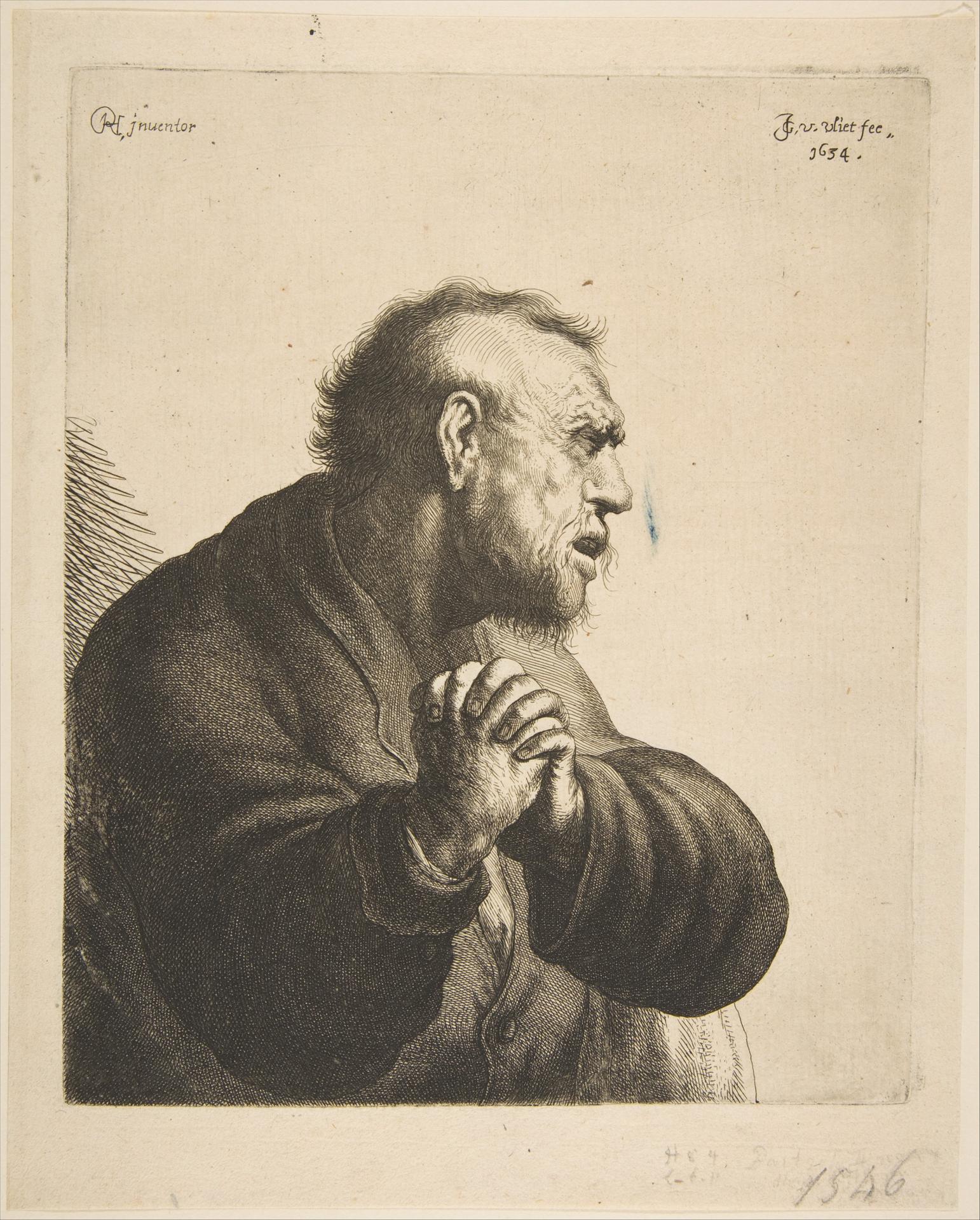
A man in profile, withdrawn into himself, appears in this 1634 etching by Jan Georg (Joris) van Vliet. The print is the first state of two and measures 22.8 x 18.9 cm (plate). The sitter holds his hands clasped; his expression suggests sorrow or deep thought.
Description
From the left, a man's profile emerges, with short, curly hair and a beard. Over a buttoned shirt he wears a dark, long-sleeved jacket, his hands folded before his chest. His face looks serious and pensive, hinting at grief. A plain, dark background sets off the figure. In the upper left is the artist's monogram; in the upper right, the date '1654' and the name 'J. van der Wilt fec.'
Context
Jan Georg van Vliet, a seventeenth-century Dutch etcher, often worked from designs by Rembrandt. This etching was made in 1634, when van Vliet was active in Leiden. It belongs to a series of studies depicting human emotions—a common theme in Dutch Golden Age art. The date on the print reads '1654', which may differ from the actual creation, as the plate was later reworked.
Impact
A quiet, melancholy mood arises from the man's closed posture and lowered gaze. Fine hatching creates a lively texture, rendering clothing and hair in detail. The dark background heightens the intimacy of the moment and draws attention to the sitter's emotional expressiveness.
Technique
In etching, acid bites into the plate to create the lines. The strokes vary in thickness, suggesting skilled handling of needle and biting times. The print is black and white and shows a fine gradation of tones, achieved through different densities of hatching.
AI-generated description text
Source: Metropolitan Museum of Art · Public Domain (CC0 1.0)