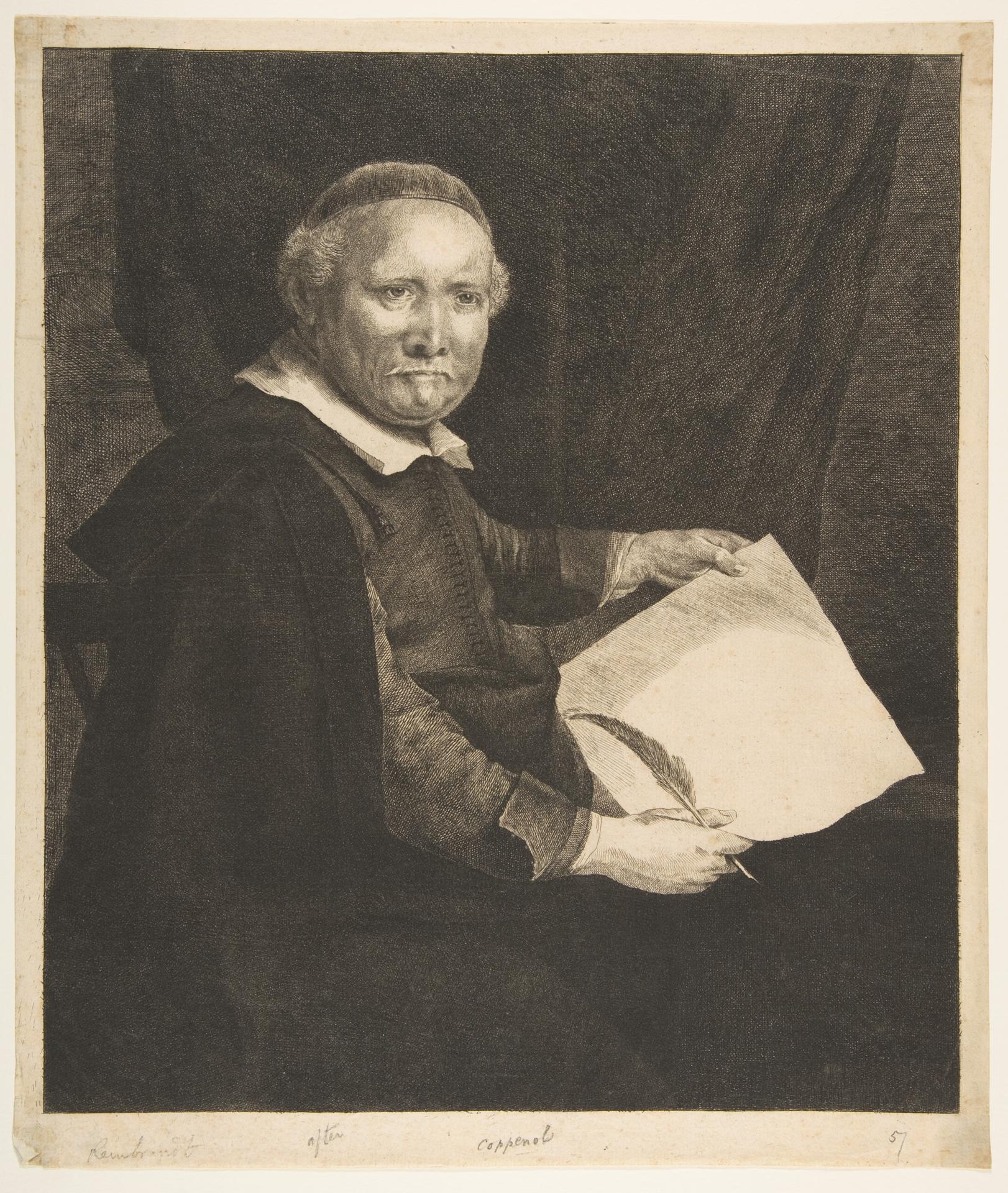
Lieven Willemsz van Coppenol, Writing Master: the Larger Plate (copy)
Original title: Lieven Willemsz van Coppenol, Writing Master: the Larger Plate (copy)
kurzbeschreibung
What sets this print apart from related portraits of van Coppenol is that the writing master appears not as a figure of standing but in a quiet act: seated, quill and paper in hand. Rembrandt's undated etching is a copy after the larger plate and belongs among his printed works.
Description
At the heart of the image sits the scribe, a sheet in his hand, the quill poised to write. Over him falls a plain dark robe with a collar that recalls a monastic habit. The surroundings stay dark and undefined, drawing the eye to the figure. Light enters from the front and picks out the features of the face and the texture of the cloth. Held in shades of grey, the monochrome sheet shows dense, meticulously detailed linework.
Context
Lieven Willemsz van Coppenol, an amateur calligrapher from Amsterdam, was portrayed by Rembrandt more than once; the etching was probably made in the 1650s, when printmaking occupied Rembrandt intensely. That a copy after the larger plate exists here speaks to how widely the motif circulated in different formats. Van Coppenol was known for his elaborate pieces of writing and was also depicted by other artists.
Impact
The scene feels calm and collected, since the writing master's gaze rests on his work. The dark setting and the directed light create an intimate, almost contemplative mood. The precise stroke of the line reveals a craftsman's care that echoes the subject of writing itself.
Technique
In etching, lines are bitten into a metal plate that has been treated with acid. Rembrandt worked with various stages of biting to achieve fine transitions between light and dark. Textures such as cloth and paper can thus be rendered in great detail.
AI-generated description text
Source: Metropolitan Museum of Art · Public Domain (CC0 1.0)