Bust of an Old Man in a Coat and Fur Collar (copy)
Original title: Bust of an Old Man in a Coat and Fur Collar (copy)
kurzbeschreibung
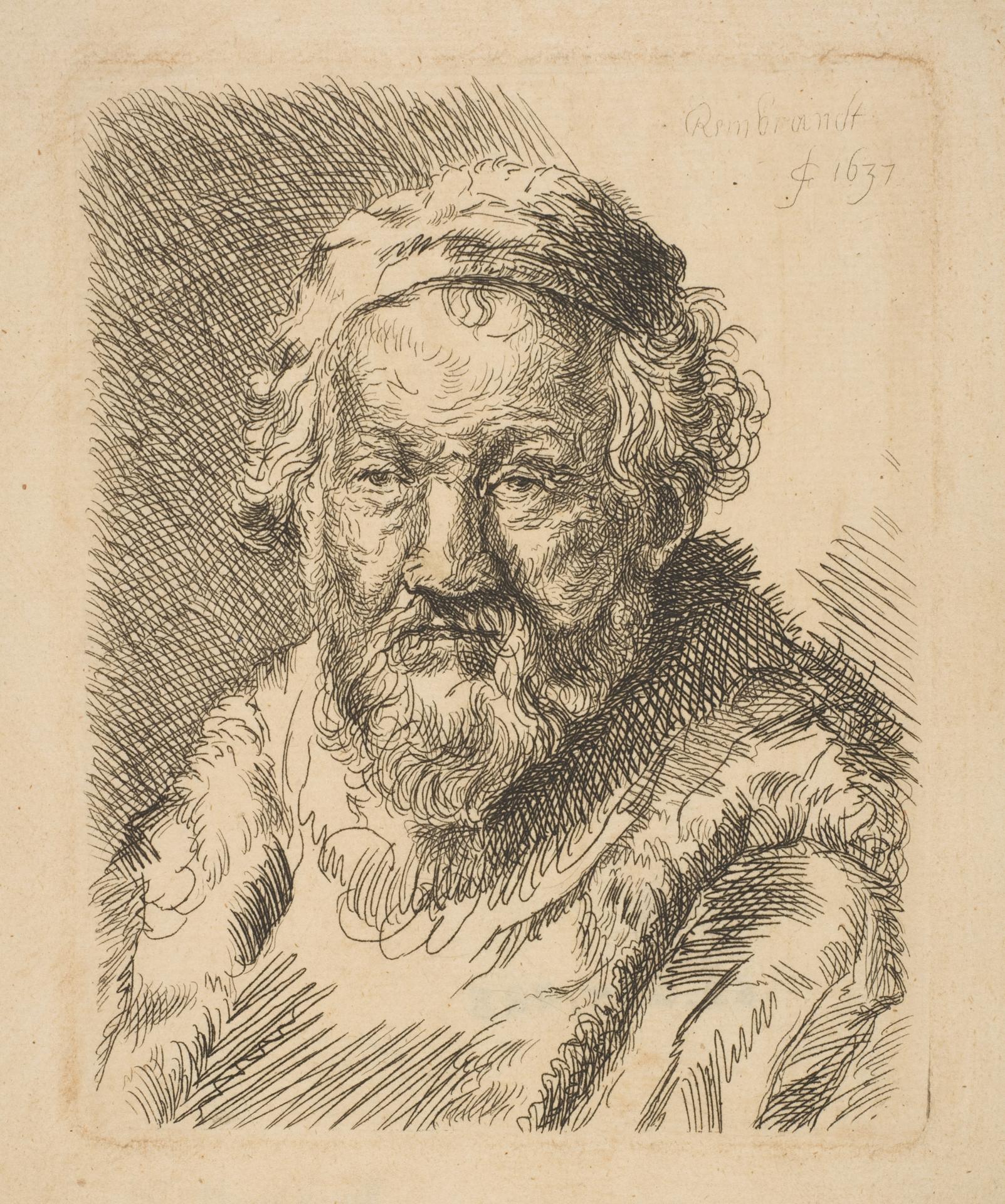
This etching is attributed to Rembrandt van Rijn and catalogued as a copy; it bears no date. It shows the bust of an old man with thick, wavy hair and a long beard, wearing a jacket trimmed with fur. The inscription "Rembrandt 1637" survives on the trimmed sheet, which measures 15.5 × 12.6 cm.
Description
An old man faces the viewer straight on, his face marked by deep wrinkles and a grave, thoughtful expression. Hair and beard are rendered in fine hatching that stands out against the dark ground. The bulky fur collar of the jacket gives weight to the upper body. At the upper right appears the inscription "Rembrandt 1637". The whole arrangement centres on the bust, while the background stays plain and dark.
Context
Probably made in the first half of the 17th century, the print falls in a period when Rembrandt was working as a portraitist in Leiden and Amsterdam. Studies of old men's heads occur often in his work; they frequently served as exercises in handling light and shadow. The year 1637 on the sheet suggests it was made that year, though this particular impression is identified as a copy. The original belongs to Rembrandt's printed oeuvre, valued for its expressive line.
Impact
The grave gaze and the precise treatment of hair and beard give the portrait an immediate, insistent presence. The dark, bare setting draws all attention to the old man's physiognomy. Fine hatching produces a lively surface texture that makes the sheet feel almost tangible.
Technique
For this etching the drawing was incised into a copper plate and then bitten with acid. The lines lie close together and vary in strength, which the etching process allows. The sheet has been trimmed, so its original format is no longer fully preserved.
AI-generated description text
Source: Metropolitan Museum of Art · Public Domain (CC0 1.0)