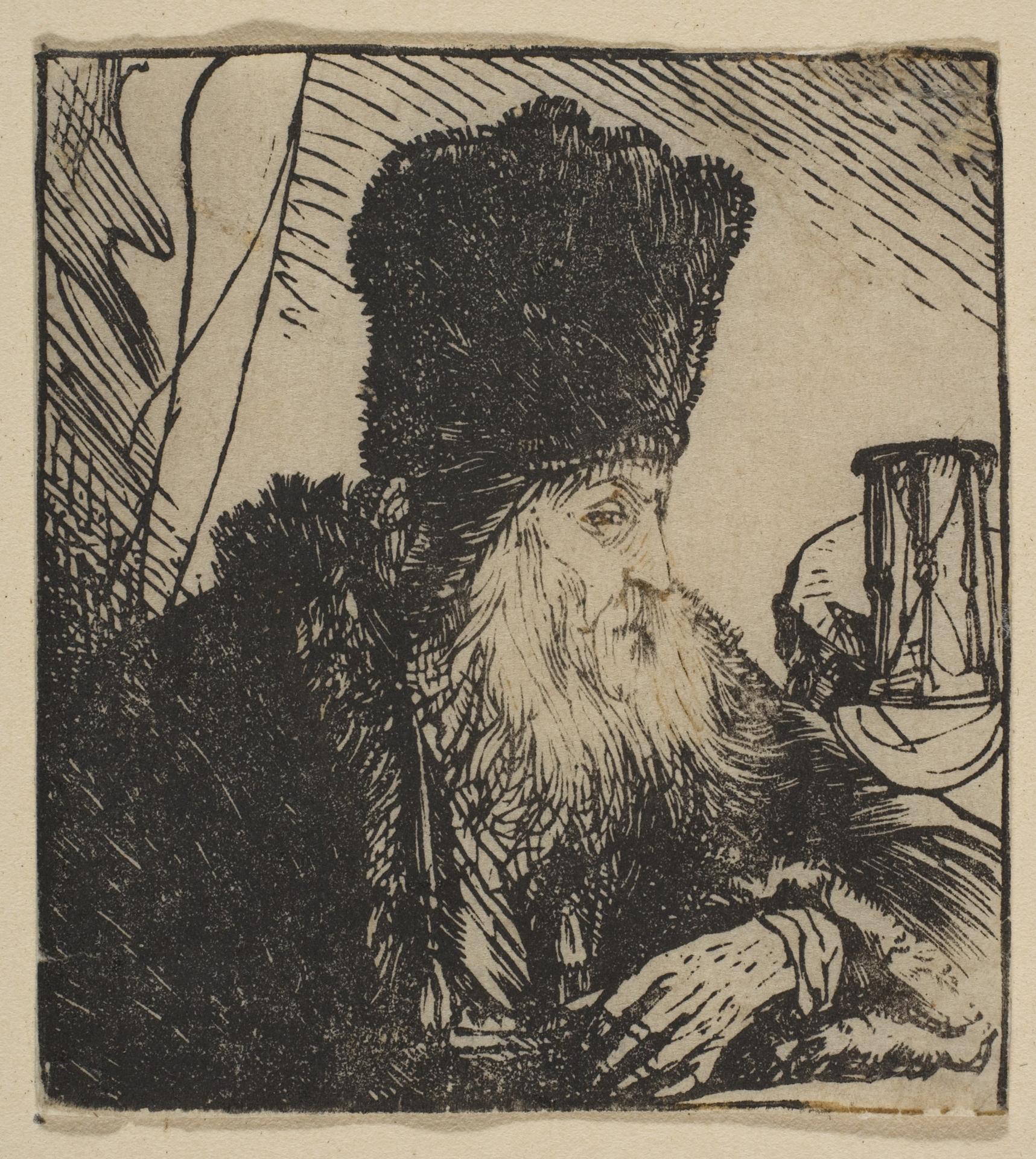
Philosopher with an Hourglass
Original title: Philosopher with an Hourglass
kurzbeschreibung
Jan Lievens made this woodcut, Philosoph mit Sanduhr, sometime between 1620 and 1674. It pictures a bearded old man in a fur hat, an hourglass held in his hand. The philosopher with an emblem of vanity was a familiar subject in seventeenth-century Dutch art.
Description
An elderly man with a long beard and a fur cap holds an hourglass. The setting stays plain: diagonal strokes suggest a wall or an interior. Colour is monochrome, a range of greys that comes from the drawn line and the relief printing. The drawing is dense with detail and dwells on the man's face and on the hourglass.
Context
Lievens cut this print in the first half of the seventeenth century, when vanitas motifs were thriving in the Netherlands. The hourglass stands for the transience of life, a common thread in the iconography of philosophers and scholars at the time. Lievens was a contemporary of Rembrandt and worked for a while in Leiden, where both artists took up related subjects.
Impact
At only 5.3 × 5 cm, the sheet has an intimate, concentrated presence. The detailed linework and the monochrome grey scale create a grave, thoughtful mood that invites reflection on mortality.
Technique
A woodcut, a relief process in which the parts that do not print are cut away from the wooden block. This is the first of two states. Fine lines and graded greys show the precision of the printing and the artist's ability to achieve sculptural effect with simple means.
AI-generated description text
Source: Metropolitan Museum of Art · Public Domain (CC0 1.0)