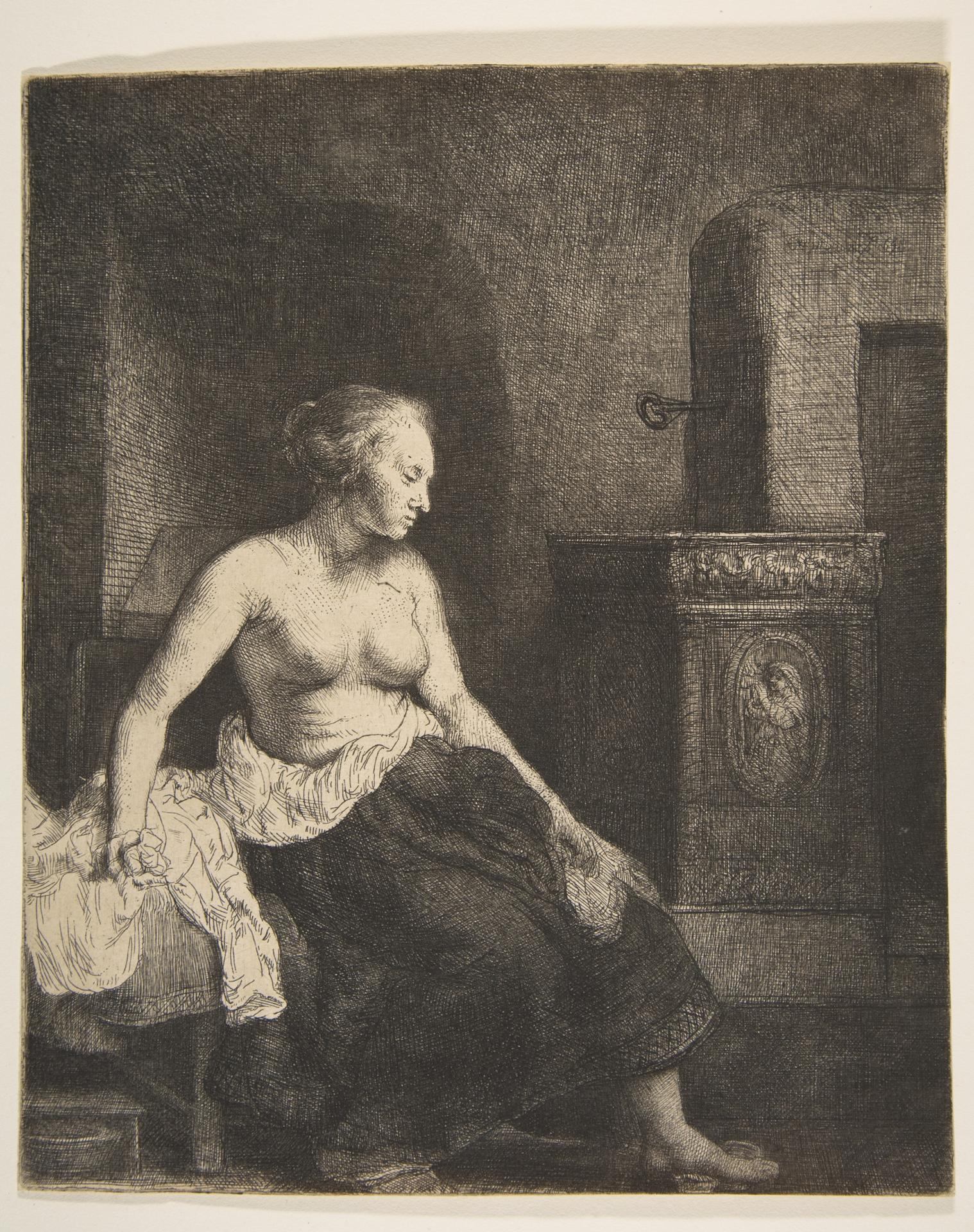
Woman Sitting Half-Dressed beside a Stove (1658, Met-Objekt 5371)
Original title: Woman Sitting Half-Dressed beside a Stove
kurzbeschreibung
A woman sits half-dressed on a chair in an interior, a motif Rembrandt van Rijn captured in 1658 in an etching. The print, the sixth of seven states, combines drypoint and burin work and measures 23 × 19.8 cm. She wears a shirt, trousers, and an apron tied around her waist; her legs are bare, and her posture seems withdrawn.
Description
Leaning slightly forward, the woman occupies the center of the image, her gaze lowered in thought. A simple shirt and trousers cover her upper body, the apron is wrapped around her waist, and her legs remain uncovered. Behind her, a fireplace with an ornate door bounds the space. Light falling from the side models the figure with soft shadows and brings out the folds of her clothing. The arrangement stays calm and focused entirely on the woman, with no distracting details.
Context
Created in 1658, during a period when Rembrandt was deeply engaged with intimate scenes of everyday life, this etching was made in Amsterdam. A half-dressed woman in a private setting was a common motif in seventeenth-century Dutch art—often as a study of female domesticity or with a moralizing intent. Rembrandt was going through difficult years economically and personally at the time, though this is not immediately reflected in his choice of subject. The sheet belongs to a series of prints that attest to his mastery of printmaking.
Impact
A quiet, intimate atmosphere emanates from this etching, carried by the woman's pensive posture and the subdued light. Fine lines and soft transitions give the sheet a tactile quality that draws the viewer close to the subject. The scene feels unpretentious and honest, without idealization—typical of Rembrandt's later prints.
Technique
Etching, supplemented with drypoint and burin, allows for fine, velvety lines and deep blacks. In the sixth of seven states, an advanced reworking is evident: Rembrandt refined the effect of light and shadow. The paper has been trimmed, which slightly compresses the view but does not affect the graphic impact.
AI-generated description text
Source: Metropolitan Museum of Art · Public Domain (CC0 1.0)