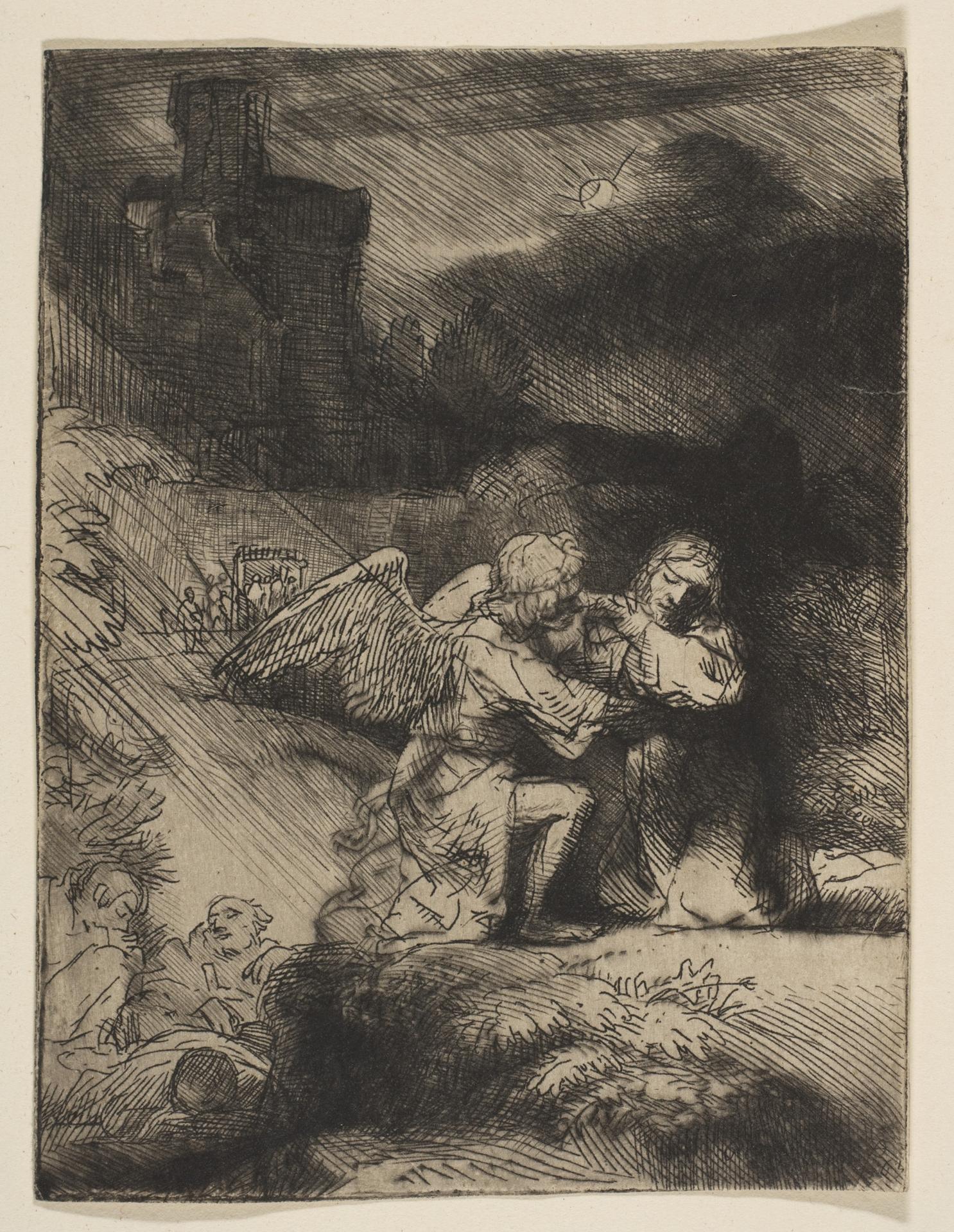
The Agony in the Garden (ca. 1652, Met-Objekt 5368)
Original title: The Agony in the Garden
kurzbeschreibung
Rembrandt van Rijn made this small etching with drypoint around 1652, showing Jesus in the Garden of Gethsemane surrounded by sleeping disciples. The impression is the first of three states.
Description
In the foreground a figure crouches with a hand to the forehead, while another embraces him from behind and a third kneels beside them. Two more figures lie on the ground, also in close emotional connection. Behind this group a landscape opens with trees and a tower; a gloomy sky arches above, in which a small bright point appears like a star. Dark, monochrome tones dominate the image, produced by dense hatching and drypoint lines.
Context
This etching arose during a creative phase around 1652 when Rembrandt was working particularly intensively on biblical subjects and the rendering of human emotion. It belongs to a series of prints from those years. That three states survive suggests a laborious working process.
Impact
The close physical bond among the figures heightens the tension of the moment, while the dense hatching and dark tonality create an oppressive, intimate mood. The small format demands close looking and rewards it with fine details.
Technique
In etching with drypoint, lines are scratched into a metal plate and then printed. The drypoint needle leaves slightly raised burrs that produce soft, velvety lines in the print. Etching and drypoint together make possible the graded tonal values and fine texture.
AI-generated description text
Source: Metropolitan Museum of Art · Public Domain (CC0 1.0)