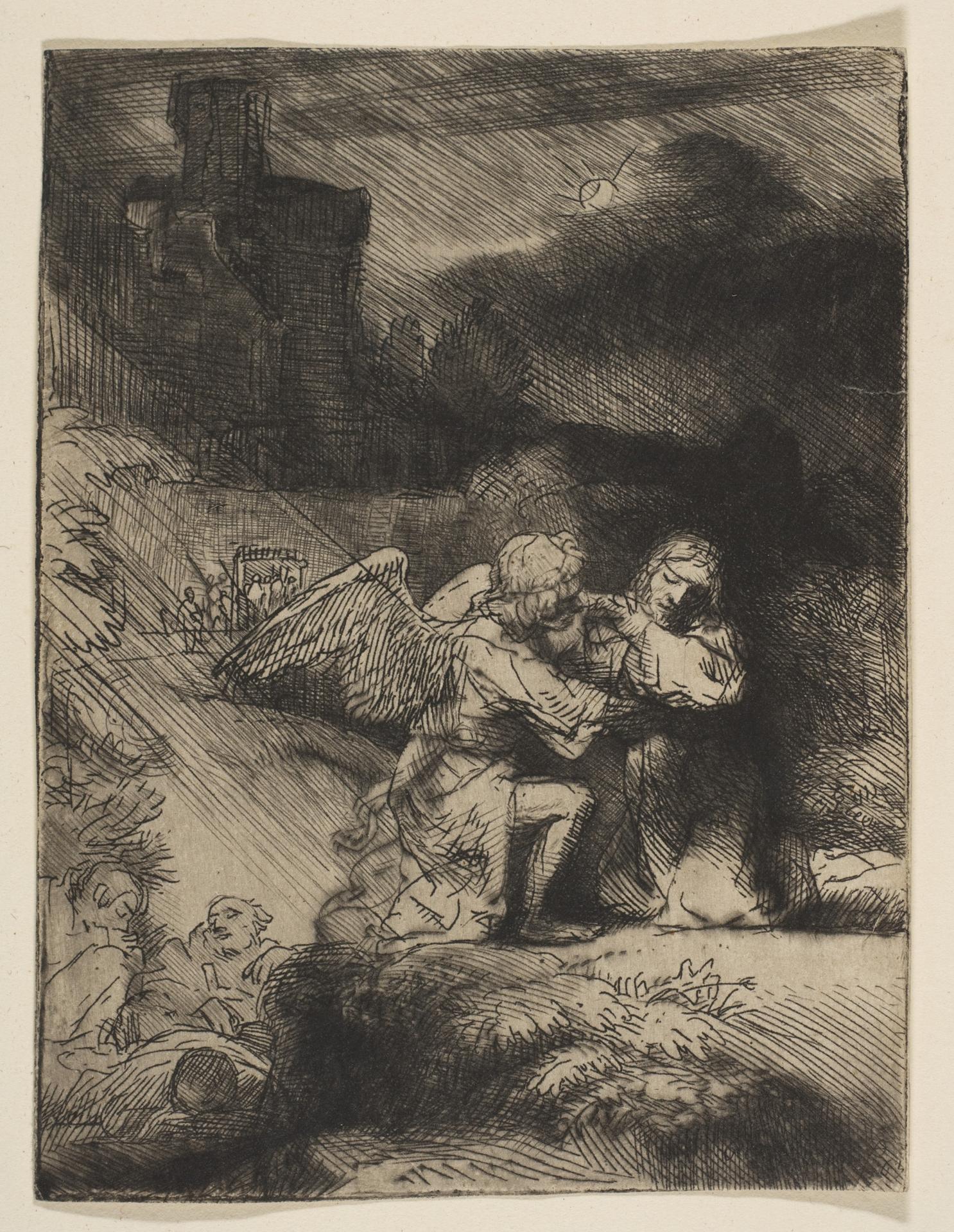
The Agony in the Garden (ca. 1652, Met-Objekt 5367)
Original title: The Agony in the Garden
kurzbeschreibung
Where most Gethsemane scenes single Christ out and leave him alone with his anguish, this print by Rembrandt (Rembrandt van Rijn) from around 1652 draws the three disciples tightly into the pictorial structure. The Agony in the Garden is worked as a drypoint with plate tone, and attention settles on the knot of figures in the foreground, closed into a tight circle.
Description
Three figures in seventeenth-century dress fill the foreground: one crouches on the ground while the other two stand over it, as if holding it up. Behind them a landscape opens out, with trees and a tower-like building that recalls a church. A sombre, almost monochrome tonality governs the sheet; subdued light falls from above and heightens the tension. The close grouping stresses nearness and intensity, while hard contrasts and finely differentiated hatching define the style.
Context
Rembrandt made this etching around 1652, during a phase of intensive engagement with biblical subjects and human feeling. It belongs to a series of prints treating scenes from the life of Christ, and in those years he kept developing his printmaking techniques. The Agony in Gethsemane was a familiar subject in the seventeenth century, often used for private devotion.
Impact
The dark tonality and restrained light produce an atmosphere poised between intimacy and drama. Because the figures stand so close together, the sense of emotional proximity and strain is reinforced. Strong contrasts of light and dark draw the eye toward the middle of the image and underscore the inner distress of the central figure.
Technique
Drypoint and plate tone distinguish this sheet, which survives in three states; the present impression is the first. Drypoint allows fine, grey lines and soft gradations of tone, while the plate tone adds further depth and shading. At 10.2 × 8.5 cm the print is trimmed small, which favours the concentrated effect of its arrangement.
AI-generated description text
Source: Metropolitan Museum of Art · Public Domain (CC0 1.0)