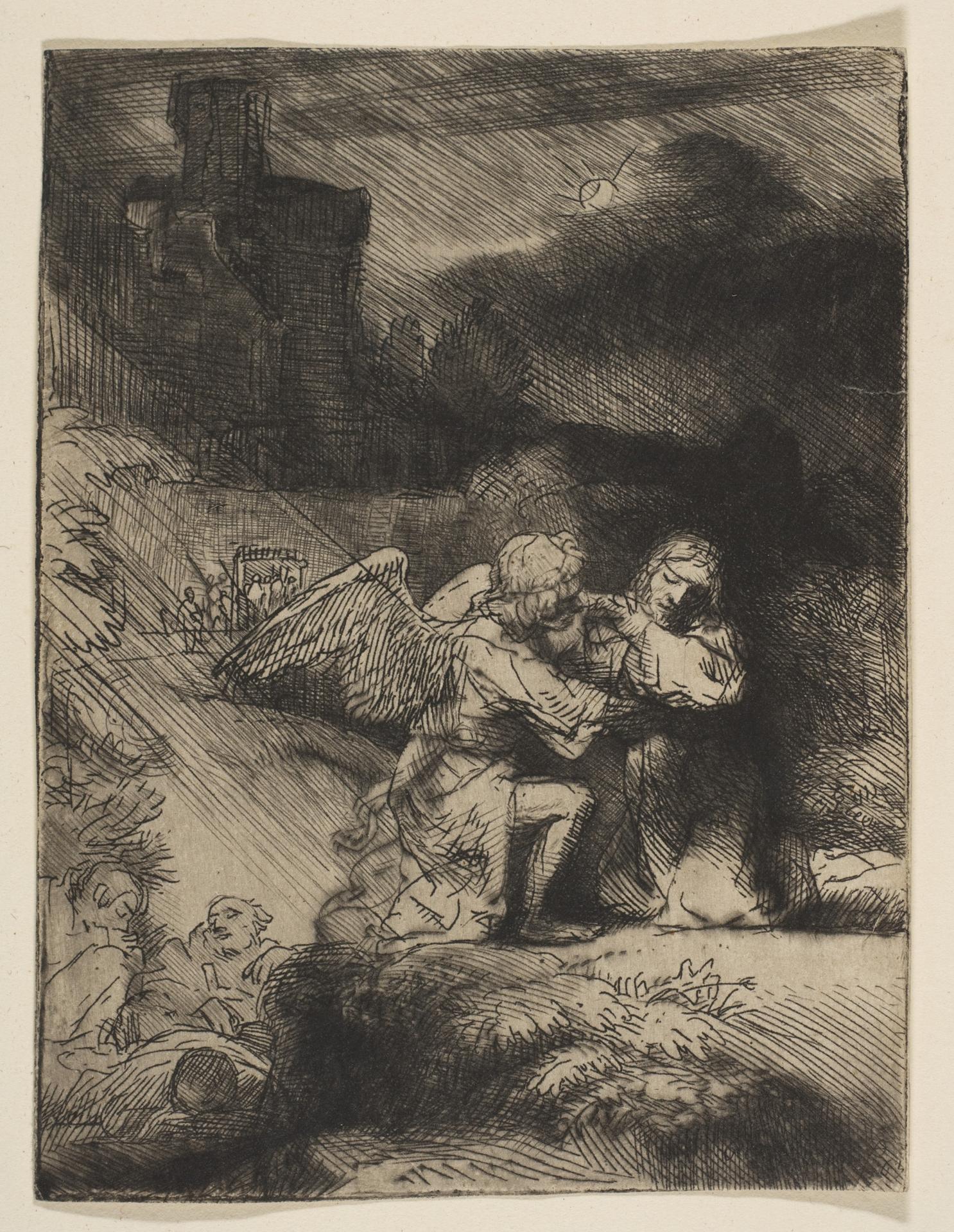
The Agony in the Garden (ca. 1652, Met-Objekt 5366)
Original title: The Agony in the Garden
kurzbeschreibung
Rembrandt (Rembrandt van Rijn) made this etching with drypoint reworking around 1652. It depicts Christ in the Garden of Gethsemane, wrestling in prayer while his disciples stay near him. This is the first of three states, printed with plate tone.
Description
In the foreground a crouched figure lies on the ground, held and supported by two companions with their arms. Their posture and expressions convey tension and urgency. Behind them a landscape with trees opens up, and a tower rises from it. Densely hatched lines and deep shadows plunge the image into a gloomy, charged light. Etching and drypoint produce varied surfaces and deepen the sense of space.
Context
The etching belongs to the early 1650s, a period when Rembrandt turned increasingly to biblical subjects. The motif of Christ in agony was common in Protestant art of the Netherlands. At about 11 by 8.4 centimeters, the sheet is small, suggesting use in private devotion. Rembrandt often made multiple states to vary light and mood.
Impact
The physical closeness of the figures and the dramatic lighting create immediate tension. The fine needlework makes the print feel intimate and almost sketch-like, drawing the viewer closer. Dark areas stand beside light accents that direct the gaze to the central figure.
Technique
The artist used etching, followed by reworking with drypoint; plate tone served to create half-shadows. Soft, velvety lines come from the drypoint, while etching contributes sharper contours. In the first state the plate is fresh and un worn, with the burr typical of drypoint.
AI-generated description text
Source: Metropolitan Museum of Art · Public Domain (CC0 1.0)