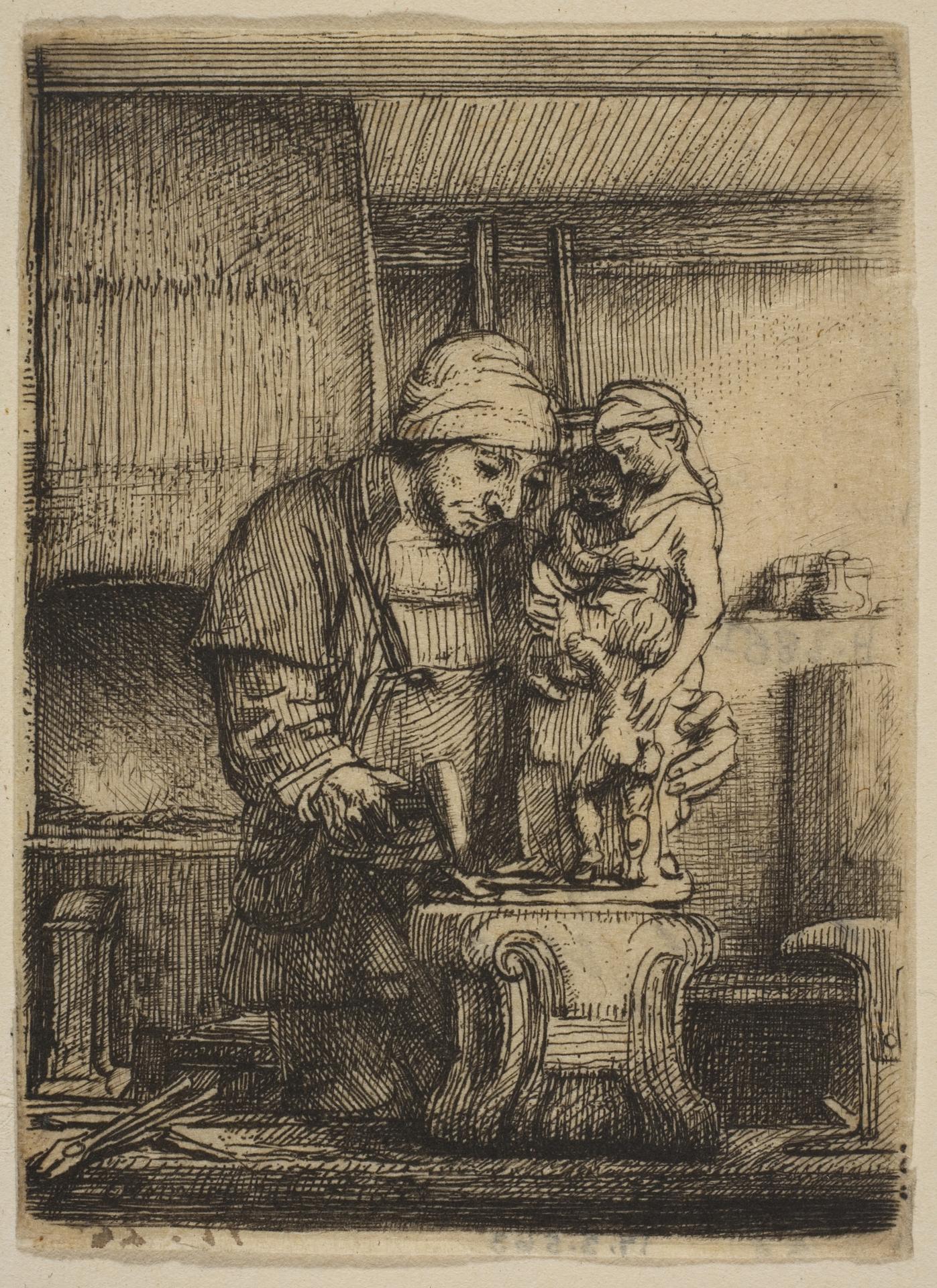
The Goldsmith (1655, Met-Objekt 5362)
Original title: The Goldsmith
kurzbeschreibung
Rembrandt van Rijn made this etching, The Goldsmith, in 1655. It shows a craftsman seated at his work while a child watches. The print survives in its first of three states and measures about 7.8 × 5.7 cm. Etching and drypoint are combined in it.
Description
A goldsmith in a hat and traditional clothing leans over his piece, while a small child stands on a platform and is lifted up by him. The child also wears period clothing and a simple hairstyle. Plain furniture and a window with curtains divide the room; soft light enters through the window. Very fine lines and shading give the figures and the space a sculptural presence. The arrangement draws the eye to the interaction between man and child.
Context
Around 1655, during a period of intense engagement with printmaking, this etching was made in Amsterdam, where Rembrandt worked as a sought-after portraitist and graphic artist. He often took up everyday scenes and craftsmen at that time. The choice of a goldsmith may allude to the appreciation of skilled labor in seventeenth-century Dutch society, which was known for its flourishing in art and trade.
Impact
Quiet working light and the concentrated attention of the two figures draw the viewer straight into the still atmosphere. Finely graded lines and restrained lighting create a contemplative mood typical of Rembrandt's graphic work. The gaze lingers on the closeness of hand and workpiece, on the lifted child—and stays there.
Technique
Etching and drypoint are combined; this is the first of three states. Etching allows fine, even lines, while drypoint adds soft, deep blacks, increasing contrast and texture. At about 7.8 × 5.7 cm the sheet is small and was likely intended for collectors.
AI-generated description text
Source: Metropolitan Museum of Art · Public Domain (CC0 1.0)