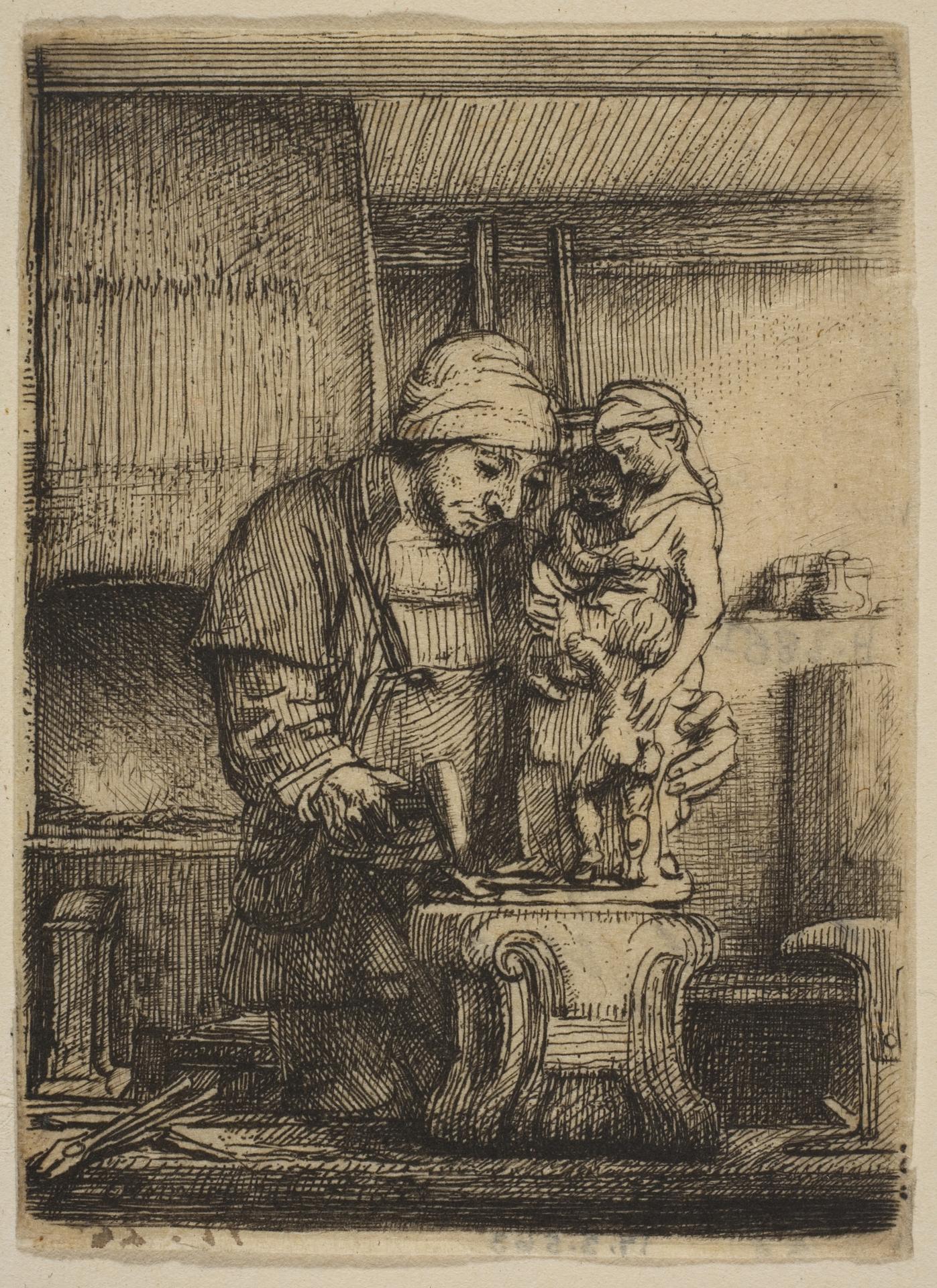
The Goldsmith (1655, Met-Objekt 5361)
Original title: The Goldsmith
kurzbeschreibung
In 1655 Rembrandt van Rijn etched Der Goldschmied: a craftsman focused on a piece of work, with a boy at his side. The print measures 8.8 × 6.7 cm and was made with drypoint.
Description
Wearing a hat and a striped jacket, the goldsmith sits at a table and brings a hammer down on a workpiece. A boy in similar clothes watches closely beside him. A window and a vertically striped wall form the setting, with tools and materials laid out ready. Light entering from the left creates shadows and details, and the figures occupy the foreground of a symmetrical arrangement.
Context
The goldsmith motif was popular in the seventeenth-century Netherlands and often stood for diligence and precision. In 1655 Amsterdam Rembrandt increasingly devoted himself to depicting craftsmen and everyday scenes. Small formats like this one of 8.8 × 6.7 cm were typical of his printmaking, which was aimed at collectors.
Impact
An intimate, quiet mood pervades the print and places the viewer directly in the workshop. Light and shadow create sculptural depth, the figures' concentration becomes palpable, and the care of the craft comes to the fore.
Technique
Here the first of three states is present as an etching with drypoint. Fine, burred drypoint lines give the print a soft, painterly texture. Rembrandt used the technique to achieve delicate transitions of light and shadow, which is especially clear in this small work.
AI-generated description text
Source: Metropolitan Museum of Art · Public Domain (CC0 1.0)