David and Goliath (1655)
Original title: David and Goliath
kurzbeschreibung
Rembrandt van Rijn takes up the biblical duel between David and the giant Goliath in 1655. He worked the subject as an etching, reworking the plate with drypoint and burin; the impression survives in the first of five states. Trimmed, the sheet measures 13 × 7.6 cm.
Description
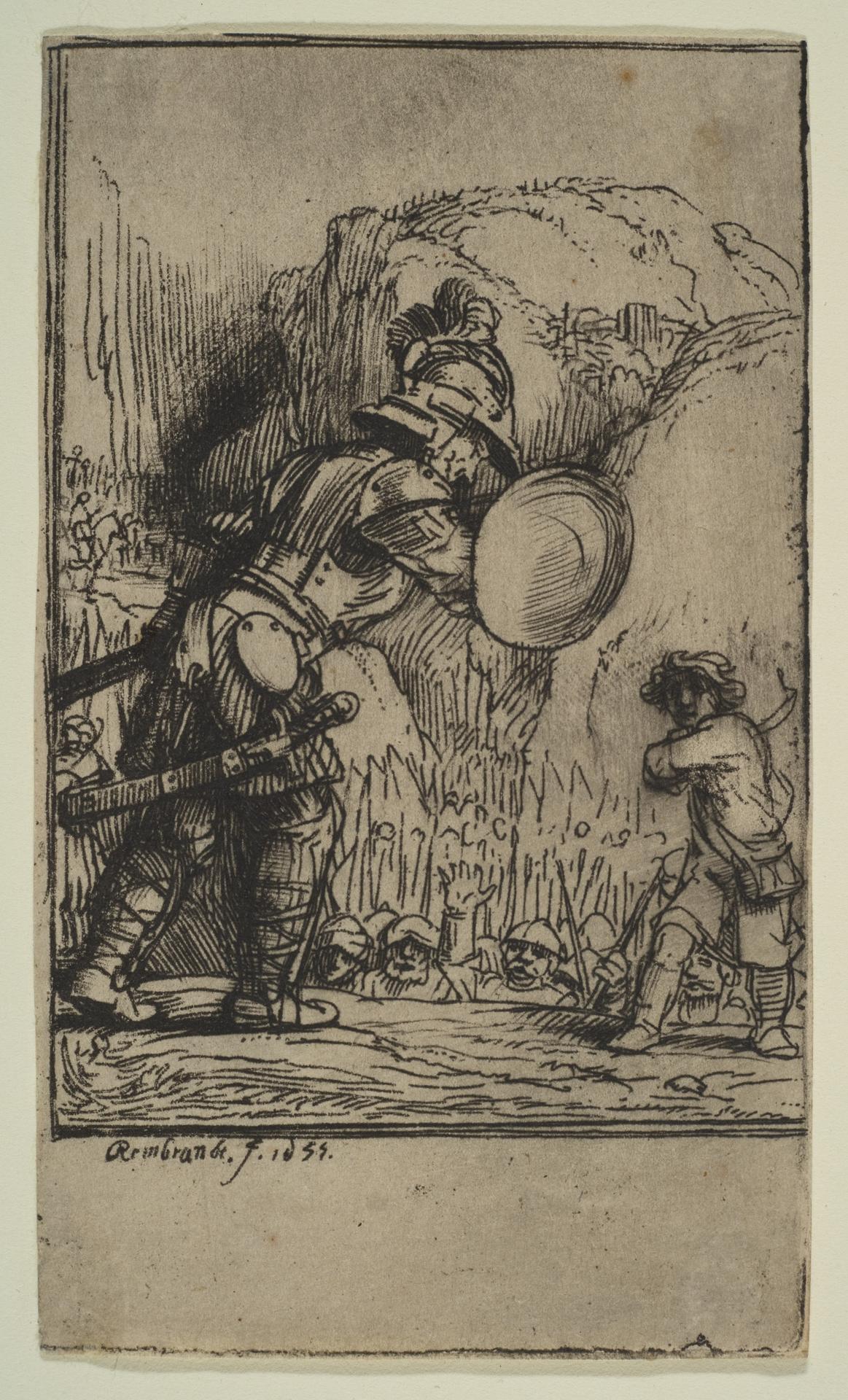
In the foreground David draws his bow, the arrow aimed at Goliath, who stands before him in armour with a shield. Behind the two figures soldiers are scattered across the field, some standing, others kneeling or lying on the ground. A wall of rock closes off the space. Bright passages and deep shadows sit close together, driving the tension of the encounter.
Context
The etching was made in Amsterdam during a period of Rembrandt's career shaped by numerous biblical subjects. In the seventeenth century the fight between David and Goliath was a common motif, since it could express the victory of faith over a seemingly crushing superior force. Rembrandt returned to this material several times, using different printmaking techniques.
Impact
The harsh contrast of light and dark keeps the eye fixed on the immediate confrontation between the two opponents and lets the tension hardly subside. Despite the small format, the delicate lines and the sparingly applied plate tone give the sheet spatial depth and a sense of closeness.
Technique
Printing was done from an etched plate that Rembrandt reworked with burin and drypoint; he used plate tone to obtain graduated tonal values. That the sheet represents the first of five recorded states points to the repeated reworking of the plate.
AI-generated description text
Source: Metropolitan Museum of Art · Public Domain (CC0 1.0)