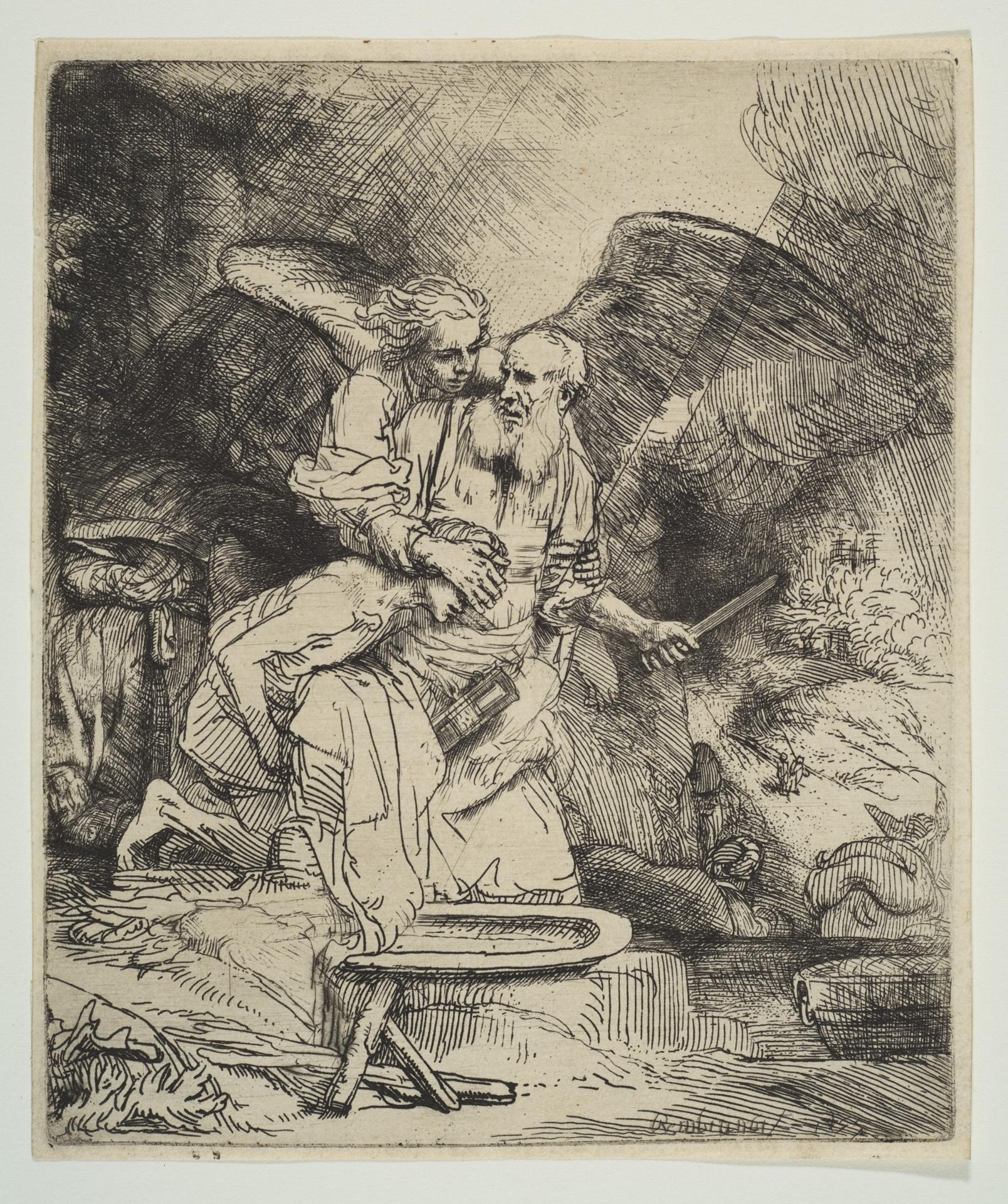
Abraham's Sacrifice (1655, Met-Objekt 5357)
Original title: Abraham's Sacrifice
kurzbeschreibung
Rembrandt van Rijn made the etching and drypoint Abraham's Sacrifice in 1655. The print recounts the biblical story in which an angel stops Abraham at the last moment from killing his son.
Description
In the foreground Abraham kneels, an offering vessel in his hand. Close behind him an angel with spread wings steps forward and gently takes hold of his arm. Jagged rocks rise in tiers behind them; a cloud drifts from right to left. At the left edge stands a loaded camel.
Context
The 1655 etching belongs to a period in which Rembrandt returned often to biblical subjects. It forms part of a series of etchings from the 1650s. The sacrifice of Abraham was widespread in seventeenth-century Protestant art and was frequently read as a prefiguration of Christ's sacrifice.
Impact
Subdued light and delicate lines give the sheet a mood both calm and tense. The tension lies in the instant of intervention between angel and Abraham. Realistically observed surfaces of rock and cloth make the scene feel physically close.
Technique
Etching and drypoint produce the finest lines, which define garments and rock structures precisely. Light falling from the right deepens the shadows and gives the figures plastic roundness.
AI-generated description text
Source: Metropolitan Museum of Art · Public Domain (CC0 1.0)