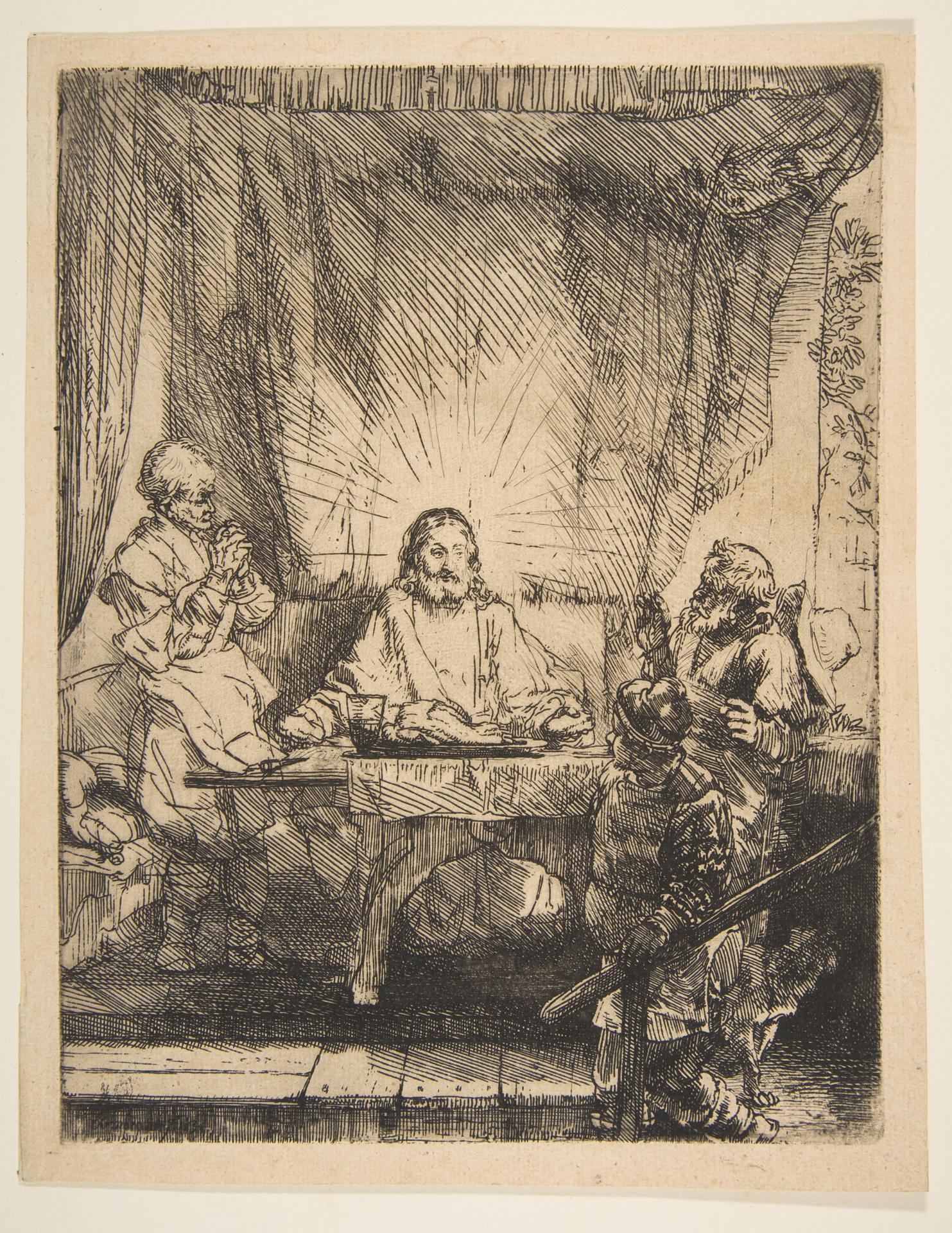
Christ at Emmaus: The Larger Plate
Original title: Christ at Emmaus: The Larger Plate
kurzbeschreibung
Rembrandt van Rijn took up the biblical story of Christ at Emmaus in 1654 with this larger-plate etching, adding drypoint and burin; the sheet survives in the fourth of four states. The encounter between Jesus and two disciples appears entirely in shades of gray.
Description
Three men sit around a table. Jesus is in the middle, hands raised, his face thoughtful; to his left an older man with folded hands, to his right a younger one with arms crossed. The background stays dark and undefined, with a few strokes hinting at a glow of light. Traditional garments, all rendered in fine, detailed lines.
Context
Around the middle of the 17th century Rembrandt devoted himself more intensively to biblical subjects. Emmaus recurs several times in his work, in varying techniques and arrangements. That he combines drypoint and burin here points to his late, experimental approach to printmaking.
Impact
Dark areas and hard contrasts create a quiet, collected mood and bring the moment of recognition to the fore. The lighting and linework draw the eye to the central figure of Jesus, producing a calm, almost devotional atmosphere.
Technique
The print was taken from an etched plate reworked with burin, drypoint, and in places a mezzotint rocker. This allowed tonal values to be graded from deep shadows to fine highlights. Trimmed, the sheet measures 22.4 × 18 cm, giving the image a concentrated, enclosed frame.
AI-generated description text
Source: Metropolitan Museum of Art · Public Domain (CC0 1.0)