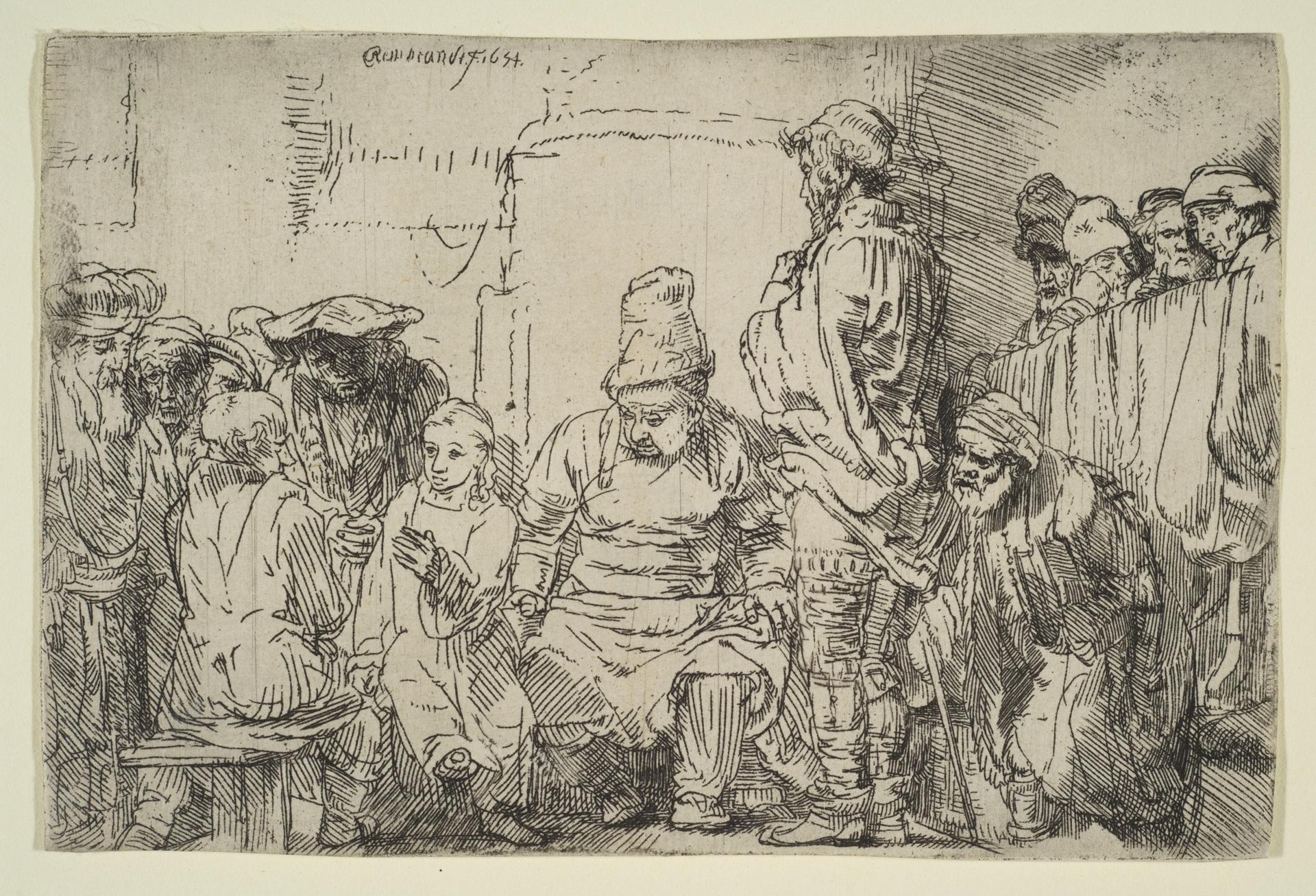
Christ Seated Disputing with the Doctors
Original title: Christ Seated Disputing with the Doctors
kurzbeschreibung
This 1654 etching by Rembrandt presents the twelve-year-old Jesus in the temple, engaged in conversation with the learned doctors. Executed in etching, possibly with touches of drypoint, the sheet measures 9.6 × 14.3 cm. A tightly packed group of figures captures the moment of intellectual exchange.
Description
Christ sits at the center, wearing a robe and head covering; around him cluster men in contemporary garments, some with hats, beards, or mustaches. The figures are arranged in varied poses—seated or standing—forming an irregular layout that underscores the liveliness of the dialogue. The setting is an interior, suggested by wall structures; light falls from above, emphasizing faces and fabrics. The etching remains monochrome, using varied gray values and line weights to create a sense of space and surface texture.
Context
The story of the twelve-year-old Jesus in the temple (Luke 2:41–52) was highly popular in seventeenth-century Dutch art. Rembrandt treated the subject several times, including in a painting of 1652. This etching falls into a period when he was deeply engaged with biblical narratives and their psychological interpretation. It was probably made for the art market, as prints were then distributed in editions.
Impact
The close staggering of the figures and the irregular arrangement create a tense atmosphere. The light from above draws the eye to Christ and the expressions of the scholars, making the intellectual contest vivid. Fine hatching and graduated gray tones give the sheet a calm yet concentrated aura.
Technique
For this etching, the plate was bitten with acid; drypoint strokes may have been added to achieve more delicate lines or stronger shadows. The process offers a wide range of tonal values, from light grays to deep blacks, which Rembrandt used for his atmospheric lighting effects. The present sheet has been trimmed, reducing the original plate size.
AI-generated description text
Source: Metropolitan Museum of Art · Public Domain (CC0 1.0)