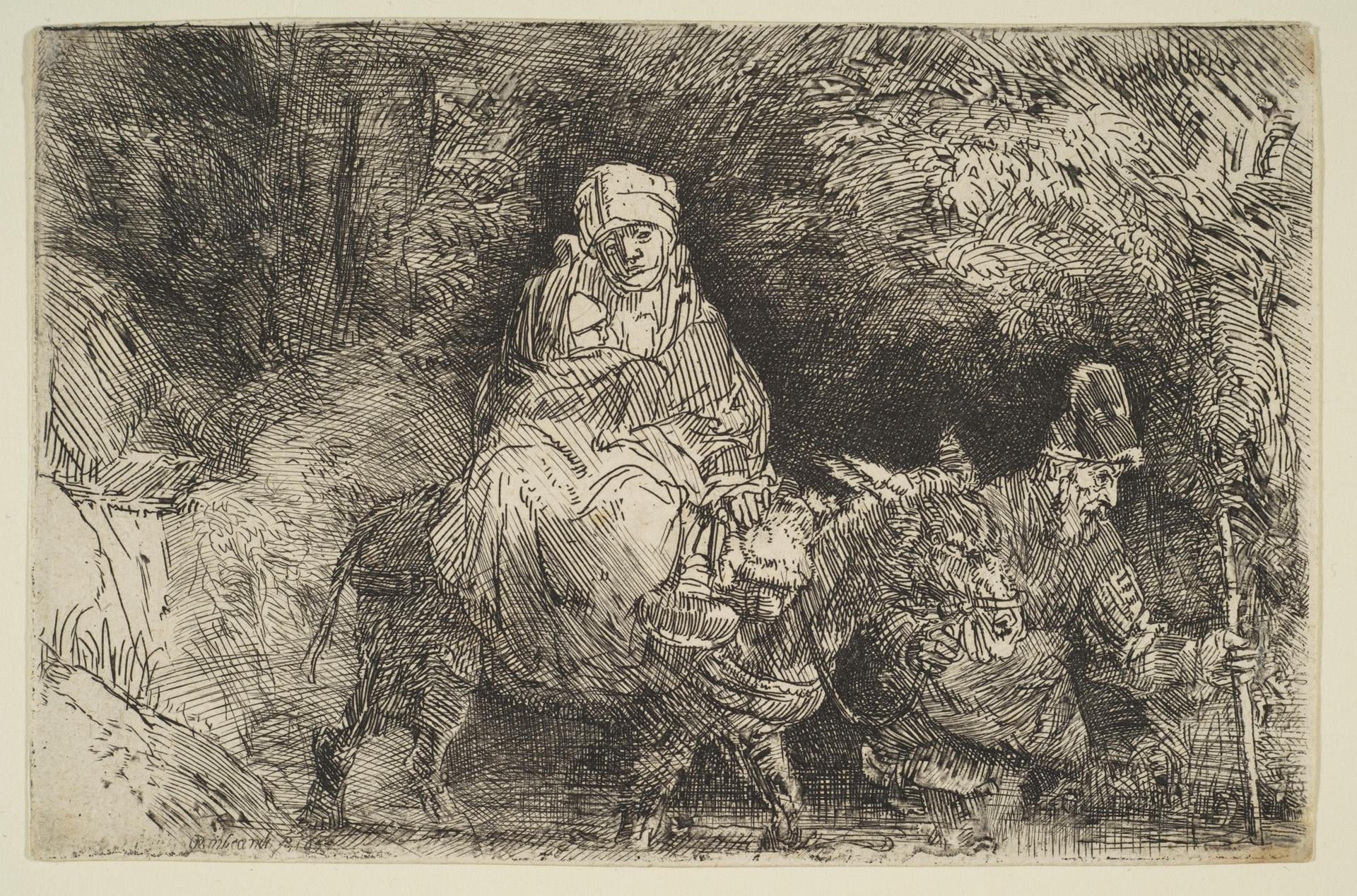
The Flight into Egypt: Crossing a Brook (1654, Met-Objekt 5352)
Original title: The Flight into Egypt: Crossing a Brook
kurzbeschreibung
Mary sits on a donkey while Joseph follows on a second animal, both wading through a stream as the biblical flight of the Holy Family into Egypt describes. Rembrandt van Rijn captured this motif in 1654 as an etching, adding engraving and drypoint to the plate.
Description
In the foreground a woman in a long robe and head covering rides a donkey; beside her, a bearded man wearing a hat and carrying a stick sits on another donkey. Trees and bushes frame the action and give it a natural setting. The layout runs across the image, with the figures holding the center and the landscape wrapping around them like a border. In black and white, varied gray tones and hatching bring out light and shadow; the lines emphasize surfaces and details, deepening the sense of space.
Context
This print was made in 1654, during a period when Rembrandt was deeply engaged with biblical subjects. The Flight into Egypt was a common theme in the seventeenth-century Netherlands and offered room for landscape and narrative. Rembrandt produced several etchings of this motif, all sharing an intimate, human approach. The work belongs to his mature years, when he experimented widely with technique and combined different printmaking methods.
Impact
A quiet, almost idyllic mood pervades the sheet; the danger of the flight recedes to the edges. Fine hatching and graduated shading create atmospheric depth that draws the eye into the scene. This version feels closer to everyday life and more personal than many other depictions of the flight from that time.
Technique
Rembrandt began with etching and then reworked the plate with engraving and drypoint. This allowed both delicate lines and soft tonal transitions. The plate was probably printed in several states, which matches his working method.
AI-generated description text
Source: Metropolitan Museum of Art · Public Domain (CC0 1.0)