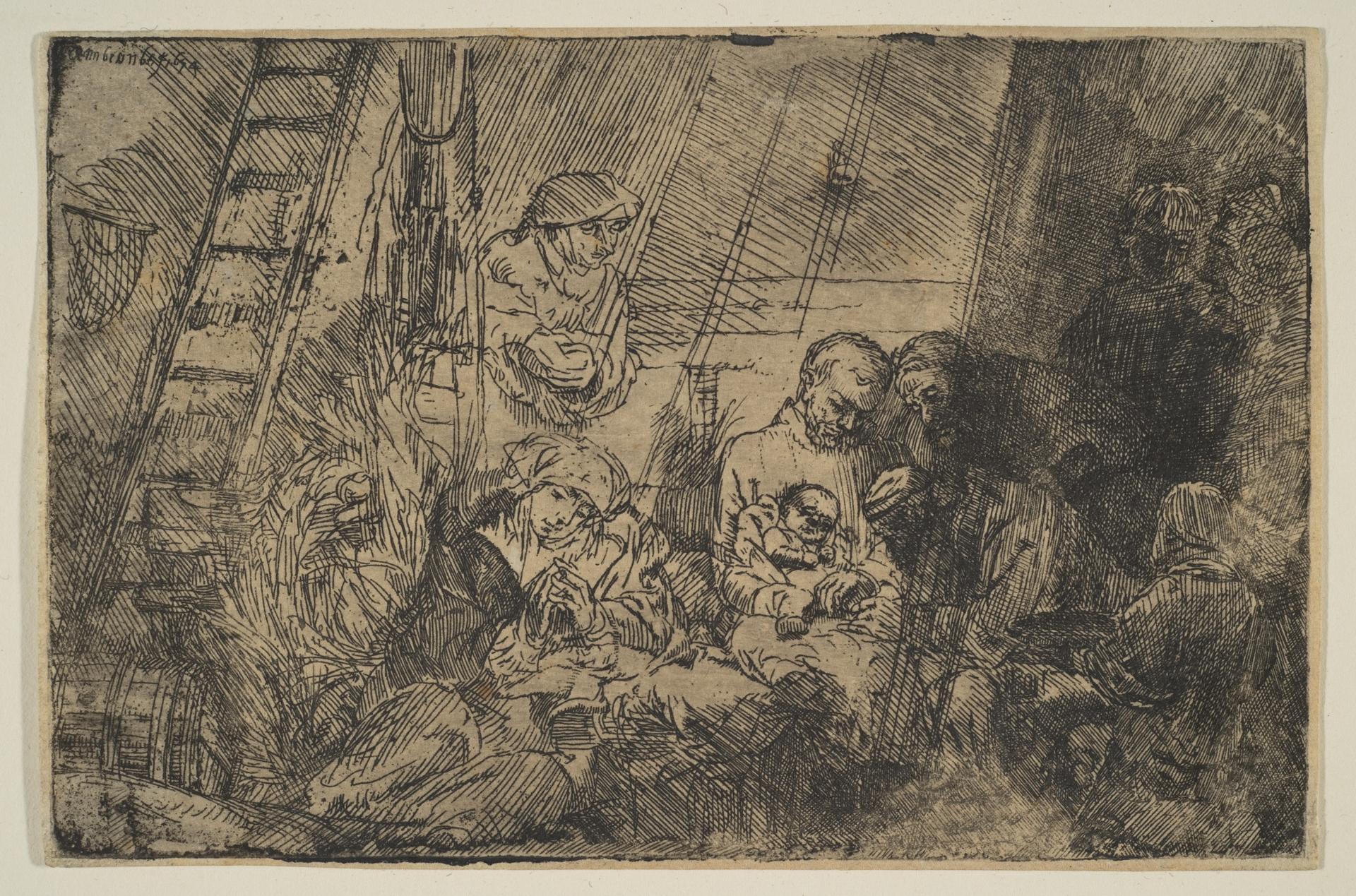
The Circumcision in the Stable
Original title: The Circumcision in the Stable
kurzbeschreibung
Where many of his contemporaries set the Circumcision of Christ in a temple or a sumptuous interior, Rembrandt in 1654 moves the scene into a plain stable. The etching, which exists in five states and is represented here by the third, places the biblical event in an everyday setting. The subject is worked out in fine etching technique.
Description
A naked child occupies the centre, being circumcised by a man with an instrument. Several figures in traditional dress stand around; some watch, others go about their own business. A staircase and the bare architecture of the stable can be made out behind them. Light falling from above casts distinct shadows and strengthens the sense of depth. Fine hatching and a strong contrast of light and dark govern the sheet.
Context
The print was made in Amsterdam in 1654, during a period of intense activity in Rembrandt's graphic work. It belongs among the biblical scenes he produced in the 1650s. In seventeenth-century Protestant art the Circumcision was an unusual subject, which underlines how independently Rembrandt chose his motifs.
Impact
The lighting of the sheet is as coherent as it is dramatic, drawing the eye to the action at the centre. The delicate etched lines give the scene detail and atmospheric density. What results is a quiet, devotional mood that draws the viewer into the biblical narrative.
Technique
The impression is the third of five states. In this process lines are bitten into a copper plate with acid, and the plate is then printed on paper; the fine lines and the contrast between light and dark areas are characteristic of Rembrandt's work as an etcher.
AI-generated description text
Source: Metropolitan Museum of Art · Public Domain (CC0 1.0)