The Adoration of the Shepherds: with the Lamp
Original title: The Adoration of the Shepherds: with the Lamp
kurzbeschreibung
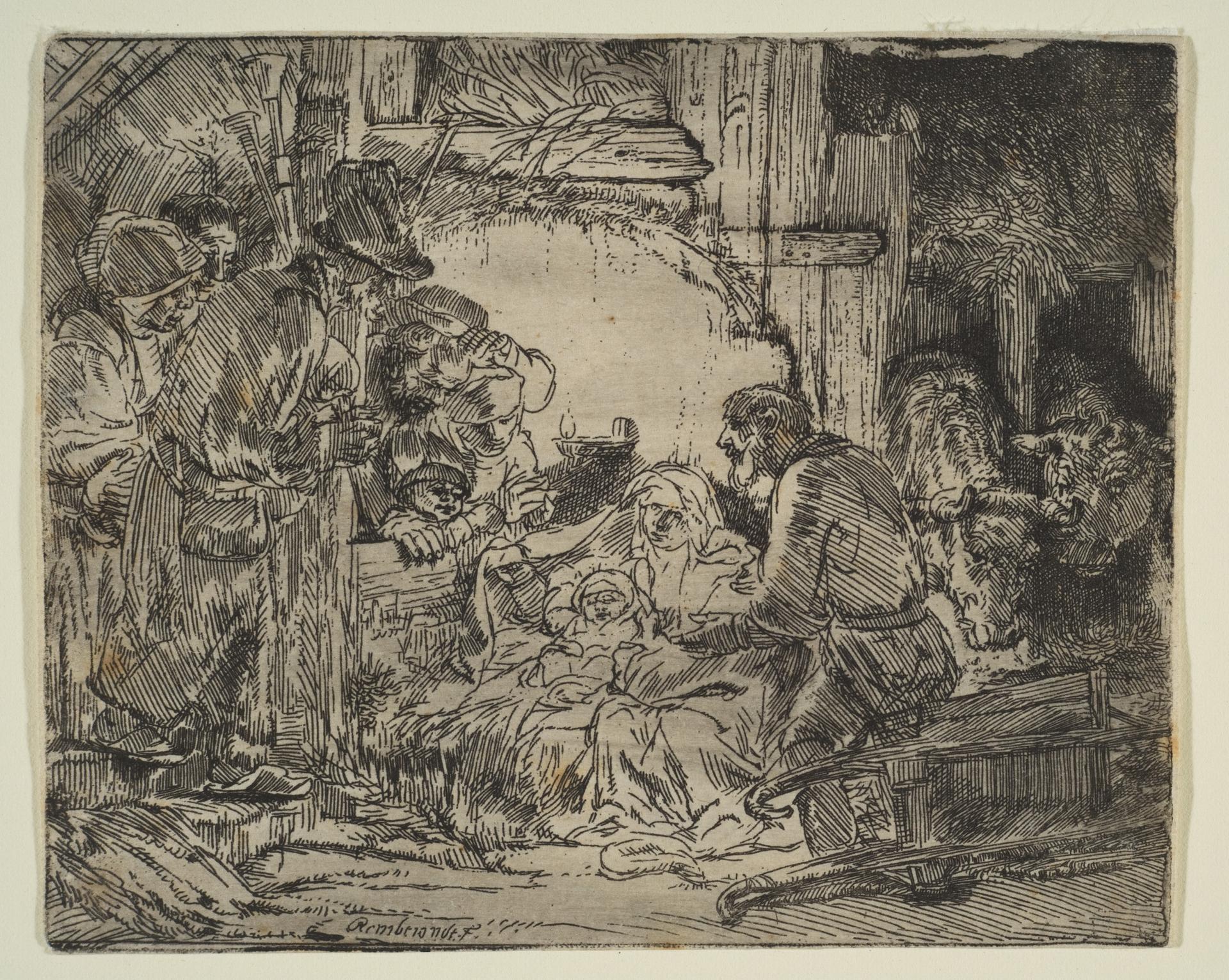
Rembrandt van Rijn's etching The Adoration of the Shepherds: with the Lamp sets the birth of Christ in a dark interior. Mary lies on a bed, with Joseph, the newborn child and several shepherds around her; one shepherd holds a lantern. The undated print was made as an etching with drypoint and plate tone and is the first of three states.
Description
Mary rests at the heart of the image on a bed, the newborn and Joseph beside her. Two shepherds stand to her left, one carrying a lantern whose thin light falls across the scene. To Mary's right another shepherd looks down at the child, while further figures in the background follow what is happening. The arrangement feels symmetrical, and the monochrome grey palette draws attention to the central event.
Context
Probably made in the 1650s, at a time when Rembrandt was deeply occupied with biblical scenes and the direction of light. The Adoration of the Shepherds was widespread in seventeenth-century Dutch art and gave him a chance to demonstrate his skill at rendering light sources at night. The sheet belongs to his printed work, which circulated widely during his lifetime and secured his reputation as one of the outstanding printmakers of his age.
Impact
The warm lantern light lifting the figures out of the darkness creates an intimate, devotional mood. Delicate lines and graded tones give the scene a quiet, almost meditative atmosphere. Viewers are drawn into the nocturnal event, which gains a timeless quality through its concentration on light and shadow.
Technique
For this sheet Rembrandt used etching with drypoint and plate tone, a process he often turned to for his prints. Drypoint leaves fine, slightly raised lines that produce a velvety effect in printing. Plate tone, a film of ink deliberately left on the plate, creates soft transitions and atmospheric depth in the shadowed areas.
AI-generated description text
Source: Metropolitan Museum of Art · Public Domain (CC0 1.0)