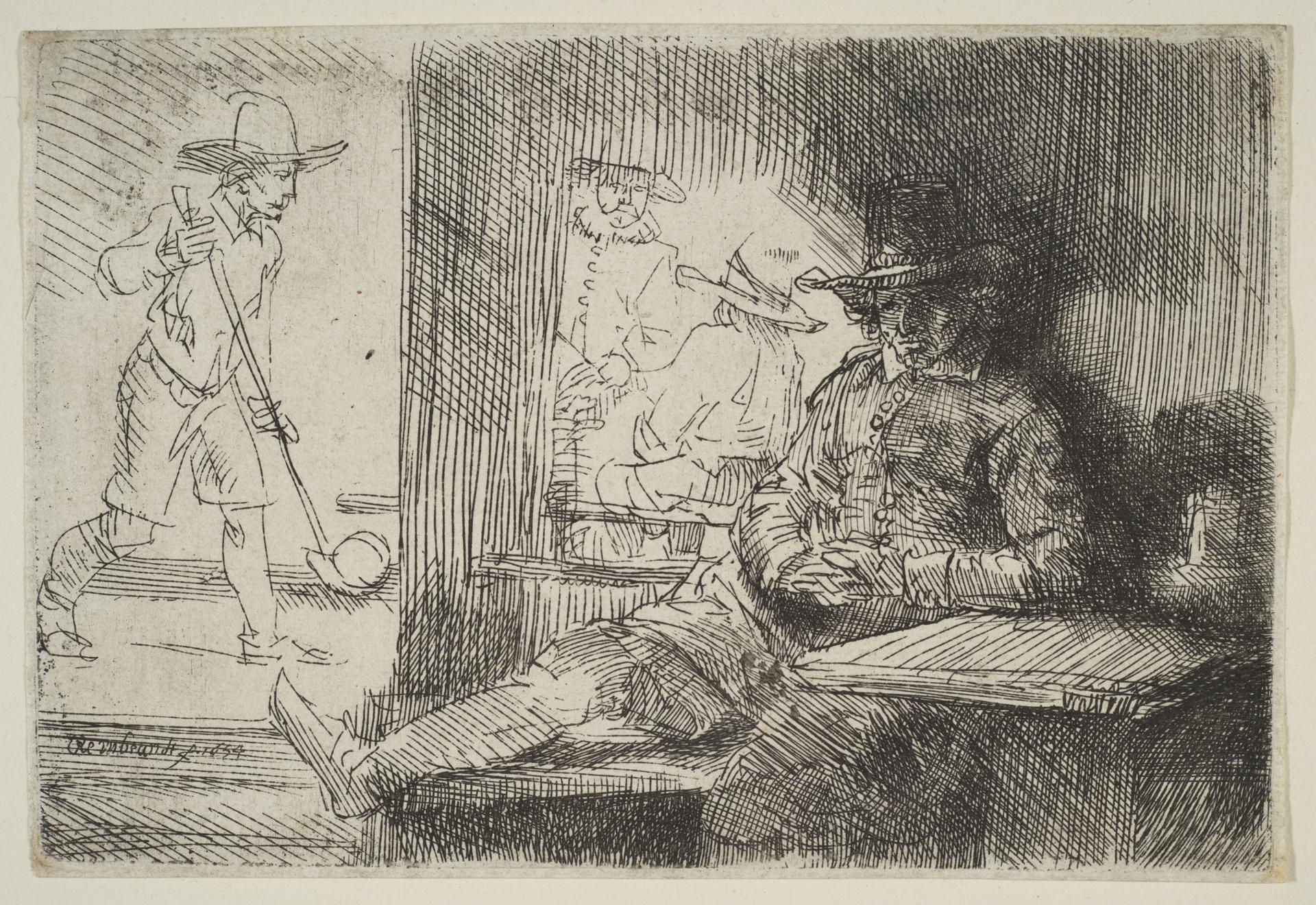
The Golf-Player
Original title: The Golf-Player
kurzbeschreibung
An etching from 1654 by Rembrandt van Rijn, preserved in the first of two states: the print leads into an interior with four figures, the person at lower left furnished with a golf club and ball. Isolated motifs of this kind recur several times among Rembrandt's prints of the 1650s.
Description
At lower left a figure sits wearing a hat and jacket, club and ball in hand. Three further people, also hatted and jacketed, occupy the rear area and appear to be talking together. The layout is deliberately unbalanced and directs the gaze to the seated figure. An open door hints at a second room where the others have taken their places. Monochrome throughout, the sheet uses hatching and shifting illumination to articulate figures and space.
Context
The etching was made in Amsterdam in 1654, during a period when Rembrandt devoted himself intensely to printmaking. A golfer as a subject feels odd, since golf was less widespread in the seventeenth-century Netherlands than other games. One might read it as a scene of everyday urban life, of a kind that appears more often in his graphic work. Only a few impressions of the first state survive; it documents how carefully Rembrandt reworked his plates.
Impact
A familiar, almost genre-like mood surrounds the print and draws the viewer into the room. Strong contrasts of light and dark and the delicate stroke work contribute to a calm, collected effect. Because the arrangement is asymmetrical, a natural tension arises that lets the eye wander between foreground and rear area.
Technique
Etching on a copper plate, its lines modelled into differentiated tones through fine hatching and cross-hatching. The impression was taken on paper and trimmed to a sheet of 9.8 × 14 cm, as was usual for Rembrandt's small-format prints.
AI-generated description text
Source: Metropolitan Museum of Art · Public Domain (CC0 1.0)