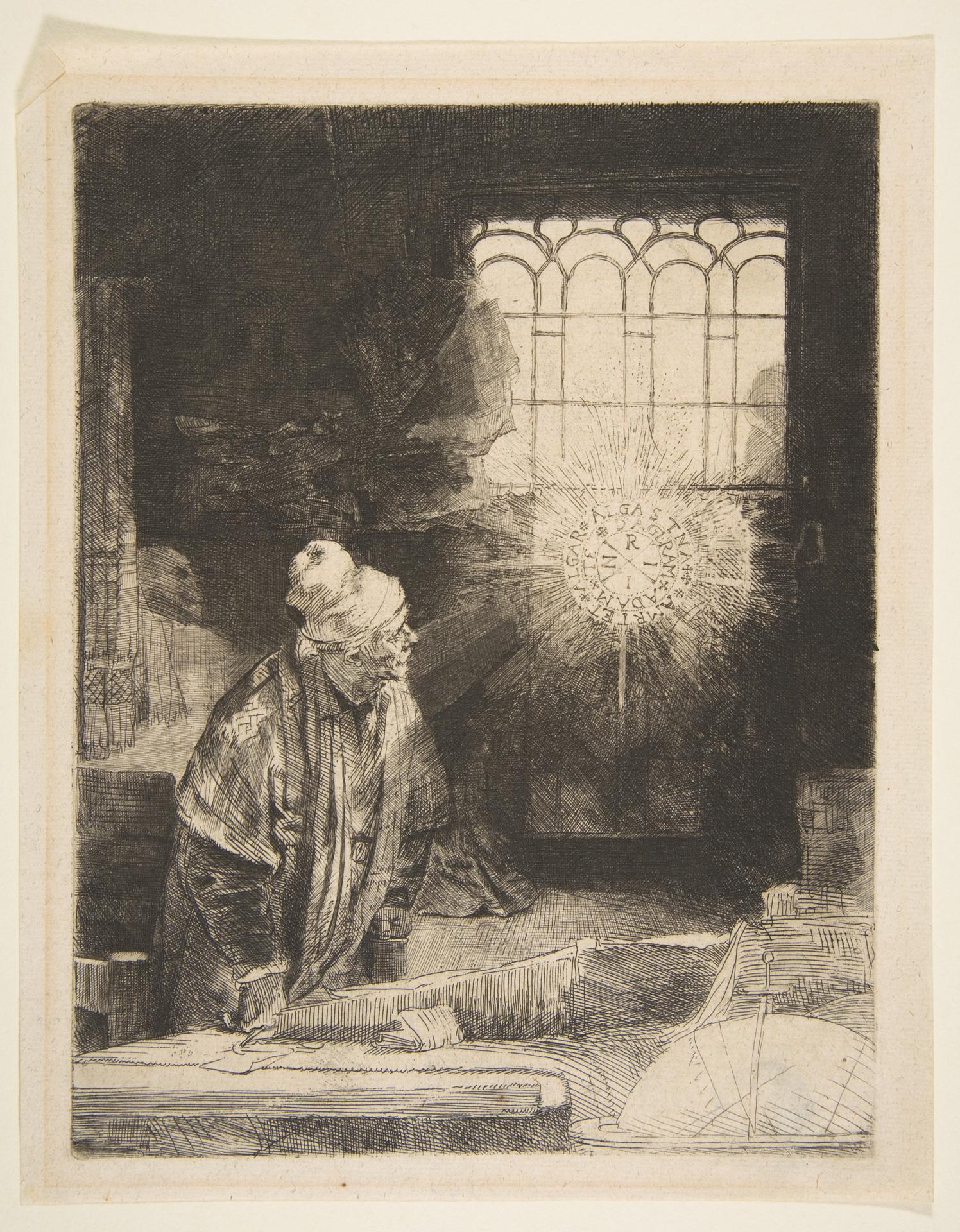
Faust (ca. 1652, Met-Objekt 5346)
Original title: Faust
kurzbeschreibung
Rembrandt van Rijn made this etching around 1652, working in etching, engraving and drypoint; it is the fourth of seven states. The image holds a puzzling scene: a figure reading or writing in a dim room, before a window from which a bright, geometrically shaped form emerges.
Description
A figure in cap and jacket sits at a table, bent over a sheet bearing Latin characters. Behind, a window opens onto a multi-part geometric pattern surrounded by a radiant halo. Little light enters through the opening, yet it lifts the figure and paper into strong chiaroscuro. The layout feels asymmetrical: person in front, window behind. Fine hatching and cross-hatching make the surfaces of the scene tangible.
Context
This print belongs to Rembrandt's late Amsterdam years, a period when he tested printmaking intensively. The title "Faust" was not given by the artist; it came later, when the motif was linked to the Faust legend. Several states of the print exist, suggesting careful reworking by Rembrandt. What the scene means exactly remains unresolved.
Impact
A dense, dark mood settles over the sheet and draws the eye to the figure's quiet absorption. Light and shadow work against each other, and the strange glow at the window gives the whole something suggestive, almost supernatural. Standing before the etching, one senses the tense stillness of the moment.
Technique
Rembrandt combined etching, engraving and drypoint to achieve fine lines and soft transitions. Drypoint leaves characteristic, slightly raised ridges in the print that feel velvety. The fourth of seven states shows how far the plate had already been reworked and allows Rembrandt's precise procedure to be followed.
AI-generated description text
Source: Metropolitan Museum of Art · Public Domain (CC0 1.0)