Faust (ca. 1652, Met-Objekt 5345)
Original title: Faust
kurzbeschreibung
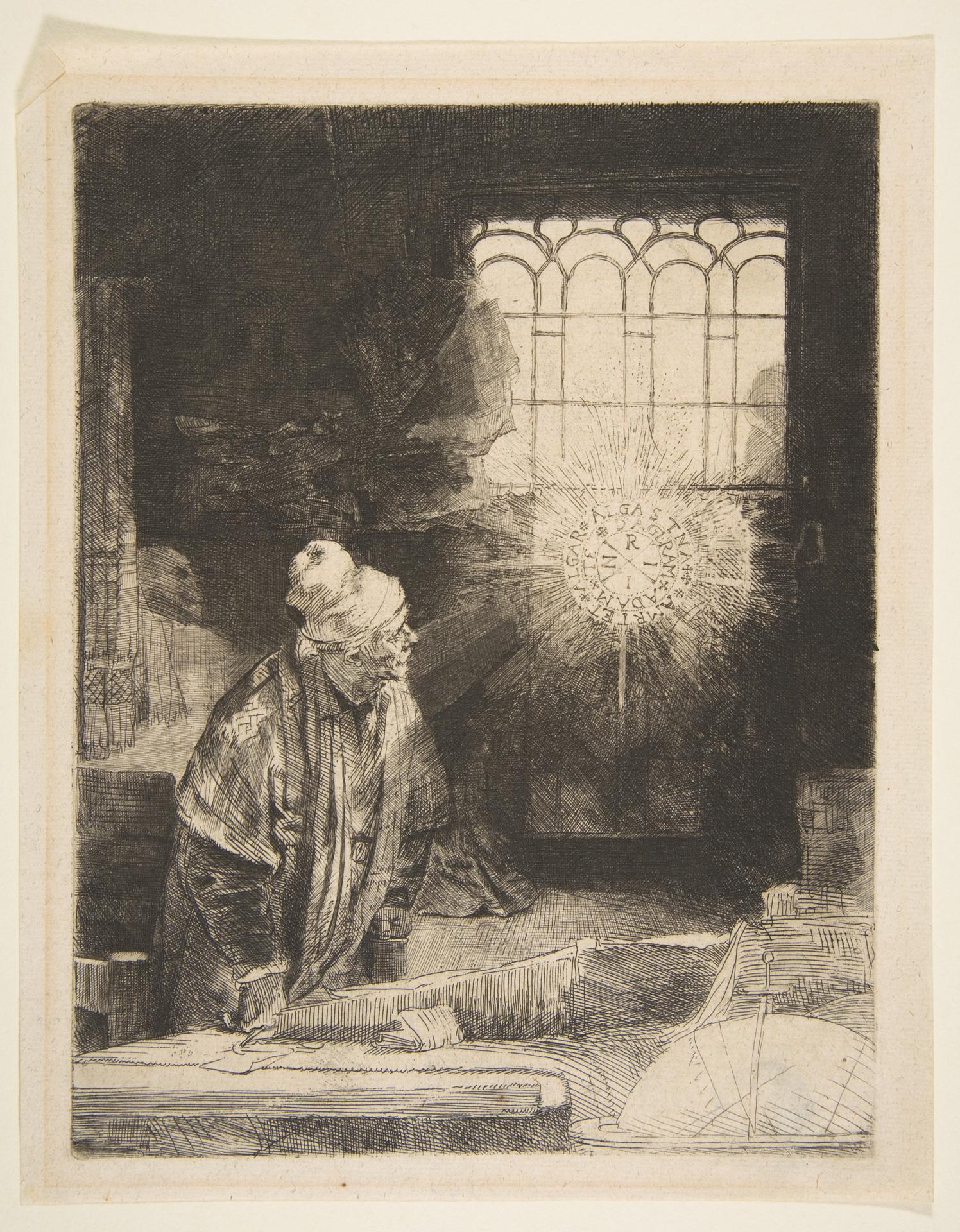
Rembrandt's etching Faust, made around 1652, presents a scholar in his study, sunk in thought. The print combines etching, engraving and drypoint; this is the first of seven states.
Description
On the left, a figure in a cap and jacket sits in a dark room, gazing thoughtfully into the distance. Books and a quill lie on the table before him. To the right, behind him, a window with a multi-part pattern is suggested, and through it falls a beam of light that seems to emanate from a dial set into the window. The black-and-white of the reproduction lives from dense, varying strokes; the layout is asymmetrical, with the figure placed to the left and the window with its light to the right.
Context
Rembrandt made this print during his mature Amsterdam period, when he engaged closely with biblical and allegorical subjects. The Faust story was widespread in the seventeenth-century Netherlands, yet Rembrandt found his own interpretation. The work dates from a time when he was experimenting with printmaking techniques and using drypoint more often.
Impact
The interplay of light and shadow gives rise to a quiet, enigmatic mood. The dense working and delicate lines lend the print a strong sense of spatial depth.
Technique
The print was taken from an etched plate that was further worked with engraving and drypoint. Drypoint leaves soft, velvety lines, while etching allows fine transitions between light and dark. That several printing techniques come together in a single work reflects Rembrandt's experimental approach.
AI-generated description text
Source: Metropolitan Museum of Art · Public Domain (CC0 1.0)