Peasant Family on the Tramp
Original title: Peasant Family on the Tramp
kurzbeschreibung
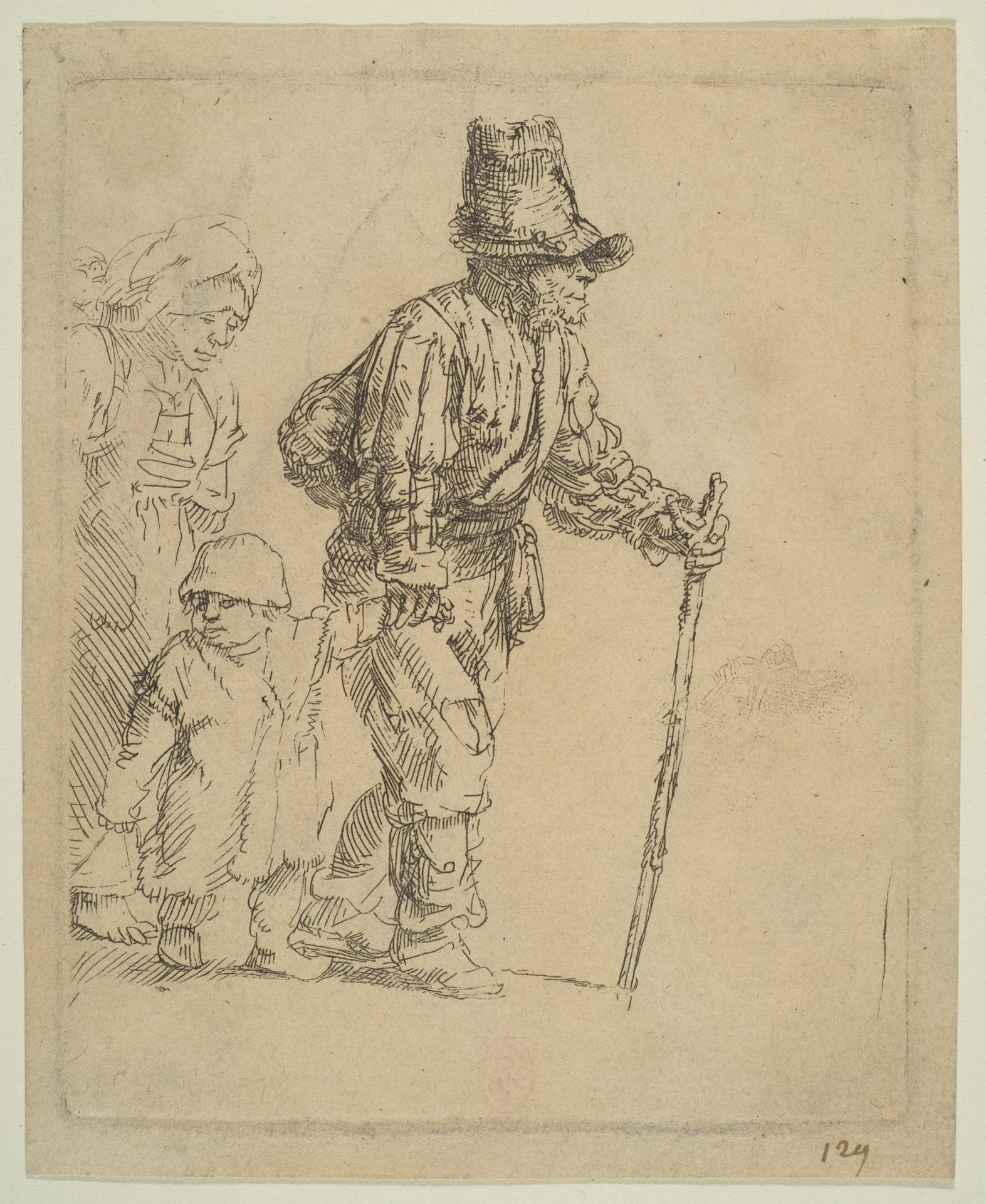
Three figures, understood as a peasant family, walk along a country road. Rembrandt van Rijn etched this motif around 1652. The impression is the second of three states.
Description
A man in a broad hat comes first, carrying a staff; beside him a child in a cap; behind them a woman with a headscarf. Their clothing is plain and practical, and the man's trousers are slit at the knees and lower legs. Daylight gives even brightness without strong shadows. The image stays black and white, and dense, realistic lines bring out the texture of the fabrics clearly.
Context
In the early 1650s Rembrandt turned more often to ordinary people. The peasant family belongs with works about rural life. Such subjects were common in seventeenth-century Dutch art and often carried a moralizing or socially critical note. Within Rembrandt's printed oeuvre, which he developed alongside painting, this sheet has a firm place.
Impact
The scene feels calm and dignified, without sentimental heightening. The clear layout and even light give it something timeless, almost monumental. The viewer's gaze is drawn to the simple appearance of the figures, which stand out with sculptural presence through the detailed linework.
Technique
Rembrandt made this etching by working the drawing into a metal plate, which was then bitten with acid. In this way he achieved fine lines and shading that closely reproduce the materiality of the clothing and facial features. The second state marks an intermediate stage of the printing process: the plate had already been reworked but was not yet finally finished.
AI-generated description text
Source: Metropolitan Museum of Art · Public Domain (CC0 1.0)