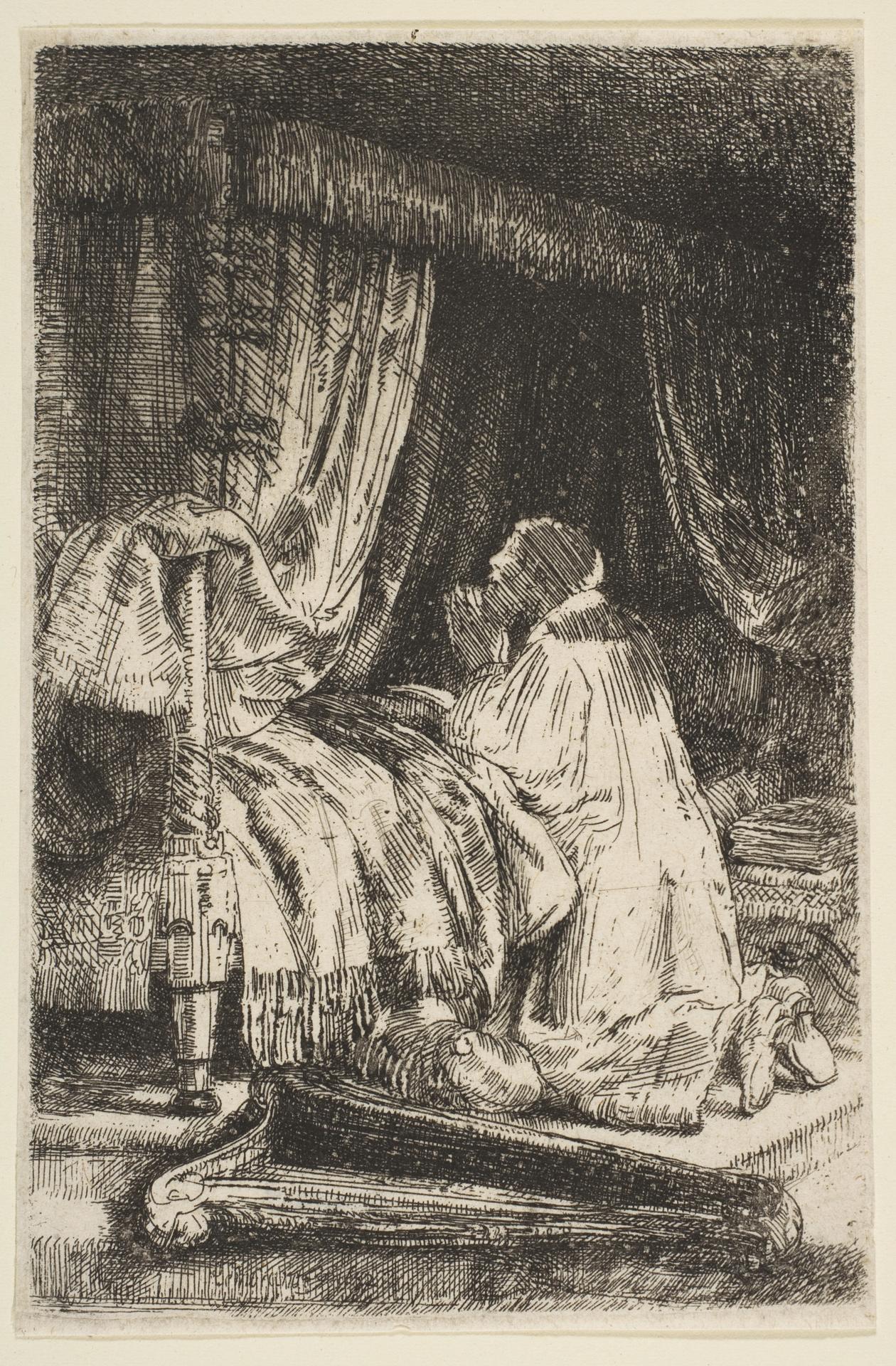
David in Prayer
Original title: David in Prayer
kurzbeschreibung
Unlike many related sheets, Rembrandt's 1652 etching David in Prayer presents the biblical king not as a ruler but as a supplicant: David kneels in an interior with hands raised. Executed as an etching with drypoint, the print belongs among the artist's religious scenes.
Description
A bearded man in a long, hooded robe kneels in the foreground, hands folded in prayer. To the left stands an upright figure with a sword, which can be read as an angel or a guard. Curtains, a door, and a window divide the space; the arrangement feels deliberately unbalanced. Light falling from the side casts strong shadows and makes the folds of the fabrics clearly visible.
Context
The sheet dates from a period in Rembrandt's career when biblical themes and personal piety played a major role. David at prayer appears several times in his work, often with reference to the Psalms. This etching belongs to 17th-century Dutch art, in which biblical histories counted among the most important genres.
Impact
The kneeling prayer posture and the subdued light give the sheet an immediate, contemplative mood. A tension arises between the praying figure and the standing, armed one, yet it remains calm and does not disturb the devotion.
Technique
Rembrandt combines etching and drypoint in this print, producing delicate lines and soft, velvety shadows. The process opens a wide range of tonal values—from deep darks to light passages—and thus contributes to the spatial effect.
AI-generated description text
Source: Metropolitan Museum of Art · Public Domain (CC0 1.0)