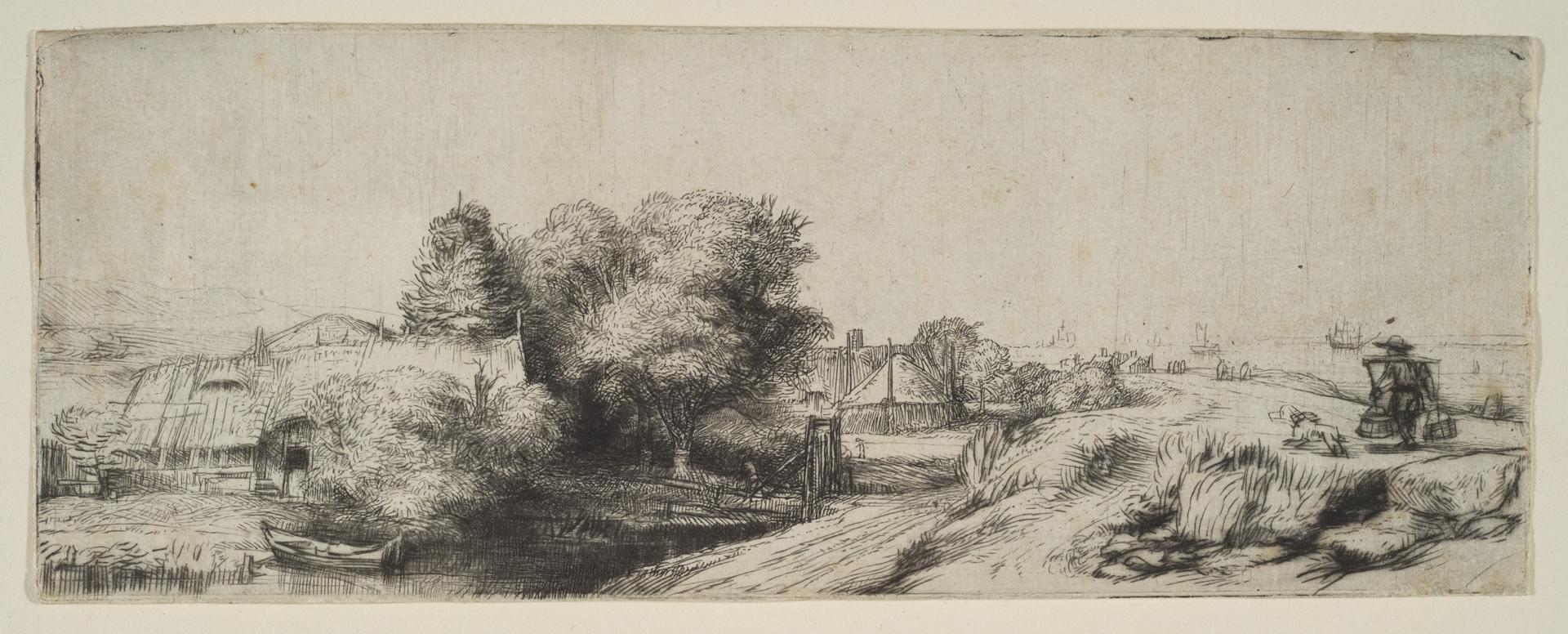
View of the Diemerdijk with a Milkman and Cottages ('Het Melkboertje')
Original title: View of the Diemerdijk with a Milkman and Cottages ('Het Melkboertje')
kurzbeschreibung
Rembrandt van Rijn made this etching with drypoint around 1650, in the third of three states. It opens onto a wide stretch of countryside along the Diemerdijk, with a river, cottages and the small figure of a milkman. The sheet measures 6.7 × 17.6 centimetres and belongs among Rembrandt's landscape etchings.
Description
The view spreads out broadly: a river with a boat lies in the foreground, several reed-thatched houses stand among trees on the left, and further buildings and clumps of trees step back into the distance. On the right a man carrying a pail and a broom — the milkman — walks along a field path, while distant ships can be made out on the water. Black on white, with evenly distributed light and hardly any shadow.
Context
The etching dates from around 1650, when Rembrandt was devoting close attention to landscape. The Diemerdijk lies near Amsterdam, where he had lived since 1639; the area was familiar to him and served him as a subject more than once. This sheet belongs to a series of landscape etchings from the 1640s and 1650s. Drypoint reworking appears in the third state, as is typical of later impressions.
Impact
A quiet, everyday mood comes across, characteristic of seventeenth-century Dutch landscape art. Delicate lines and the even spread of light give a clear, matter-of-fact atmosphere without drama. The viewer is left with the sense of a direct, true-to-nature observation of the landscape.
Technique
Etching with drypoint, third of three states. In etching the drawing is scratched into an acid-resistant layer on a copper plate and then bitten; drypoint produces soft, velvety lines. Printed on paper, the sheet measures 6.7 × 17.6 centimetres.
AI-generated description text
Source: Metropolitan Museum of Art · Public Domain (CC0 1.0)