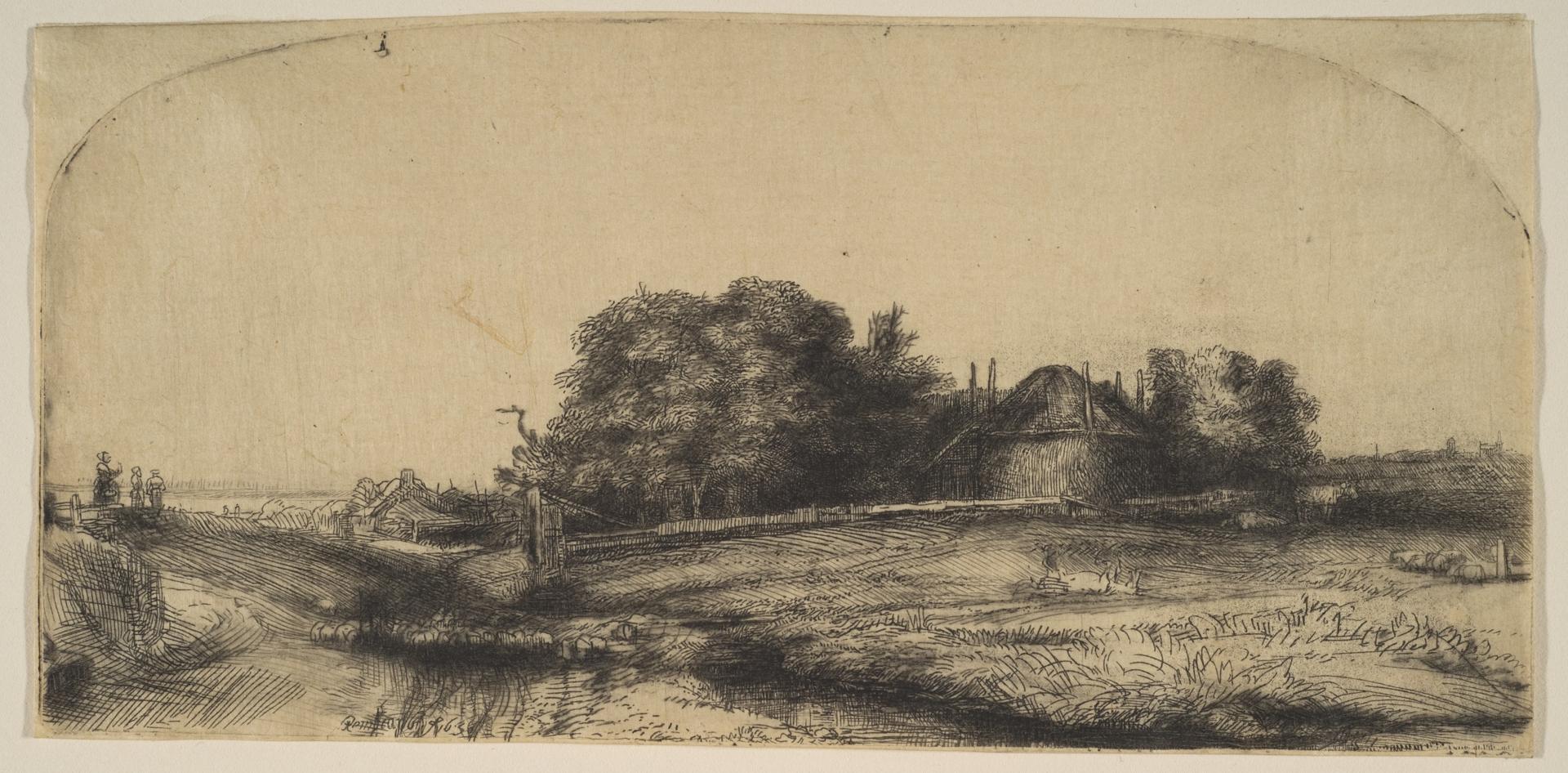
Cottages and a Hay Barn on the Diemerdijk with a Flock of Sheep
Original title: Cottages and a Hay Barn on the Diemerdijk with a Flock of Sheep
kurzbeschreibung
Unlike many of his pure river views, this 1652 etching with drypoint by Rembrandt ties pastoral farming to a specific place: the Diemerdijk. The eye travels across fields, a small stream and clusters of trees toward houses and a large barn. Two figures stand on a bridge while a flock of sheep moves along the path.
Description
A wide, flat landscape opens up, threaded by a narrow waterway that winds through the terrain. On the left, two figures cross a bridge over the stream. Beyond, several houses are staggered, including a striking round building with a thatched roof, read as a hay barn. Trees and shrubs frame the foreground edge and give the arrangement depth. Light falls evenly across everything, with no hard shadows, suggesting an overcast sky. Fine hatching articulates fields and foliage.
Context
The etching was made in 1652, during a period when Rembrandt was deeply engaged with landscapes. The Diemerdijk lies near Amsterdam, where he lived and worked. The subject belongs to a series of landscape etchings from the 1640s and 1650s. That two states of the plate survive shows Rembrandt reworked the effect afterward.
Impact
The sheet radiates a quiet, almost idyllic calm. Because the light is so evenly distributed and the lines remain fine, a contemplative mood arises. Without dramatic climax, the view places the beholder in the Dutch landscape of the 17th century, observed close to nature.
Technique
Rembrandt worked with etching and drypoint; the plate survives in two states. Fine lines and hatching serve him to draw out the fabric of trees, fields and buildings. Drypoint allowed stronger, velvety lines with which he accented the dark passages.
AI-generated description text
Source: Metropolitan Museum of Art · Public Domain (CC0 1.0)