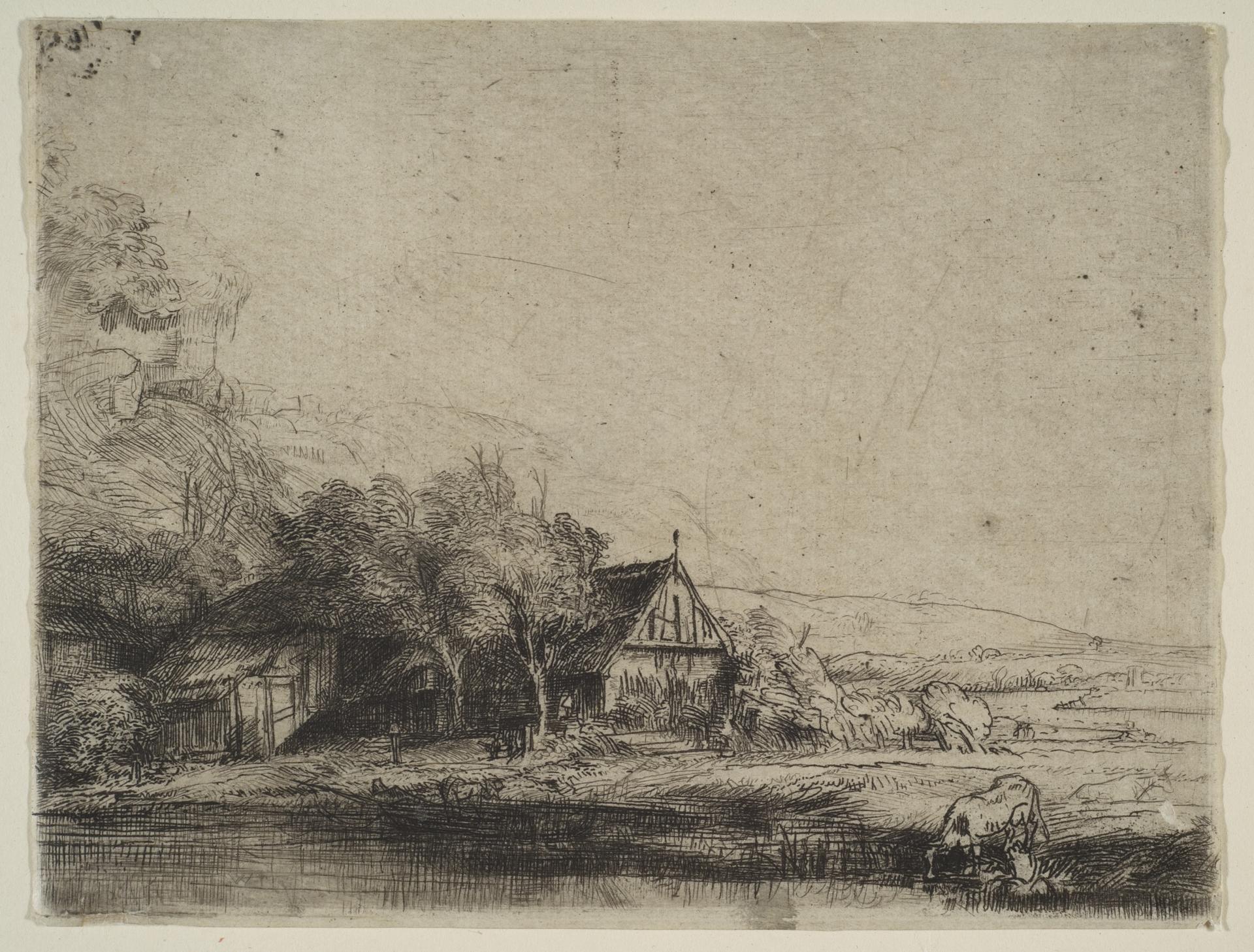
Landscape with a Cow Drinking
Original title: Landscape with a Cow Drinking
kurzbeschreibung
Rembrandt van Rijn made "Landscape with a Drinking Cow" as an etching; the year of creation is not recorded. The print presents a rural scene: a single cow drinks from a pool, with a farmstead of buildings and trees rising behind it. The execution combines etching and drypoint; this impression is the third of five states and was reworked by Claude-Henri Watelet.
Description
A lone cow stands at the lower right edge of the image, drinking from a pool, while a farmstead stretches out in front of it. Several buildings can be made out beyond, including a large house with a steep roof and outbuildings. Trees and bushes are worked in detail up to the horizon; the landscape remains flat, with gentle hills. Various shades of gray dominate the monochrome image, and the light is evenly distributed, with neither strong shadows nor highlights.
Context
In the 1640s Rembrandt produced a series of landscape etchings, often taking motifs from the rural surroundings of Amsterdam. In the 18th century the French collector and printmaker Claude-Henri Watelet reworked Rembrandt's plates so that they could be printed again. At about 9.8 × 12.9 cm, the small format is entirely in keeping with Rembrandt's etched landscapes, which were intended for collectors' prints.
Impact
A quiet, idyllic mood emanates from the calm, evenly lit scene. The fine lines of etching and drypoint create a detailed, true-to-nature rendering that draws the viewer into the rural setting. The monochrome gray palette emphasizes the drawing-like quality and directs attention to the precise capture of the landscape.
Technique
Etching and drypoint come together here; this impression is the third of five states and was reworked by Claude-Henri Watelet. In etching, acid bites the lines into the copper plate, while drypoint allows direct scratching that produces soft, velvety effects. The sheet measures 9.8 × 12.9 cm—a trim that suggests a deliberate presentation of the printed image.
AI-generated description text
Source: Metropolitan Museum of Art · Public Domain (CC0 1.0)