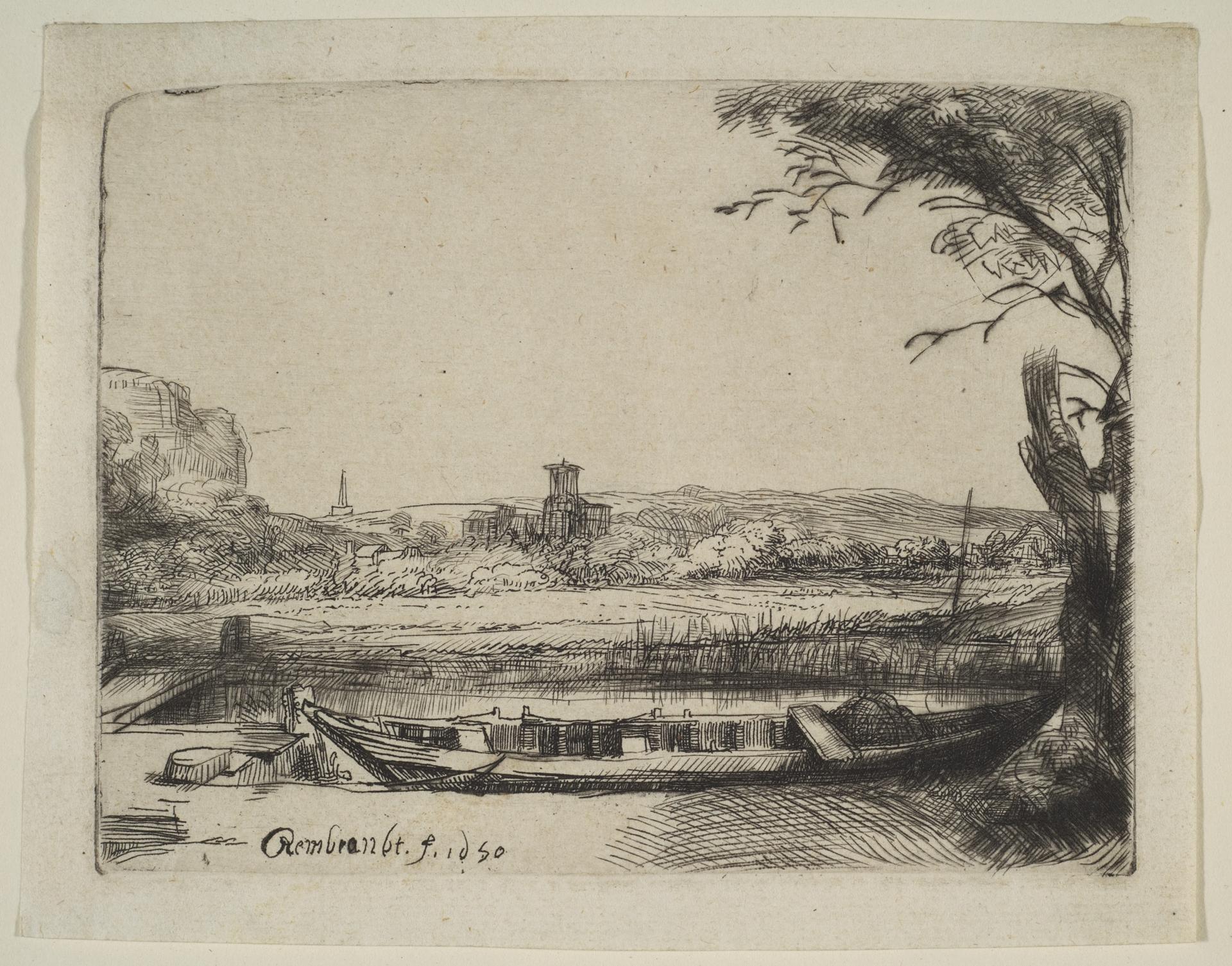
Canal with a Large Boat and a Bridge
Original title: Canal with a Large Boat and a Bridge
kurzbeschreibung
Rembrandt van Rijn made this etching with drypoint in 1650. A canal, a large boat in the foreground, a bridge, and hills with a tower in the distance are depicted. The impression is the second of two states.
Description
The layout stretches wide, with the canal holding the middle. A large boat sits on the water in front; a rock formation frames the left, and a tree with branches appears at the upper right. Hills and a tower emerge in the distance, suggested by fine lines. The black-and-white image uses varying line thickness and hatching to create shading and texture. Calm and openness emanate from this landscape.
Context
The print was made in 1650, during a period when Rembrandt was deeply engaged with landscape etching. He often worked around Amsterdam, where canals and rural motifs were part of his everyday world. This etching belongs to a series of small landscape prints made in the 1640s and 1650s. In the second state, reworkings are visible that increase the contrast.
Impact
The etching feels intimate and almost sketch-like, yet precisely observed. Fine lines and graduated tones produce a quiet, atmospheric mood. The small format demands close looking and draws attention to Rembrandt's craftsmanship.
Technique
An etching with drypoint, in the second of two states. Etched lines combine with drypoint scratches that yield soft, velvety effects. Printed on paper; the plate size of 8.2 × 10.8 cm corresponds to the small format.
AI-generated description text
Source: Metropolitan Museum of Art · Public Domain (CC0 1.0)