Medea: or The Marriage of Jason and Creusa
Original title: Medea: or The Marriage of Jason and Creusa
kurzbeschreibung
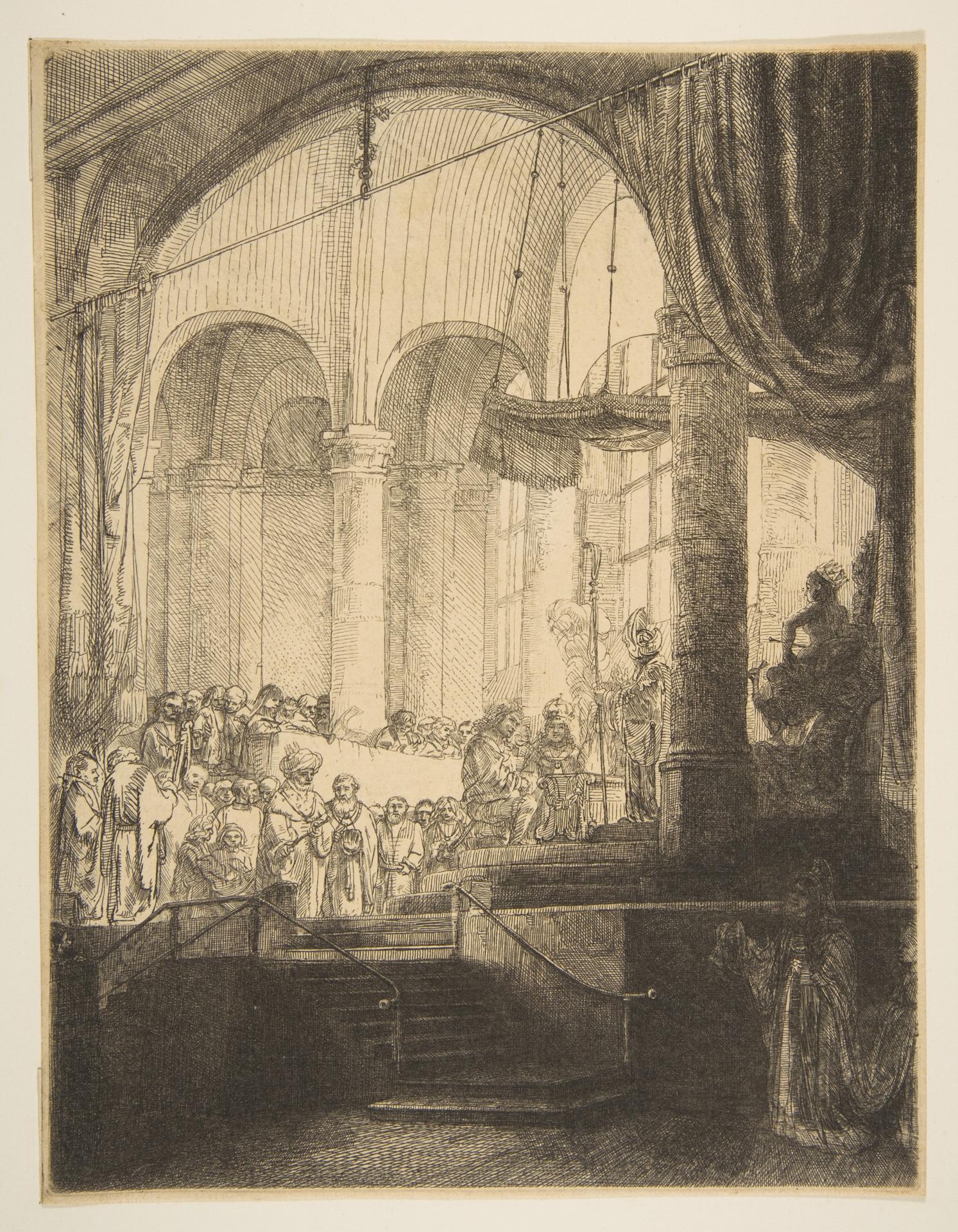
Rembrandt van Rijn made this etching, Medea: or The Wedding of Jason and Creusa, in 1648. It shows the wedding celebration of the two mythological figures. The print is the fifth state of five and combines etching with touches of drypoint. Its dimensions are 23.3 × 17.8 cm.
Description
A large hall with arcades and columns, where Gothic and Renaissance forms meet, sets the stage. A staircase in the foreground leads up to a raised platform, where a group of people in traditional dress has gathered. Several figures wear head coverings, suggesting a ceremonial or historical occasion. On the right, a statue or sculpture is worked into the scene. The monochrome palette and subdued light emphasize shading and contrast.
Context
The print was made in Amsterdam in 1648, when Rembrandt was turning more and more to biblical and mythological subjects. The story of Medea was familiar in the seventeenth century through Seneca's tragedy; it is conceivable that Rembrandt had a theatrical performance or a pictorial model in mind. This etching offers a rare depiction of the wedding scene, which in ancient myth comes to a tragic end. It belongs to several of Rembrandt's works that take up the Medea–Jason material.
Impact
Fine lines and restrained lighting create a somber, almost threatening mood that foreshadows the tragic end of the wedding. The detailed architecture and the arrangement of the figures give the print a theatrical presence that draws the viewer into the action. Contrasts between light and dark heighten the emotional tension of the moment.
Technique
Etching with touches of drypoint allows for fine and precise linework. Through biting and drypoint, different tonal values and textures can be produced. The fifth state contains additional drypoint work that further refines the shading and details.
AI-generated description text
Source: Metropolitan Museum of Art · Public Domain (CC0 1.0)