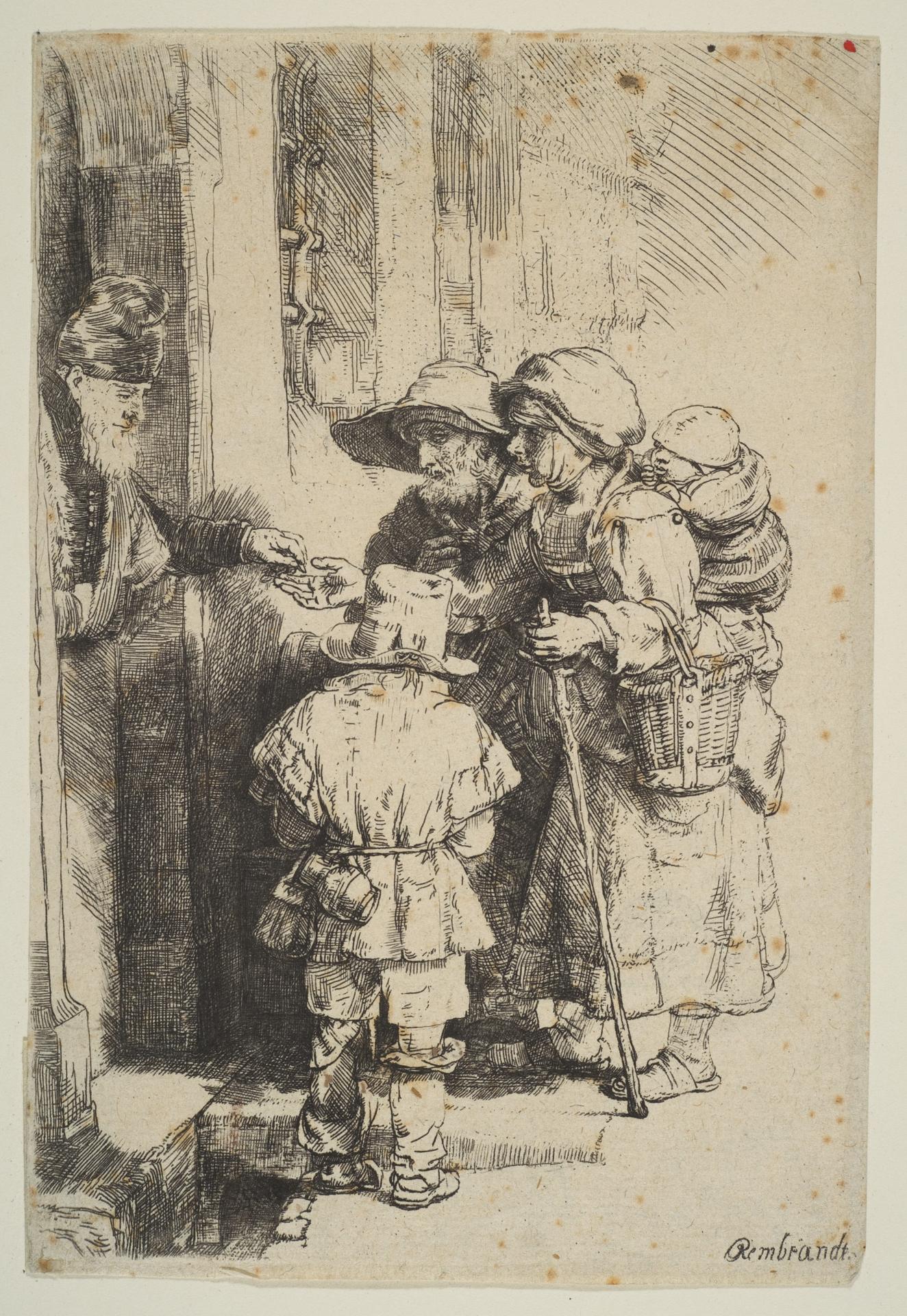
Beggars Receiving Alms at the Door of a House
Original title: Beggars Receiving Alms at the Door of a House
kurzbeschreibung
Unlike many beggar studies of its time, Rembrandt's 1648 print brings the act of giving itself into view: a group of alms recipients presses at a house door where they are being given charity. The work is an etching, reworked with burin and drypoint; the third of five states is preserved here.
Description
A bearded man in a hat anchors the middle, his hand extended as if he were the one dispensing. Beside him a child in plain dress pushes forward with an outstretched hand, while a second child in a hat holds out a bowl. On the left another bearded man in a doublet passes along a gift. A door with wooden and metal ornaments frames the group; the figures wear ordinary clothing. Subdued light falls across the whole, giving the arrangement a certain restraint.
Context
The etching was made in Amsterdam in 1648, during a period when Rembrandt was deeply engaged with biblical and social subjects. Beggar depictions belonged to the standard repertoire of the seventeenth-century Netherlands and brought the social circumstances of the era into the picture. That the print exists in five states, with the third shown here, points to thorough, step-by-step reworking by the artist himself.
Impact
Despite the hardship the motif presents, the sheet radiates a composed, dignified mood. Clearly set lines and restrained light direct the eye to the giving and receiving, creating an intimate atmosphere that invites pause.
Technique
Etching was the base, afterward deepened with burin and drypoint. The sharp lines and fine grain of the ink are among the hallmarks of this process. In the third state the etching appears further worked through, which makes details in the clothing and the door ornament stand out more clearly.
AI-generated description text
Source: Metropolitan Museum of Art · Public Domain (CC0 1.0)