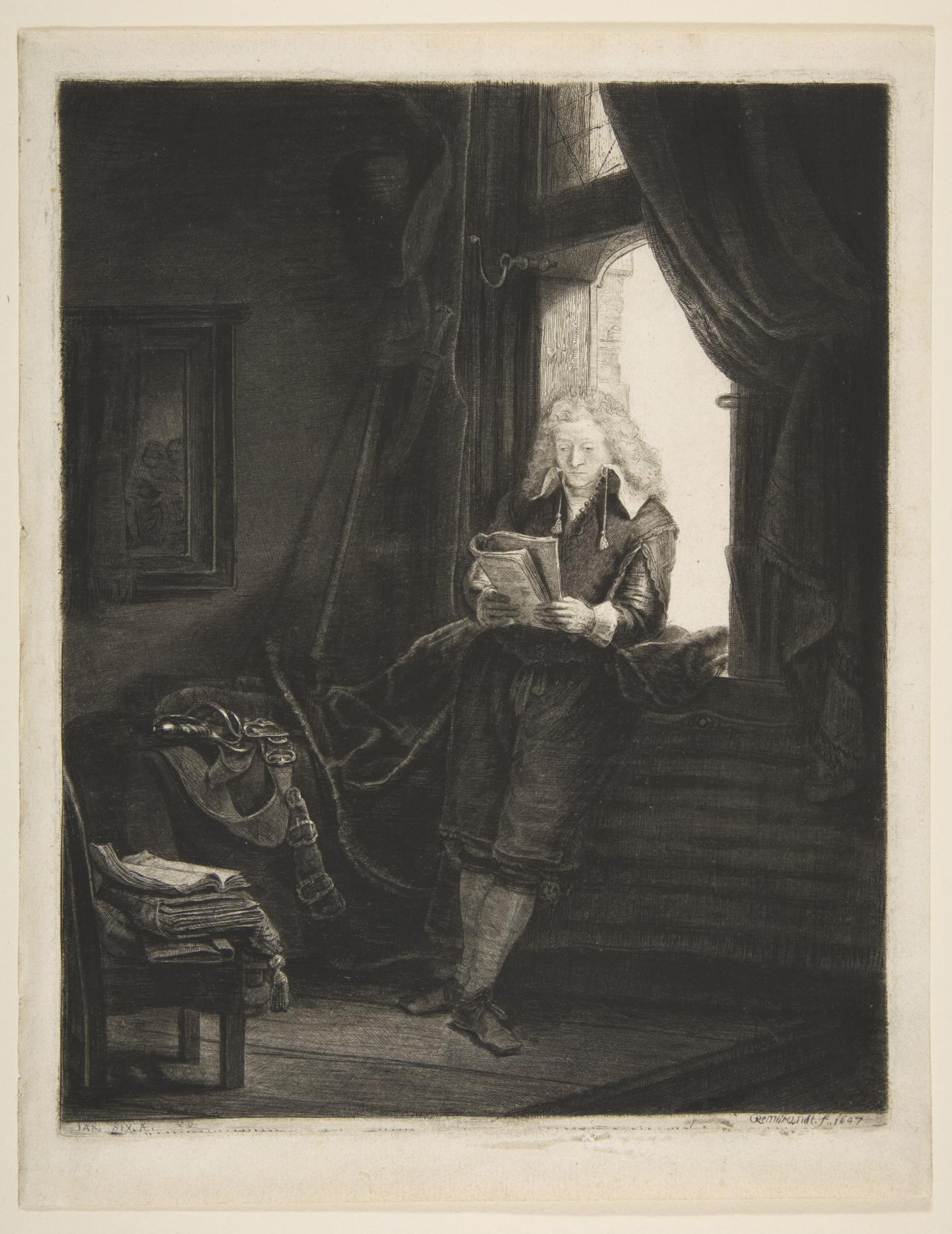
Jan Six (1647, Met-Objekt 5326)
Original title: Jan Six
kurzbeschreibung
Rembrandt's etching Jan Six, made in 1647, places the Amsterdam art collector and future mayor in an interior, absorbed in a book. The print combines etching, engraving and drypoint and survives here in the fifth of five states.
Description
A man sits in a room reading. His shirt has rolled-up sleeves, and he wears trousers and shoes; long, curling hair frames his face. Several books rest on a chair beside him. A window with half-drawn curtains lets in daylight. Dark, muted tones dominate, strong shadows meeting pale passages. The arrangement feels balanced: the reader holds the middle, the books are grouped to the left.
Context
Jan Six (1618–1700) was a wealthy Amsterdam merchant, art collector and later mayor. Rembrandt portrayed him around 1647 in this etching, one of his best-known prints. Six appears at a private, intellectual occupation, which underlines his role as a patron of art and literature. The print went through five states; the fifth shows the fully worked-out version.
Impact
The reader's calm, concentrated posture and the dark, intimate atmosphere make the image remarkably alive. Light and shadow draw the eye to face and hands and create a quiet, thoughtful mood. The viewer gains the impression of a moment of private scholarship that makes the sitter both distinguished and human.
Technique
Rembrandt combined etching, engraving and drypoint to achieve fine lines and soft tonal values. Drypoint leaves its characteristic, slightly raised lines, which print with a velvety quality. Dense hatching and targeted biting produce the dark shadow areas and give the sheet a deep, painterly quality.
AI-generated description text
Source: Metropolitan Museum of Art · Public Domain (CC0 1.0)