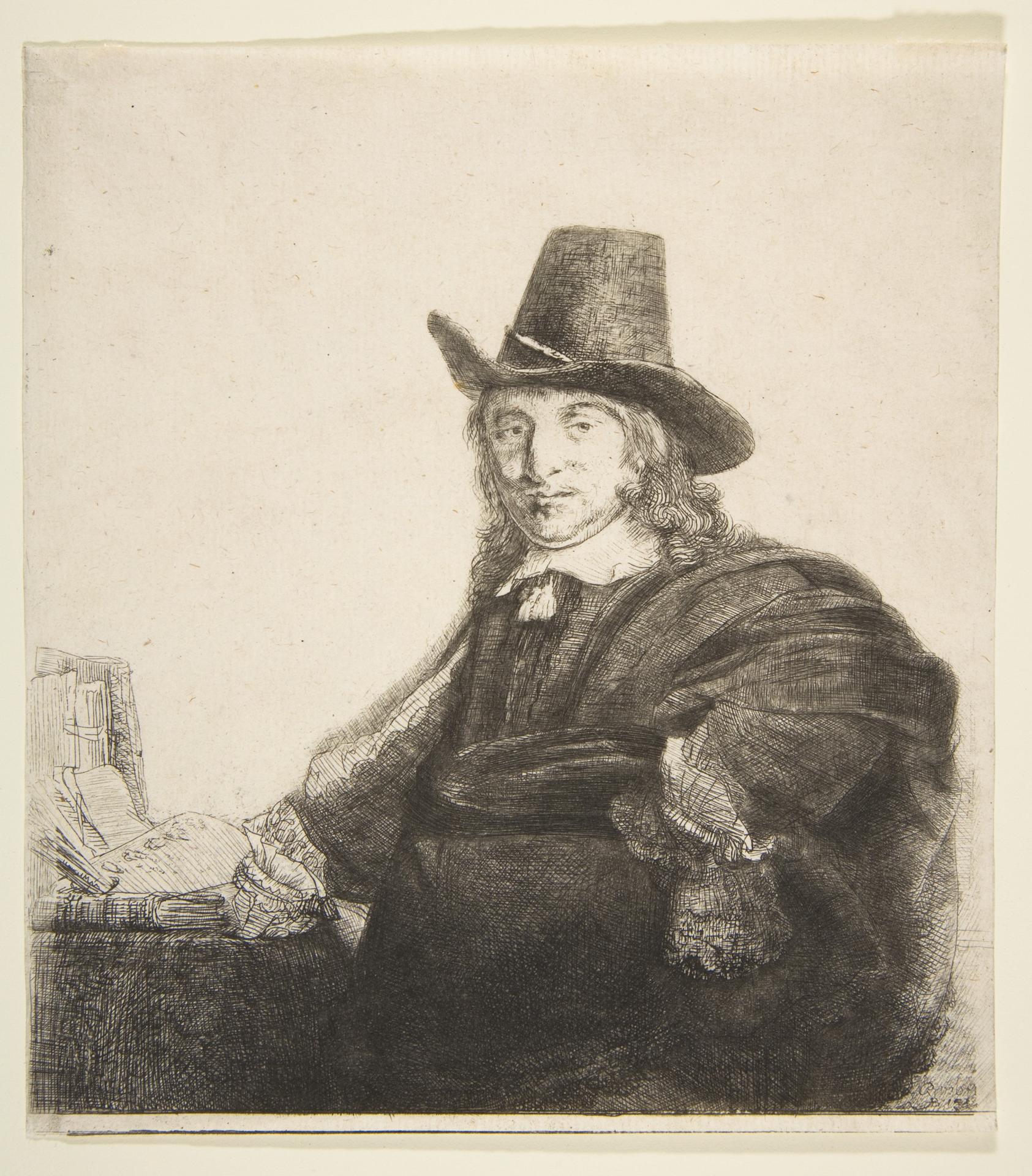
Jan Asselijn, Painter (Krabbetje) (ca. 1646, Met-Objekt 5324)
Original title: Jan Asselijn, Painter (Krabbetje)
kurzbeschreibung
Around 1646 Rembrandt portrayed the painter Jan Asselijn, known as "Krabbetje", seated with a book. The print combines etching with drypoint and burin work, and this sheet is the second of seven states.
Description
Asselijn sits holding a book in his left hand. A tall hat with a wide brim rests on his head, and his clothing draws attention through a striking collar and cuffs at the sleeves. His face carries a calm, thoughtful expression. The setting behind him stays plain, while light falling in from the side picks out contours and textures. Everything is rendered in monochrome shades of grey.
Context
The Dutchman Jan Asselijn suffered from a physical disability that earned him the nickname "Krabbetje" (little crab). This portrait probably dates from Asselijn's Amsterdam years in the 1640s, a period when Rembrandt turned more and more to printmaking and tested how different techniques might be combined.
Impact
A quiet, intimate mood emanates from the sheet. The detailed execution and the raking light give the portrait a sculptural presence. The sitter's pensive look invites the viewer to linger.
Technique
Rembrandt began the work as an etching and then reworked it with drypoint and burin, which allowed for fine lines and soft tonal values. Several states were printed from the plate; the second state seen here represents an early version.
AI-generated description text
Source: Metropolitan Museum of Art · Public Domain (CC0 1.0)