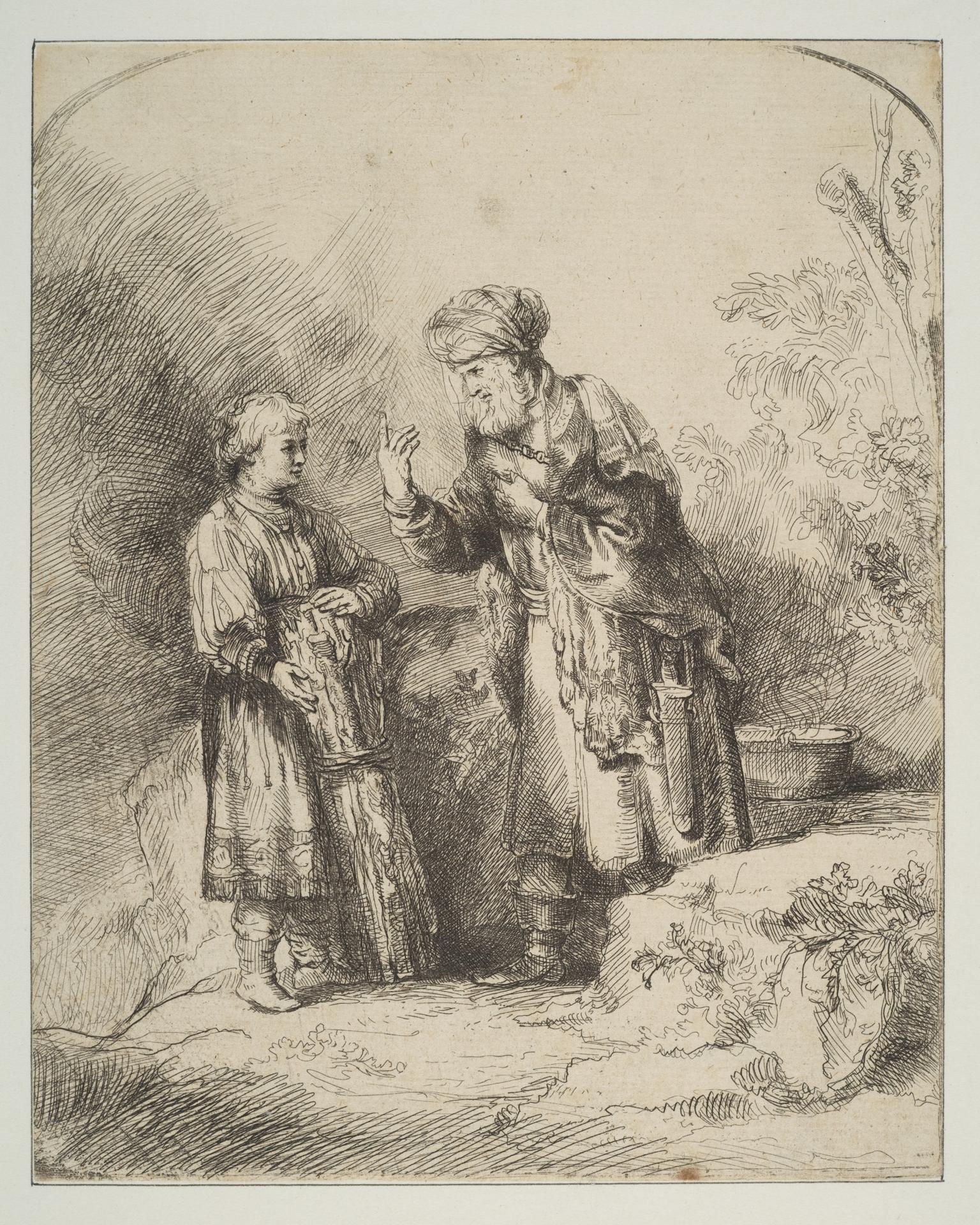
Abraham and Isaac (reverse copy)
Original title: Abraham and Isaac (reverse copy)
kurzbeschreibung
Rembrandt van Rijn made this etching, which presents Abraham and Isaac in a biblical episode. The sheet survives as a reverse copy (copy b II), a technique that suggests either a reproduction or a repeat pulled from an earlier design. In the scene Abraham points upward while Isaac looks at him; both stand in a landscape. No date is recorded.
Description
The layout feels asymmetrical: Abraham is placed on the left, Isaac to the right near the middle. Abraham raises his right hand toward heaven, and Isaac gazes up at him; both wear garments that recall biblical traditions. Trees and plants are sketched in the distance, with a water vessel at the left and a sack in the right foreground. Diffuse light from the front emphasizes the figures; the palette is limited to black and white.
Context
Rembrandt produced many etchings of biblical subjects, often as series or variations. This impression is a reverse copy, pointing to a reproduction or a repeat after an earlier design. A precise date is missing, yet the sheet belongs to Rembrandt's printed work, made between the 1630s and 1660s. Such copies often served to circulate or study the composition.
Impact
The delicate lines and the calm, asymmetrical arrangement of the figures give the etching an expressive, intimate quality. Abraham's gesture and Isaac's look create a narrative tension that draws the viewer into the biblical story. The monochrome treatment focuses attention on the figures and their interaction.
Technique
This work is an etching, in which the drawing was incised into a metal plate bitten by acid. The fine strokes and varied linework are typical of Rembrandt's printmaking. The sheet is trimmed to 15.9 × 12.7 cm, which may have reduced the original plate size.
AI-generated description text
Source: Metropolitan Museum of Art · Public Domain (CC0 1.0)