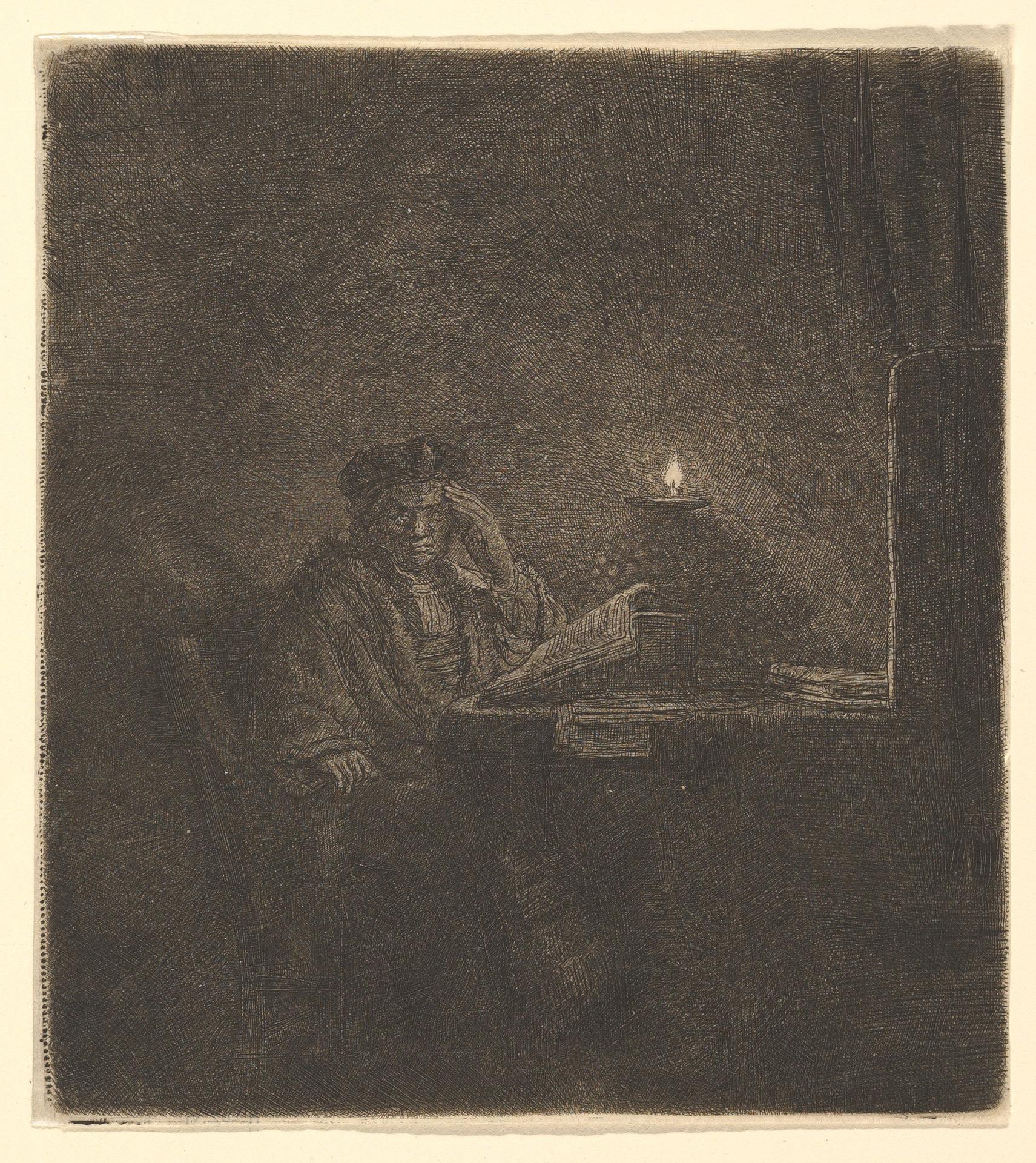
Student at a Table by Candlelight
Original title: Student at a Table by Candlelight
kurzbeschreibung
Around 1642 Rembrandt van Rijn etched a reader in a dark room lit by a single candle. Known as Student at a Table by Candlelight, the print is an early example of his masterful control of light and shadow in graphic work.
Description
A person sits at a table, bent over a book, hand to forehead—a gesture of concentration or exhaustion. Several books lie scattered on the tabletop; behind the figure a candle burns, bathing the interior in warm, muted light. The layout centers entirely on the figure and their activity; large dark areas are broken only by the flame's glow. Fine, dense lines structure the sheet, creating a quiet, intimate atmosphere.
Context
The etching dates from the years of Rembrandt's greatest success in Amsterdam, where he worked as a portrait and history painter. The motif of the scholar in his study was popular in seventeenth-century Dutch art and expressed the humanist ideal of contemplation. Created as a single sheet, the work shows Rembrandt's interest in the interplay of light and shadow that also shaped his painting of this period.
Impact
The strong contrast of candlelight evokes a calm, reflective mood and draws the viewer into the reader's silent world. The reduced layout and delicate linework give the sheet an intimate, almost meditative quality characteristic of Rembrandt's interiors.
Technique
For the etching, the drawing was scratched into an acid-resistant layer on a copper plate and then etched. The dense, fine lines produce subtle tonal gradations that render the candlelight and the room's darkness with nuance. This is the first of two states, suggesting careful reworking by the artist.
AI-generated description text
Source: Metropolitan Museum of Art · Public Domain (CC0 1.0)