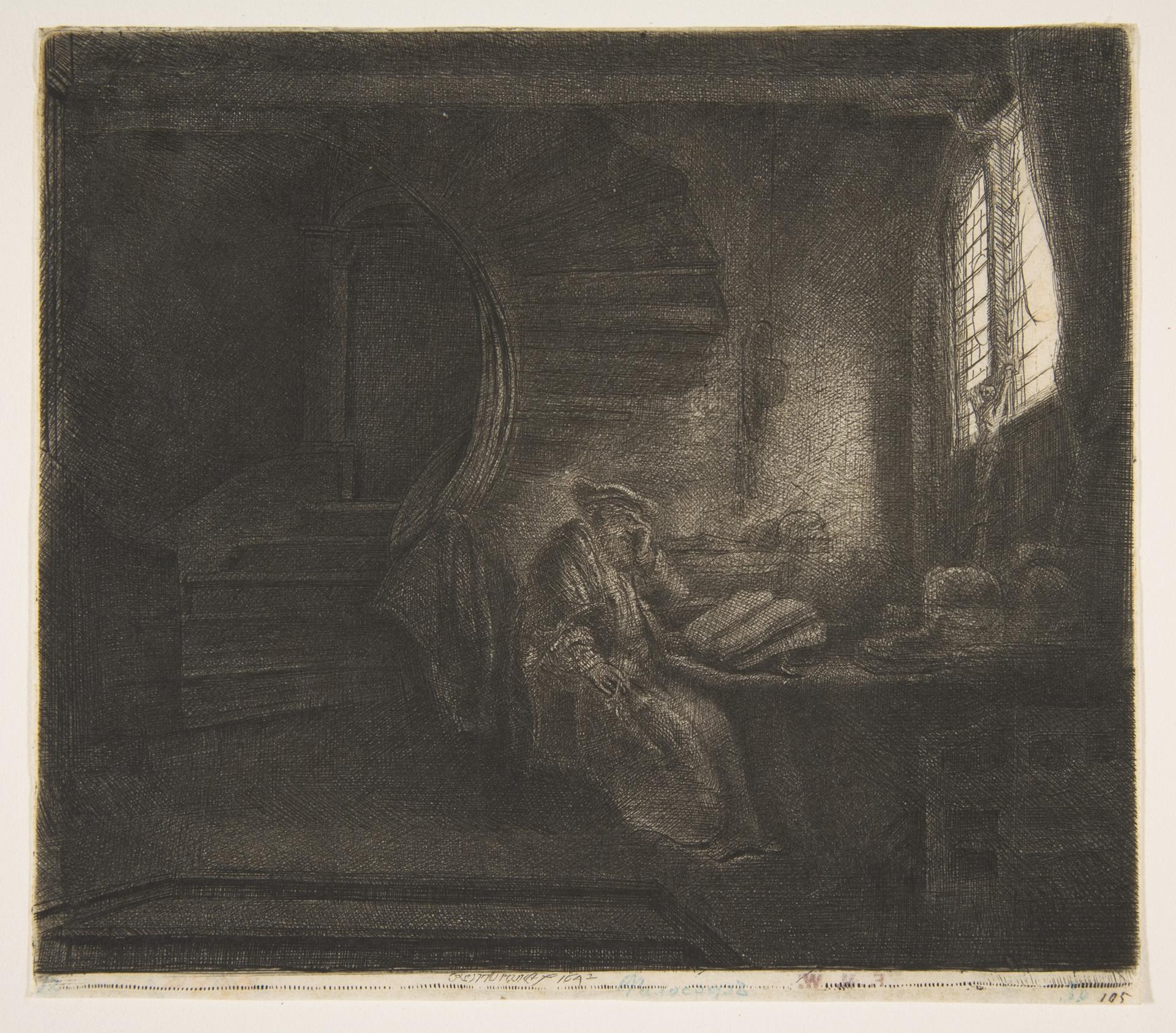
St. Jerome in a Dark Chamber
Original title: St. Jerome in a Dark Chamber
kurzbeschreibung
Unlike many related depictions of Jerome, Rembrandt's 1642 etching places the Church Father not in an open landscape but in a dark chamber, wholly absorbed in reading a book. This is the second of three states; etching, engraving and drypoint are all combined on this sheet.
Description
Jerome sits on a chair holding a book, which is lit by light falling in from the right. The chamber feels bare: a window and a column can be made out behind him. The layout is central, with the saint's figure as its pivot. Light and shadow stand in strong contrast, while clothing and room are worked out in fine textures.
Context
Rembrandt made the work in Amsterdam in 1642, during a phase of intense artistic production. The scholar in a contemplative pose was a subject he took up several times. Around this period he was testing the effects of light and shadow in printmaking more and more.
Impact
A sombre atmosphere and directed light create an intimate, meditative mood. The viewer is drawn into the saint's quiet concentration, and the sheet becomes an impressive example of Baroque lighting.
Technique
Etching, engraving and drypoint come together on this sheet, allowing rich tonality and fine linework. Soft, velvety edges come from the drypoint, while the engraving contributes precise details. In the second state additional hatching is added, deepening the darkness.
AI-generated description text
Source: Metropolitan Museum of Art · Public Domain (CC0 1.0)