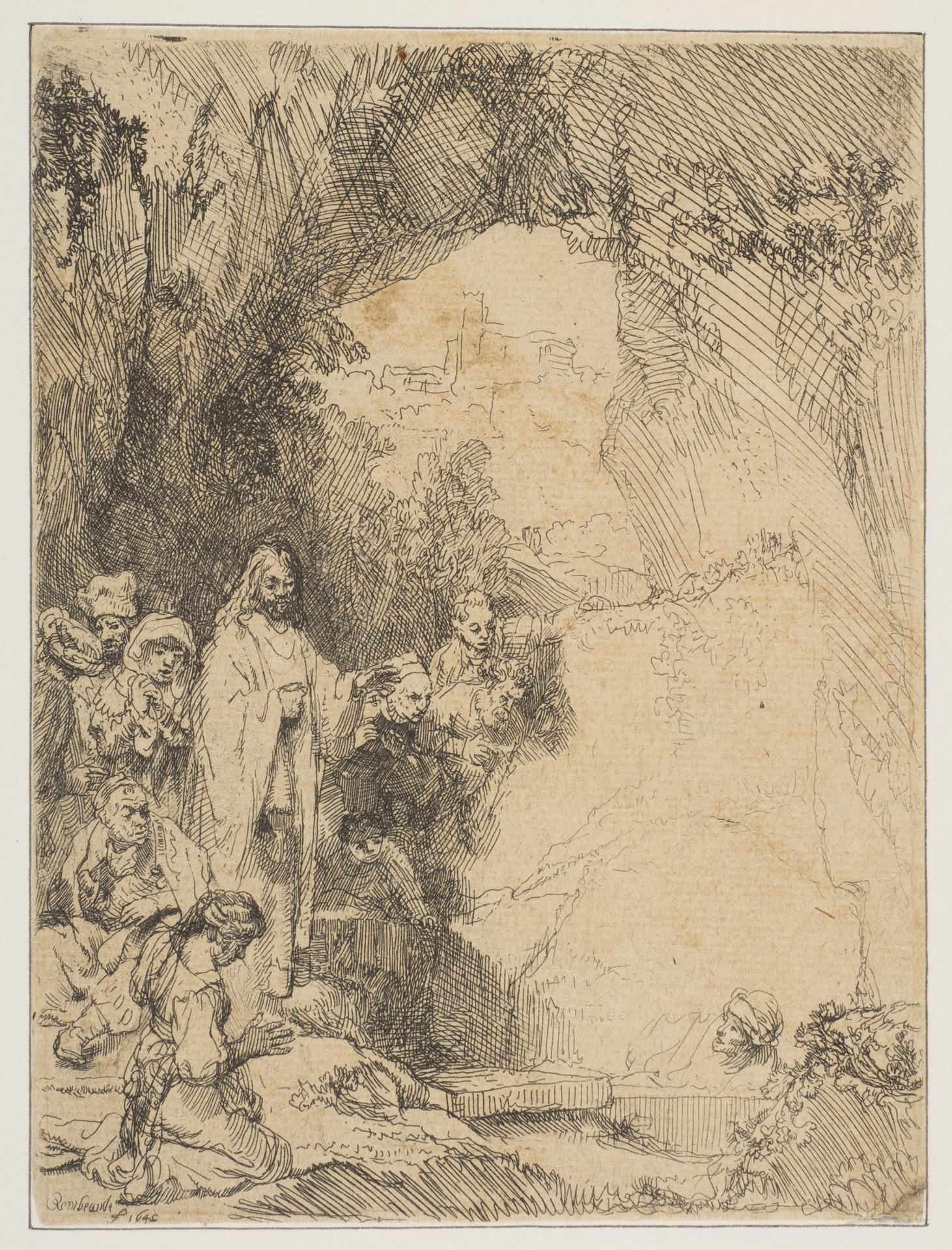
The Raising of Lazarus: The Smaller Plate
Original title: The Raising of Lazarus: The Smaller Plate
kurzbeschreibung
Rembrandt van Rijn returned in 1642 to the biblical miracle of the raising of Lazarus. This print exists as an etching with touches of drypoint and survives in the second of two states. A crowd surrounds the dramatic event, which unfolds within a landscape setting.
Description
Christ stands raised on a platform, wrapped in a white robe, one hand stretched out. People press in on every side, their reactions ranging from astonishment to horror to grief. Trees and a hill close off the view and root the action in natural surroundings. The arrangement feels restless, and a strong perspective draws the eye into depth. Graded greys and soft light build an atmosphere full of tension.
Context
The etching dates from 1642, a period when Rembrandt worked on biblical subjects with particular intensity. Known as the smaller plate, it belongs among several versions of the Lazarus motif from his hand. By then he was established as a successful artist in Amsterdam. The print stands in the Baroque tradition, in which religious drama and the expression of emotion held a central place.
Impact
A dramatic interplay of light and shadow sharpens the tension of the moment. The animated layout and expressive figures provoke an immediate emotional response in the viewer. Delicately graduated lines and nuanced grey values give the sheet spatial depth.
Technique
Drypoint passages supplement the etching, allowing both tender and forceful lines. The existence of a second state points to reworking of the plate, something that occurs fairly often with Rembrandt. The method permits precise rendering of light and shadow, which is characteristic of his style.
AI-generated description text
Source: Metropolitan Museum of Art · Public Domain (CC0 1.0)