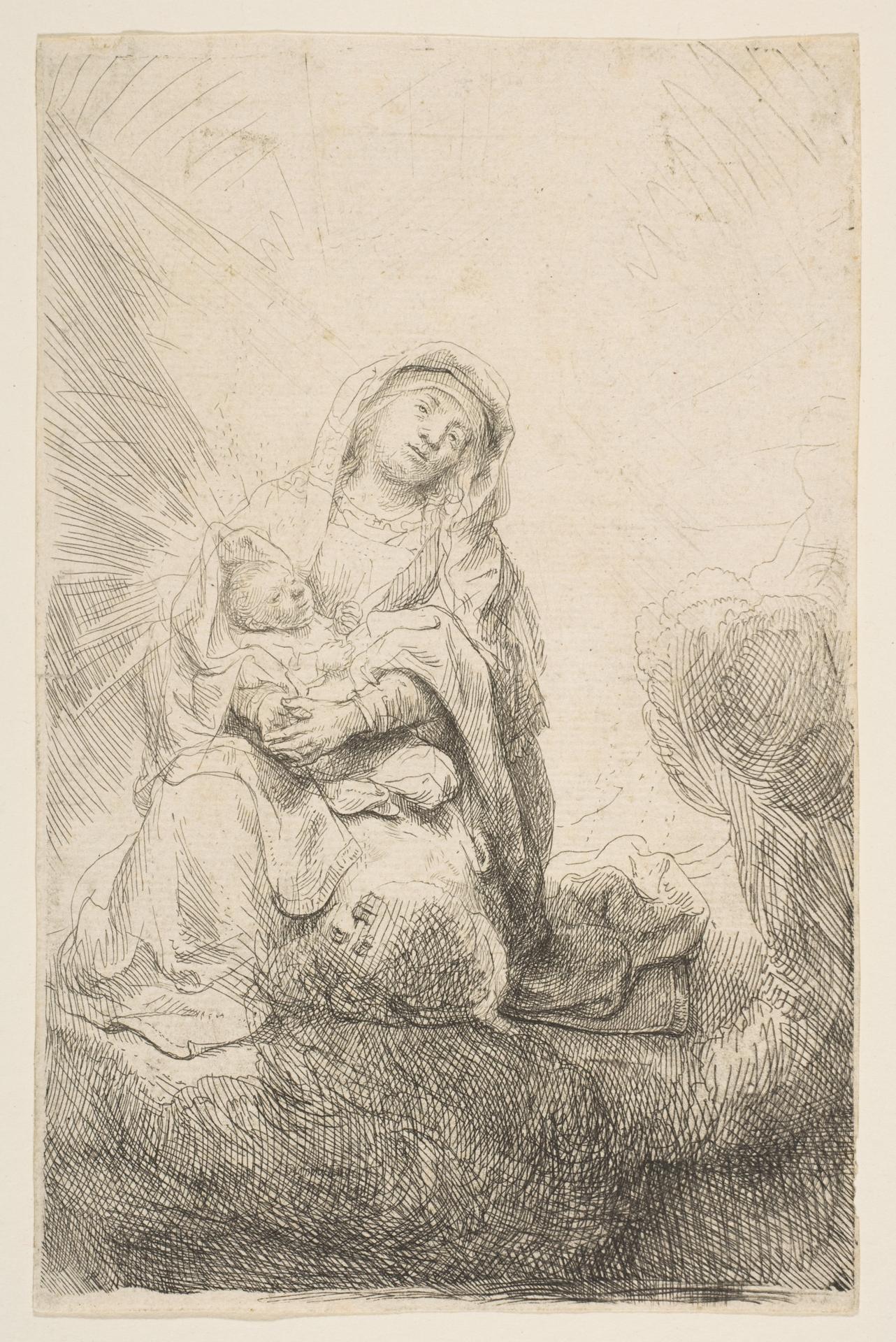
The Virgin and Child in the Clouds
Original title: The Virgin and Child in the Clouds
kurzbeschreibung
Rembrandt van Rijn made this etching with drypoint in 1641. It shows Mary and the Christ Child in a heavenly setting framed by a luminous aura. The print is in black and white and is the first of the two surviving states.
Description
Seated on a bench, Mary holds the Child on her lap; her gaze rises calmly and thoughtfully. The infant Jesus appears relaxed, one hand resting at his side, the other slightly raised. Radiating lines run from the left to the right edge, forming a bright frame around the two figures. The layout places the figures centrally and draws them into view. Precise hatching and gradations render textures and body forms accurately.
Context
The work was made in Amsterdam in 1641, when Rembrandt was deeply engaged with biblical subjects and the treatment of light and shadow. By this phase he was already known as a portraitist and printmaker beyond the Netherlands. The motif of the Mother of God with the Child in the clouds was widespread in both Catholic and Protestant art of the seventeenth century. For fine details and soft transitions in the print, drypoint was valued at the time as an independent technique.
Impact
A quiet, almost devotional impression arises above all from the delicate lines and the bright background. Viewers are drawn into the scene by the luminous aura and Mary's absorbed posture; the image gains spiritual depth. Because color is absent, attention turns entirely to the formal quality and finesse of the graphic work.
Technique
Etched and additionally worked with drypoint, the print combines two processes: lines are etched into the metal plate or scratched directly with the needle. The needle leaves soft, slightly blurred traces that appear in the print as characteristic burr lines. The trimmed format measures 16.5 × 10.3 cm; the first state of the print makes the sheet rare and artistically significant.
AI-generated description text
Source: Metropolitan Museum of Art · Public Domain (CC0 1.0)