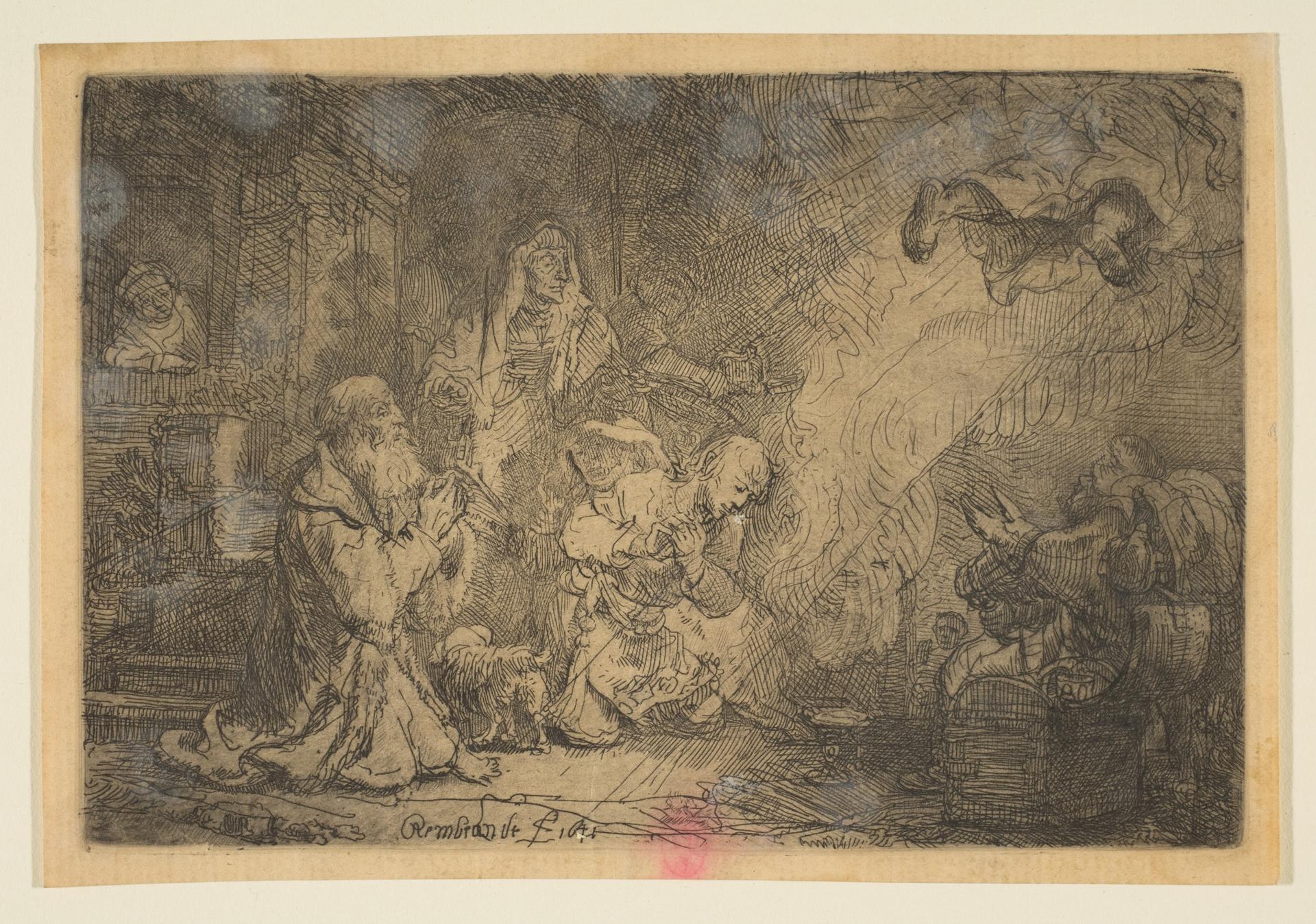
The Angel Departing from the Family of Tobias (1641, Met-Objekt 5305)
Original title: The Angel Departing from the Family of Tobias
kurzbeschreibung
Rembrandt etched this scene in 1641, the moment the angel Raphael takes leave of Tobias's family. The subject comes from the Book of Tobit and unfolds indoors, with several figures gathered around. This impression is an etching with drypoint, the eighth of nine states.
Description
In the foreground an old man, presumably Tobit, sinks toward the ground with lowered gaze while a child beside him leans in close. Further back more figures step forward, among them a woman supporting the angel's head. Raphael himself stands in a restless, flowing posture, his figure rising above the others. Columns and a window frame the room, and light falls in from the side, drawing out shadows and surfaces.
Context
The plate dates from 1641, when Rembrandt was working in Amsterdam. The biblical story of Tobias was a familiar subject in seventeenth-century Dutch art. Rembrandt returned to it more than once, which points to a lasting interest in the narrative.
Impact
Subdued light and delicate hatching give the sheet a quiet, reflective tone. The angel's moving outline is set against the family's still grief, and a tension arises between the two moments.
Technique
Etching and drypoint meet here, allowing both fine lines and soft transitions. By the eighth of nine states the plate has been worked over considerably: Rembrandt steered light and shadow through successive bites and added accents with the drypoint needle.
AI-generated description text
Source: Metropolitan Museum of Art · Public Domain (CC0 1.0)