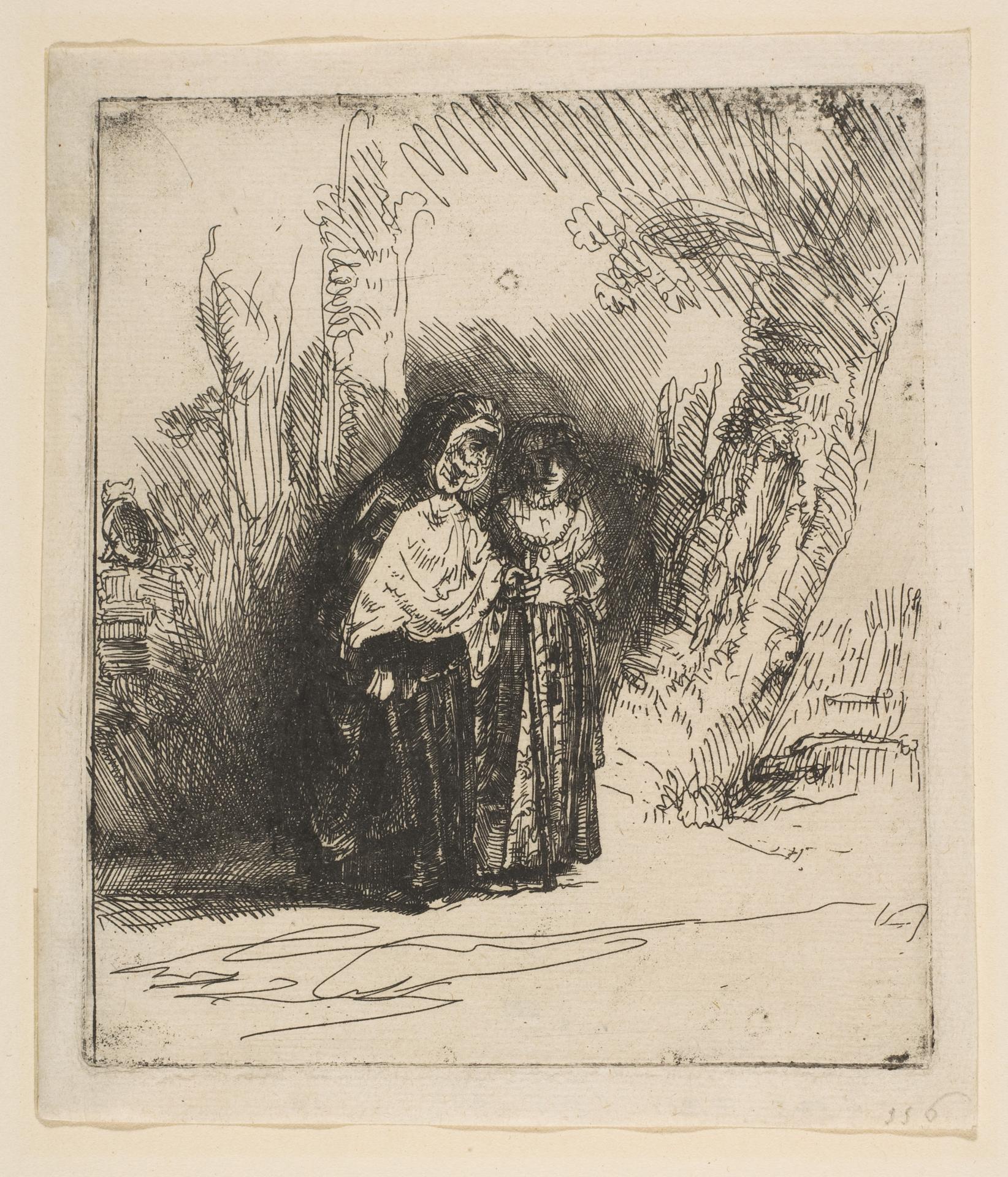
The Spanish Gipsy "Preciosa"
Original title: The Spanish Gipsy "Preciosa"
kurzbeschreibung
Unlike many prints of the period that isolate a figure against a blank ground, Rembrandt's etching 'The Spanish Gypsy 'Preciosa'' from around 1642 places two people deep within a dense grove. The pair hold hands and conceal themselves among the branches. The etching draws on a scene from a literary or theatrical source, likely Cervantes's 'Preciosa'. The medium is etching.
Description
Two figures stand in what feels like an impenetrable thicket, their hands intertwined, both looking in the same direction. The figure on the left wears a plain dark robe, while the one on the right has a patterned garment and a headdress. Trees and bushes in the background are only sketchily indicated, heightening the sense of hiding or flight. Light falls from the upper left, accentuating shadows and the contours of the bodies. The layout feels asymmetrical, with the figures shifted slightly to the left.
Context
This etching was made around 1642, during a period of intense engagement with biblical and literary subjects. The motif of 'Preciosa' probably derives from Miguel de Cervantes's novella 'La Gitanilla', published in 1613, whose heroine is a gypsy named Preciosa. Rembrandt was known for his etchings, which often took up scenes from literature and everyday life. The exact circumstances of its creation are not recorded, but the sheet ranks among his experimental works in this technique.
Impact
An intimate yet enigmatic mood arises from the hidden figures in the forest. Fine hatching and strong chiaroscuro give the scene dramatic depth. The viewer is drawn into the narrative and wonders why the couple is hiding.
Technique
For this etching, Rembrandt scratched the drawing into a wax layer on a copper plate and then etched it. Varying hatching and line density create textures and shadows. The sheet has been trimmed, reducing the original plate size.
AI-generated description text
Source: Metropolitan Museum of Art · Public Domain (CC0 1.0)