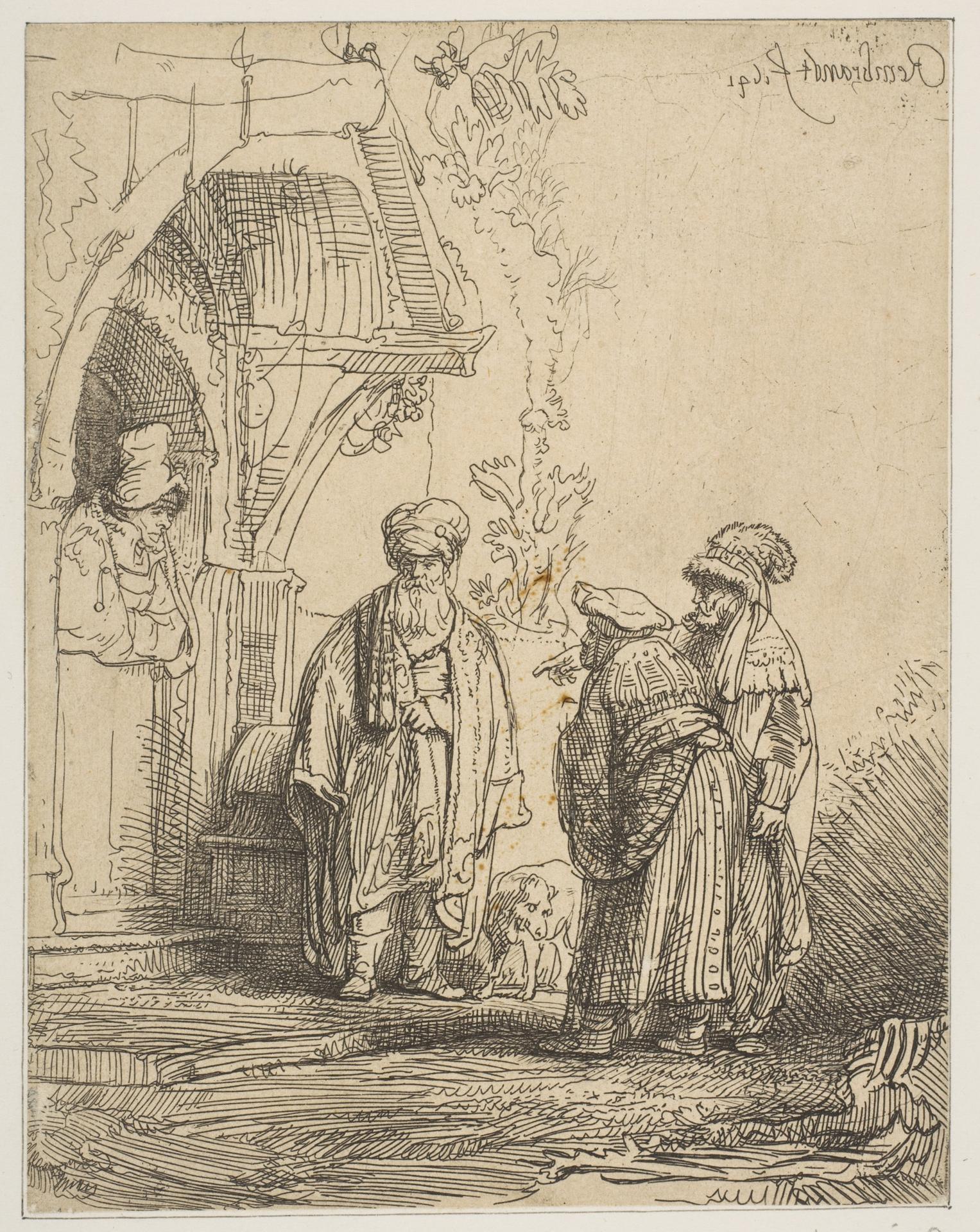
Three Oriental Figures (Jacob and Laban?)
Original title: Three Oriental Figures (Jacob and Laban?)
kurzbeschreibung
The biblical encounter between Jacob and Laban is thought to underlie this 1641 etching by Rembrandt. Three figures in oriental dress stand before a building, with another person visible behind them. The black-and-white print relies on fine lines and graded shading to build its scene.
Description
Three robed figures occupy the foreground in front of a structure with an elaborate roof. To the left, partly hidden by a curtain, another person turns toward the group. A dog stands between the two figures on the right. Trees and shrubs frame the action; light enters from the left, casting shadows to the right.
Context
The sheet was made in 1641, during a period of intense production in Amsterdam. Oriental costumes and biblical subjects were highly popular in seventeenth-century Dutch art, partly due to trade connections with the Near East. Whether the figures actually represent Jacob and Laban cannot be said with certainty, since Rembrandt often conceived comparable scenes without a clear narrative identification.
Impact
The calm, narrative density arises from the interplay of the figures and the detailed architecture. Light and shadow create an intimate, almost stage-like atmosphere that draws the viewer into the biblical event.
Technique
Executed as an etching, the sheet exists in the second of two states and is printed on paper. Rembrandt used drypoint and etching to achieve fine lines and soft shading that emphasize the textures of the garments and the architecture. The paper has been trimmed, so the original plate edge is no longer visible.
AI-generated description text
Source: Metropolitan Museum of Art · Public Domain (CC0 1.0)