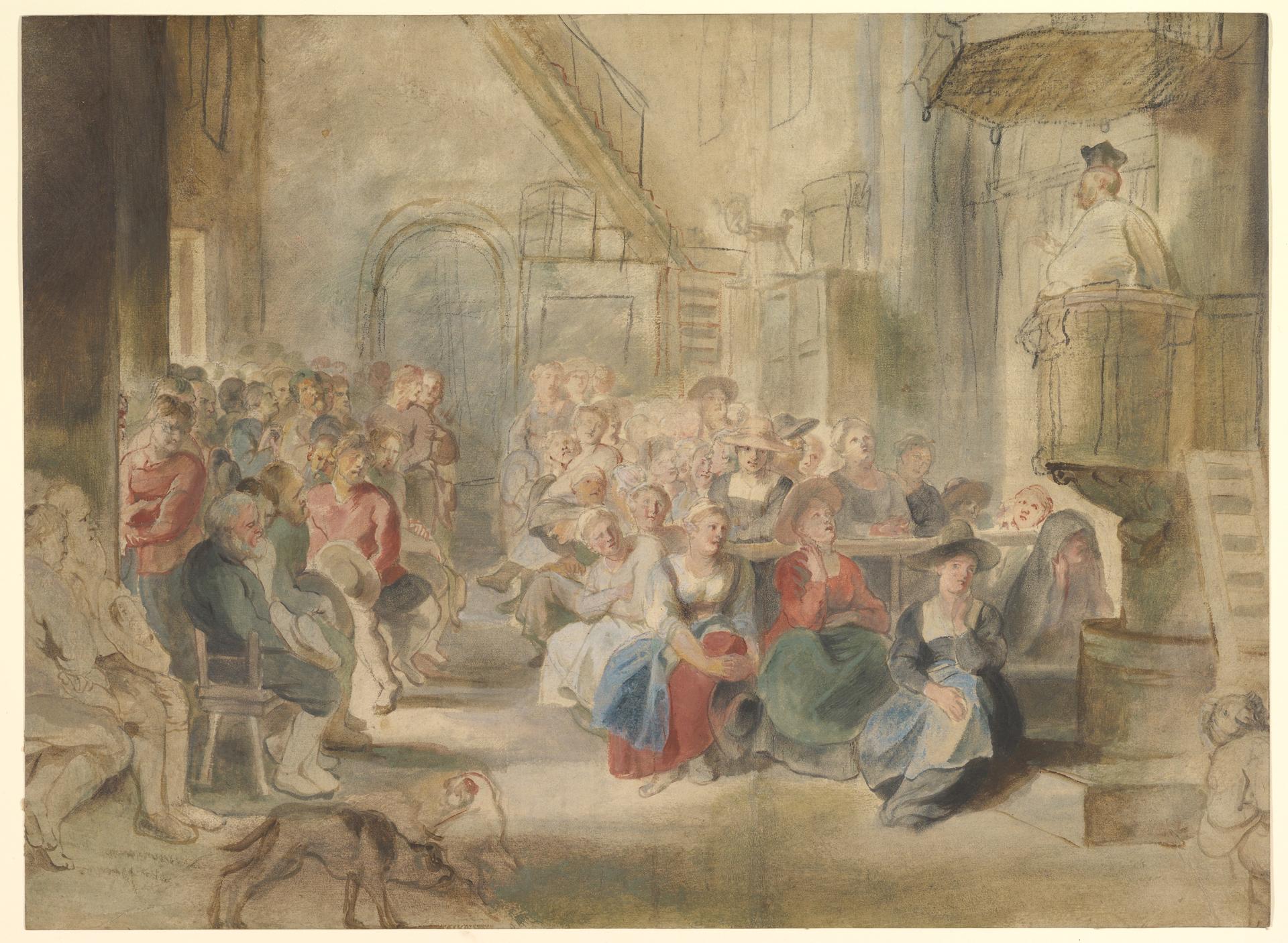
A Sermon in a Village Church
Original title: A Sermon in a Village Church
kurzbeschreibung
Peter Paul Rubens made 'A Sermon in a Village Church' around 1630, capturing a preaching scene in a rural church. The sheet is executed in a mixed technique combining black chalk with oil- and water-based paints. The moment depicted shows the assembled congregation following the sermon.
Description
In the foreground, several figures stand and sit in 17th-century dress. At the upper right, on a gallery, a man speaks, delivering the sermon, and those around him turn their gaze toward him. A dog is included at the lower left. An open door and a stairway structure the rear area. The colors remain subdued, and the light appears soft, as is characteristic of Dutch painting of that era.
Context
In his late period, Rubens often turned to oil sketches and mixed techniques to prepare larger compositions. This sheet may thus have served either as a preparatory study for a more extensive painting or as an independent devotional image. Rural sermons appear frequently in 17th-century Flemish art; they illustrate the influence of the Counter-Reformation and the weight of popular piety.
Impact
The collected stillness of the moment draws the viewer into the event. Everyday details like the dog and the sacred action bring the congregation close.
Technique
The sheet is worked with black chalk, oil- and water-based paints on paper. This method allowed Rubens both precise drawn lines and painterly effects. Restrained color values and gently guided light characterize his late works on paper.
AI-generated description text
Source: Metropolitan Museum of Art · Public Domain (CC0 1.0)