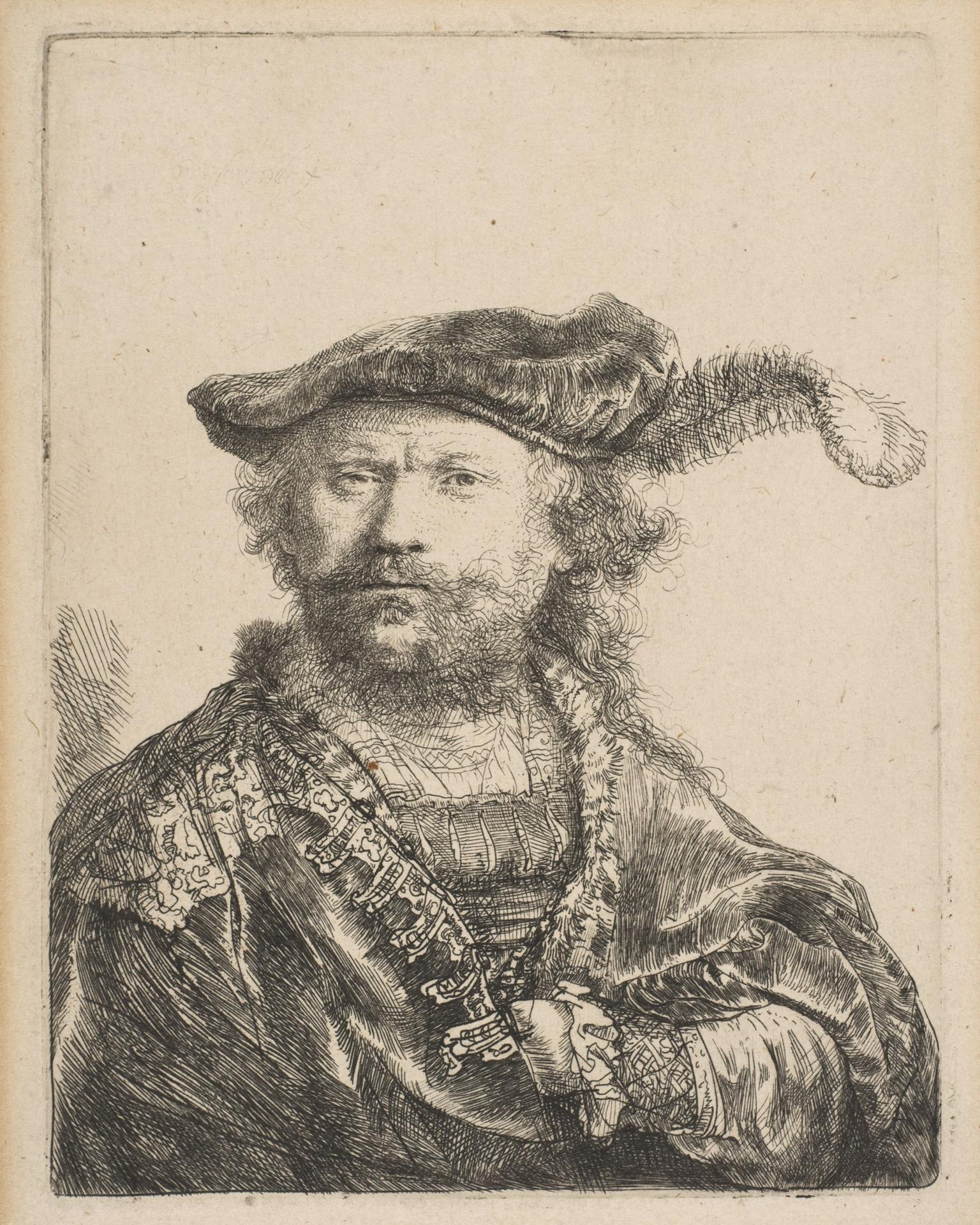
Self-Portrait in a Velvet Cap with Plume (1638, Met-Objekt 5297)
Original title: Self-Portrait in a Velvet Cap with Plume
kurzbeschreibung
Rembrandt made this etching in 1638 as a self-portrait. He shows himself in a jacket trimmed with fur and an elaborately decorated collar, topped by a velvet hat with a feather, his hair in curls and a full beard. The etching process allowed him fine, exact lines that catch every nuance of the face.
Description
A striking feather on the velvet hat pulls the eye first. The fur-trimmed jacket and the richly worked collar are drawn out in close detail. Thick beard and curling hair frame the face. Behind him the ground stays bare, so face and clothing stand forward on their own. The strokes read as sharp and precise, the likeness realistic and full of incident.
Context
Rembrandt made this self-portrait during his Amsterdam years, once he had established himself as a portraitist. His own face occupied him again and again, in etching, drawing and painting alike. The costly dress, velvet hat and feather point to the elevated social standing of a successful artist. The sheet belongs to a period when he was experimenting with technique and refining his graphic language.
Impact
Exact, sharp lines build an unusual density of detail that draws the viewer in close. The elaborate costume and the direct gaze convey self-assurance and artistic authority. The plain background heightens the intimacy of the self-portrait and keeps the artist's personality at the fore.
Technique
In etching the drawing is bitten into a metal plate previously treated with acid. That method permits fine, controlled lines and soft shading, both visible in the precise strokes of this portrait. The monochrome tonality follows from the printing process and underlines the graphic character of the work.
AI-generated description text
Source: Metropolitan Museum of Art · Public Domain (CC0 1.0)