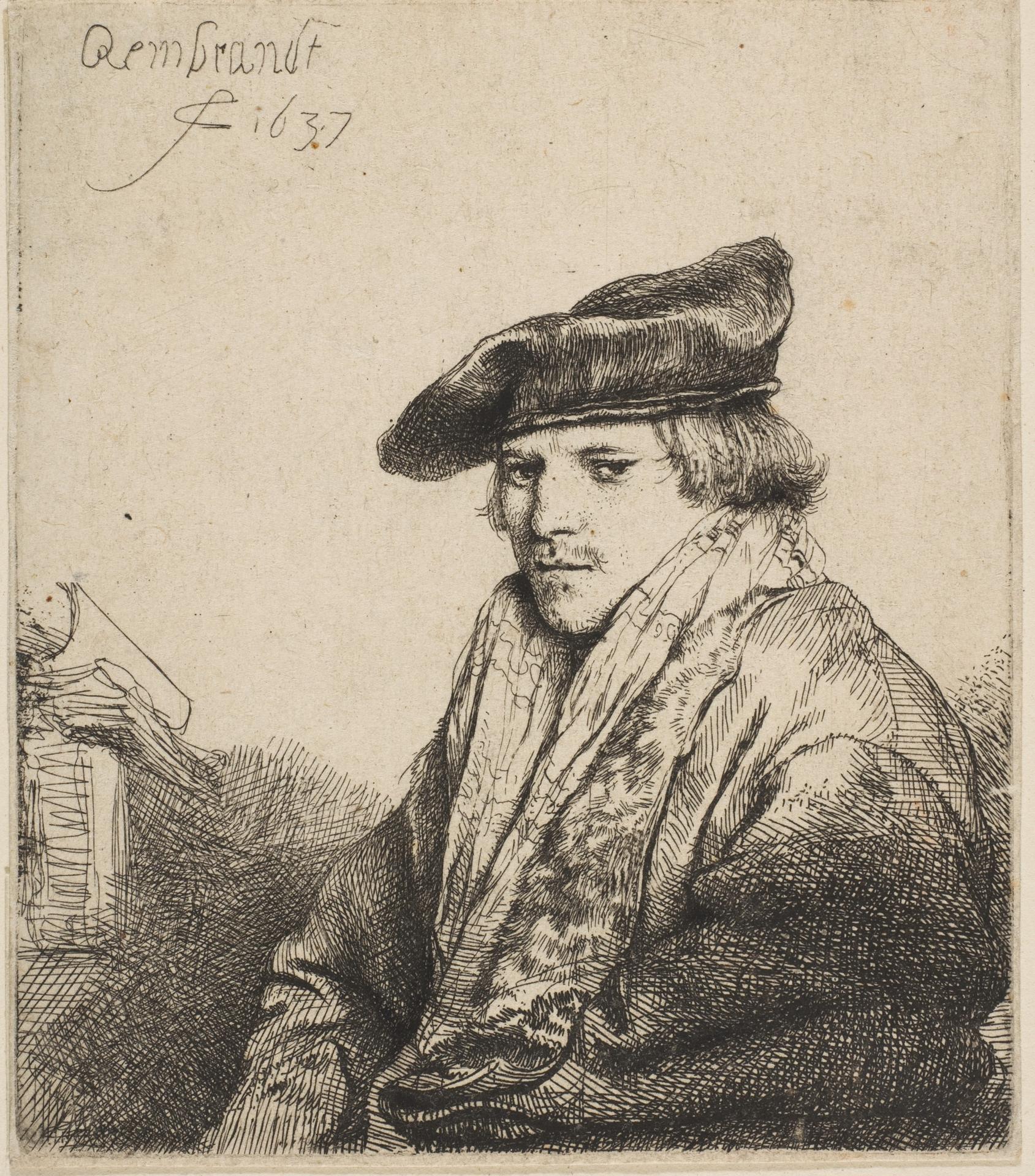
Young Man in a Velvet Cap (1637, Met-Objekt 5296)
Original title: Young Man in a Velvet Cap (Ferdinand Bol)
kurzbeschreibung
A young man in profile, wearing a cap and holding a book in his hands: this is what Rembrandt's etching of 1637 presents. The black-and-white print measures 9.5 x 7.7 cm.
Description
The young man looks out of the picture from the side, dressed in a shirt and jacket. The cap sits on his head, and he holds a book in such a way that it becomes the centre of the arrangement. The background stays sparse and directs the gaze entirely onto the figure. Precise lines and hatching shape light and shadow and bring out textures and forms. Detail and realism point to Dutch art of the 17th century.
Context
By 1637, in Amsterdam, Rembrandt was already established as a portraitist and printmaker. During this period he made the etching, which belongs to a series of head studies — often exercises in expression and the direction of light. The Ferdinand Bol named in the title was a pupil of Rembrandt, which suggests a connection to the workshop. Its making falls in a phase when Rembrandt was experimenting intensively with the means of printmaking.
Impact
The restrained arrangement and delicate linework create an intimate, contemplative mood. The viewer's gaze is drawn to the facial features and the gesture of holding the book, which gives the print a quiet presence. The monochrome tonality emphasises the graphic character and the timeless elegance of the portrait.
Technique
For this etching, the drawing was scratched into an acid-resistant layer on a copper plate, and the metal was then etched. Fine hatching and lines produce graduated greys and textures. Black printing ink on paper was presumably used, which explains the clear contrasts.
AI-generated description text
Source: Metropolitan Museum of Art · Public Domain (CC0 1.0)