The Presentation in the Temple: Oblong Plate
Original title: The Presentation in the Temple: Oblong Plate
kurzbeschreibung
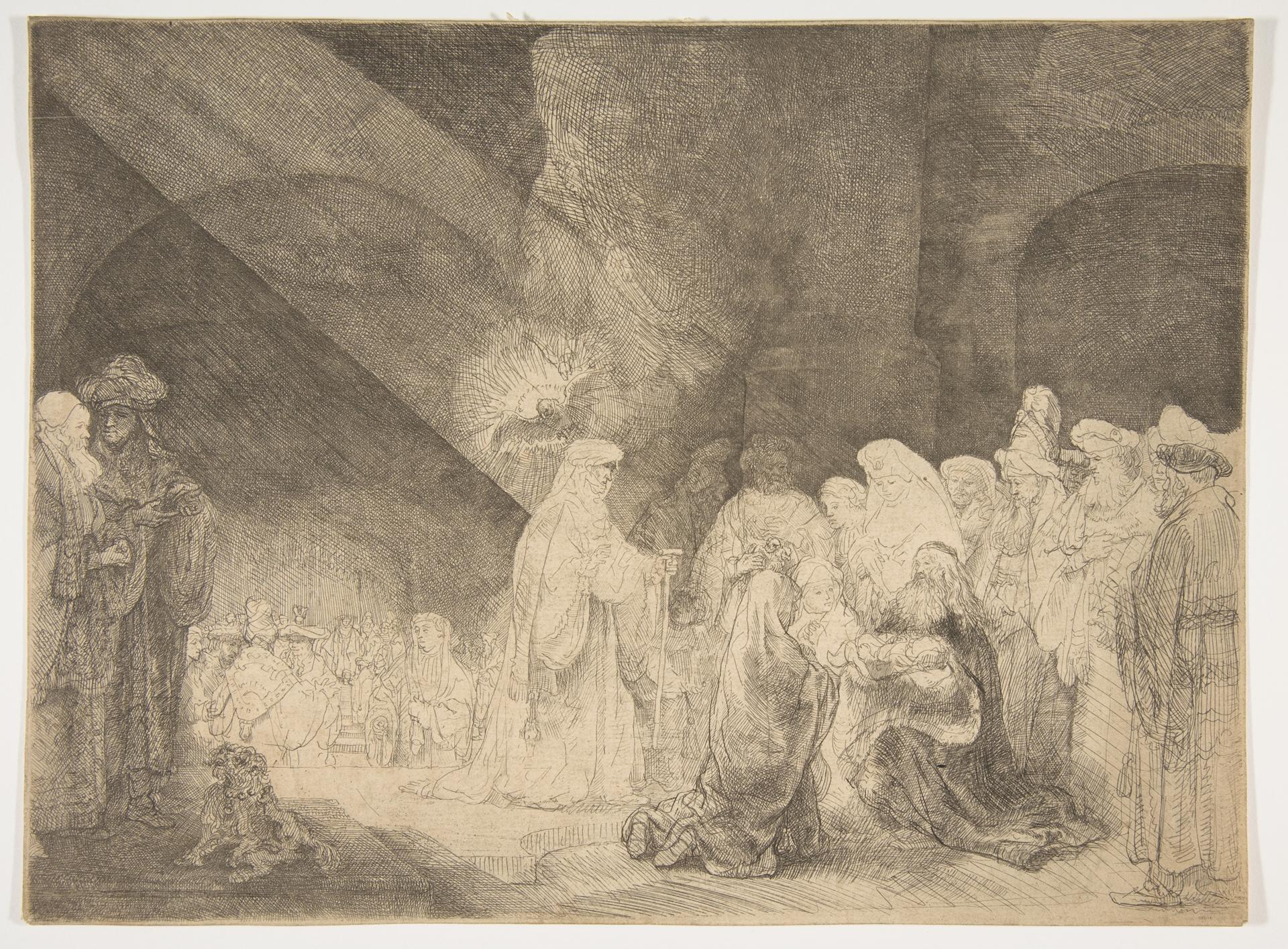
A kneeling woman with a child forms the focal point of this etching by Rembrandt (Rembrandt van Rijn). Titled "The Presentation in the Temple: Oblong Plate," the print depicts the biblical scene of Jesus' presentation in the temple. It is an undated etching in monochrome. Other figures surround the woman, and bright light falls into the scene from above.
Description
Symmetrically arranged, the kneeling woman with the child stands at the center. Around her are grouped several figures, including one in traditional clothing who observes the action. Further figures can be made out in the background, partly overlaid by a semi-transparent, radiant light that enters from above. The palette is limited to various shades of gray, as is characteristic of etching. The diffuse light gives the scene a dramatic mood.
Context
Rembrandt produced numerous etchings on biblical subjects, often in series or in different plate states. The exact date of this etching is not recorded; it is however placed in his middle period. The Presentation of Jesus in the Temple is a rare subject in Rembrandt's printed work, which makes this sheet special. The "Oblong Plate" (landscape-format plate) is one of several versions Rembrandt made of this theme.
Impact
The etching feels calm and solemn through its symmetrical arrangement and the falling light. Because the image is reduced to gray tones, the figures and the lighting come to the fore; the scene appears intimate and at the same time sublime. The clear arrangement directs the viewer immediately to the central event.
Technique
This sheet is an etching, an intaglio process: the drawing is scratched into an acid-resistant layer on a copper plate and then etched. The monochrome effect comes from printing with black or brown ink on paper, with various gray tones achieved through the density of the lines and the depth of the etching. Rembrandt often used multiple plate states to vary light and shadow effects, which can be assumed here as well.
AI-generated description text
Source: Metropolitan Museum of Art · Public Domain (CC0 1.0)