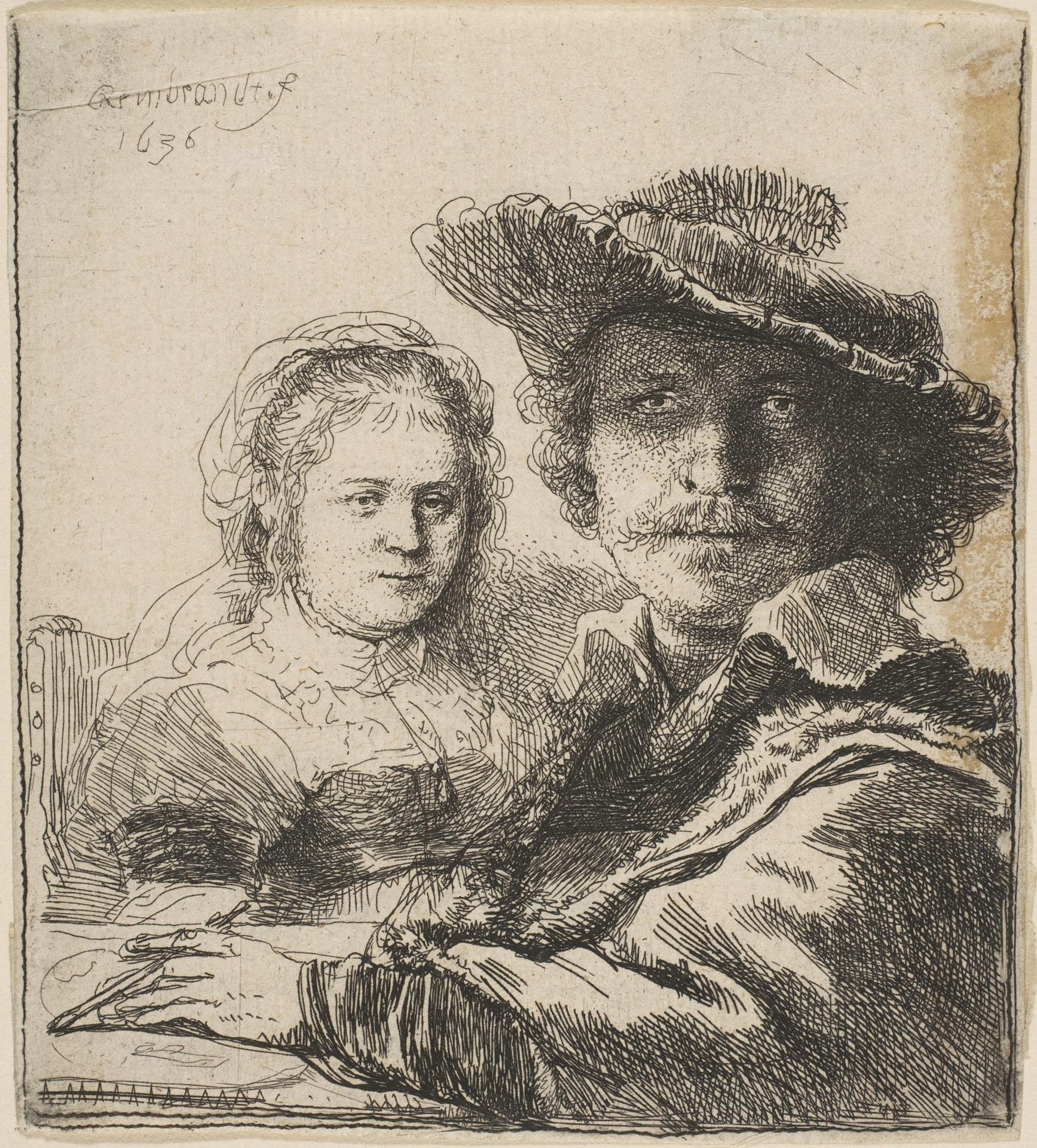
Self-Portrait with Saskia
Original title: Self-Portrait with Saskia
kurzbeschreibung
In 1636 Rembrandt van Rijn etched his Self-Portrait with Saskia. This print presents the artist and his wife Saskia in a familiar domestic setting, executed as an etching.
Description
Rembrandt sits at the front, wearing a hat and glasses, facing Saskia, who holds a quill. Their shared gaze points in the same direction and creates a thoughtful mood. The layout is symmetrical: Rembrandt on the right, Saskia on the left. The surface remains monochrome, with light worked out through fine hatching. Predominantly horizontal strokes define Rembrandt's areas, while Saskia's garment is structured by vertical lines.
Context
This etching was made in 1636, three years after Rembrandt's marriage to Saskia van Uylenburgh. The couple was living in Amsterdam at the time, where Rembrandt was enjoying success as a portrait and history painter. Self-portraits with one's wife were rare in seventeenth-century Dutch art and underscore the private intimacy. The work falls in a period when the artist was experimenting intensively with graphic means.
Impact
Through the symmetrical arrangement and the aligned gaze, the print feels calm and collected. The differentiated linework gives it an intimate, almost tender mood that emphasizes the closeness of the two figures.
Technique
In etching, the drawing is scratched into an acid-resistant layer on a copper plate and then bitten by acid. The dense, fine lines and the varying stroke directions allow for a precise rendering of surfaces and lighting conditions.
AI-generated description text
Source: Metropolitan Museum of Art · Public Domain (CC0 1.0)