The Strolling Musicians
Original title: The Strolling Musicians
kurzbeschreibung
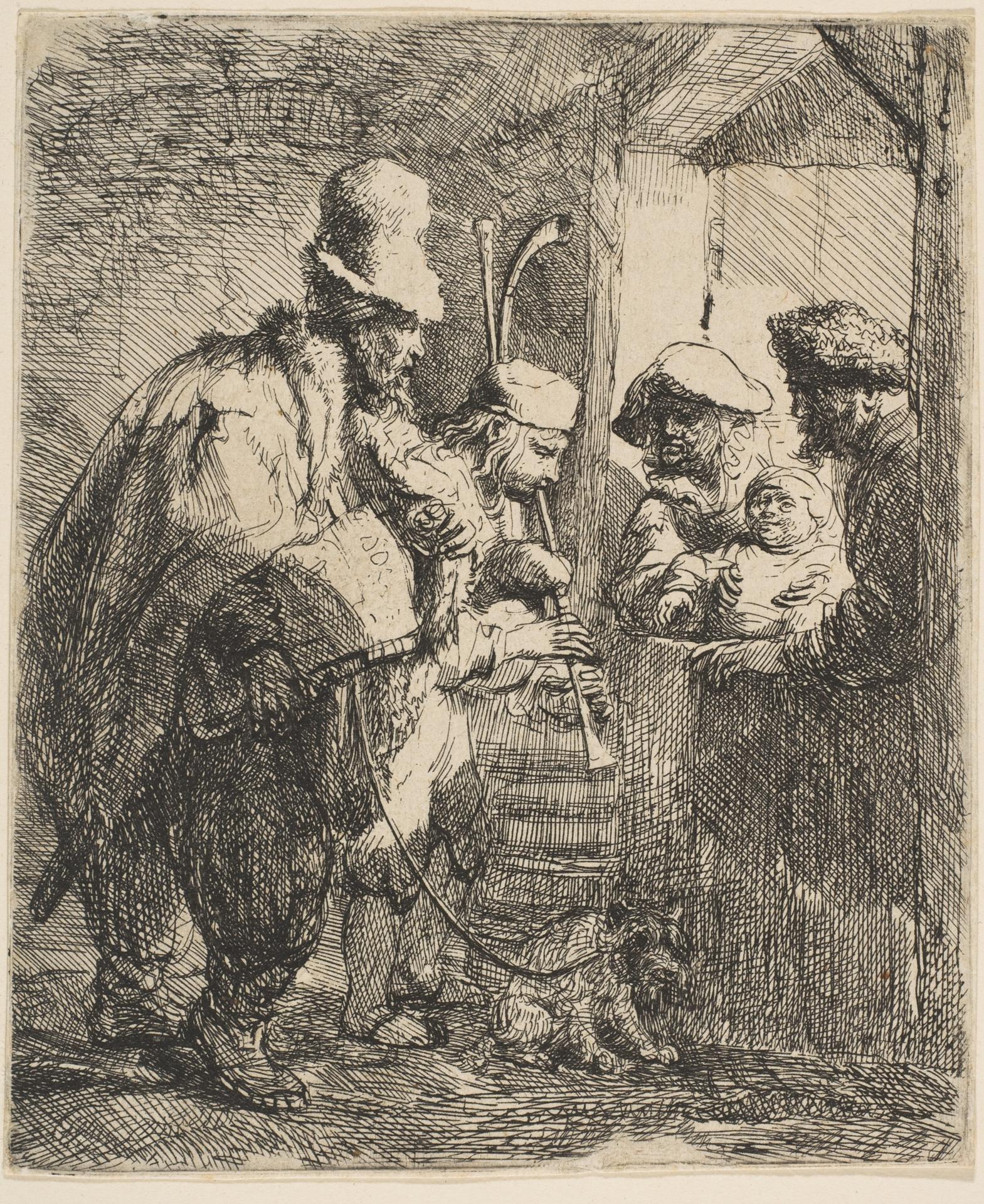
Rembrandt van Rijn made this etching, The Wandering Musicians, around 1635. It presents a group of street musicians playing trumpet, trombone and shawm in an interior. Delicate lines and a lively arrangement of figures define the print.
Description
At the front stands a trumpeter, a dog at his side. Behind him come two more musicians, one blowing a trombone, the other a shawm. To the side, in shadow, other figures linger, among them a child held by a man. Light falls from the upper right, drawing out fabrics and faces. The layout is irregular, and the players' postures feel animated and natural.
Context
This etching dates from Rembrandt's Leiden years, before he moved to Amsterdam in 1631. Itinerant musicians appear often in seventeenth-century Dutch art, frequently as signs of transience or poverty. The subject may go back to an actual encounter, for Rembrandt was known as an attentive observer of daily life.
Impact
The scene comes toward the viewer with a lively, almost genre-like immediacy, pulling one into the room. Interplay of light and shadow creates an intimate mood; despite their simple activity, the figures retain a sense of dignity.
Technique
This print is an etching: the drawing was scratched into a copper plate and bitten with acid. Rembrandt used fine, precise lines to capture details such as folds of cloth and facial features. The black-and-white technique focuses attention entirely on light and shadow.
AI-generated description text
Source: Metropolitan Museum of Art · Public Domain (CC0 1.0)